Estate Library Guide
What to Do with a Loved One's Books After They Pass
I've walked into hundreds of homes where someone has recently died and the family is standing in a room full of books, not knowing where to begin. The shelves are still arranged exactly as their parent or spouse left them. There's a reading chair with a book face-down on the armrest, holding a place that will never be returned to. I understand what you're going through, and I wrote this guide to help you take it one step at a time.
Request Your Free Pickup
Tell me what you have and where it is. I’m the only person who shows up — I do the lifting, any condition, no sorting. Tell me your timeline and I’ll do my best to work with it. Texts go straight to my phone at 505-250-3804.
Last verified July 2026 · Original research by Josh Eldred
The First 30 Days: Please Don't Throw Anything Away Yet
If someone you love has just died and you're reading this because you're staring at a house full of books, I want to start with the most important thing I can tell you: the books can wait. They were there before you walked in and they'll be there next week, next month, whenever you're ready. There is no urgency here that grief hasn't invented for you.
I've been doing this work in Albuquerque for years, and the single biggest regret I hear from families is that they made decisions about their loved one's belongings too quickly. In the first few weeks after a death, you're running on adrenaline and obligation. There are phone calls to make, paperwork to file, a memorial to plan. The house feels like it's pressing in on you. The instinct to clear things out, to make the space feel less like a shrine, is completely natural. But that instinct, if you act on it right now, can lead to decisions you can't undo.
I've had families call me months after a death, asking if there's any way to recover a collection they hauled to Goodwill in the first week. The answer is almost always no. Those books were sorted into bins, priced at a flat rate, and most of them were on the shelf within 48 hours. The first editions were mixed in with the paperback thrillers. The signed copies went for the same price as everything else. Once they leave your hands, they're gone.
So here's what I'd suggest for the first 30 days: don't move the books. Don't start sorting them. Don't let well-meaning relatives show up with boxes and start packing. If the house is secure, the books are fine where they are. If there are immediate concerns — a burst pipe, a pest problem, a lease ending — then yes, I should talk sooner. But barring an emergency, give yourself permission to leave that room exactly as it is.
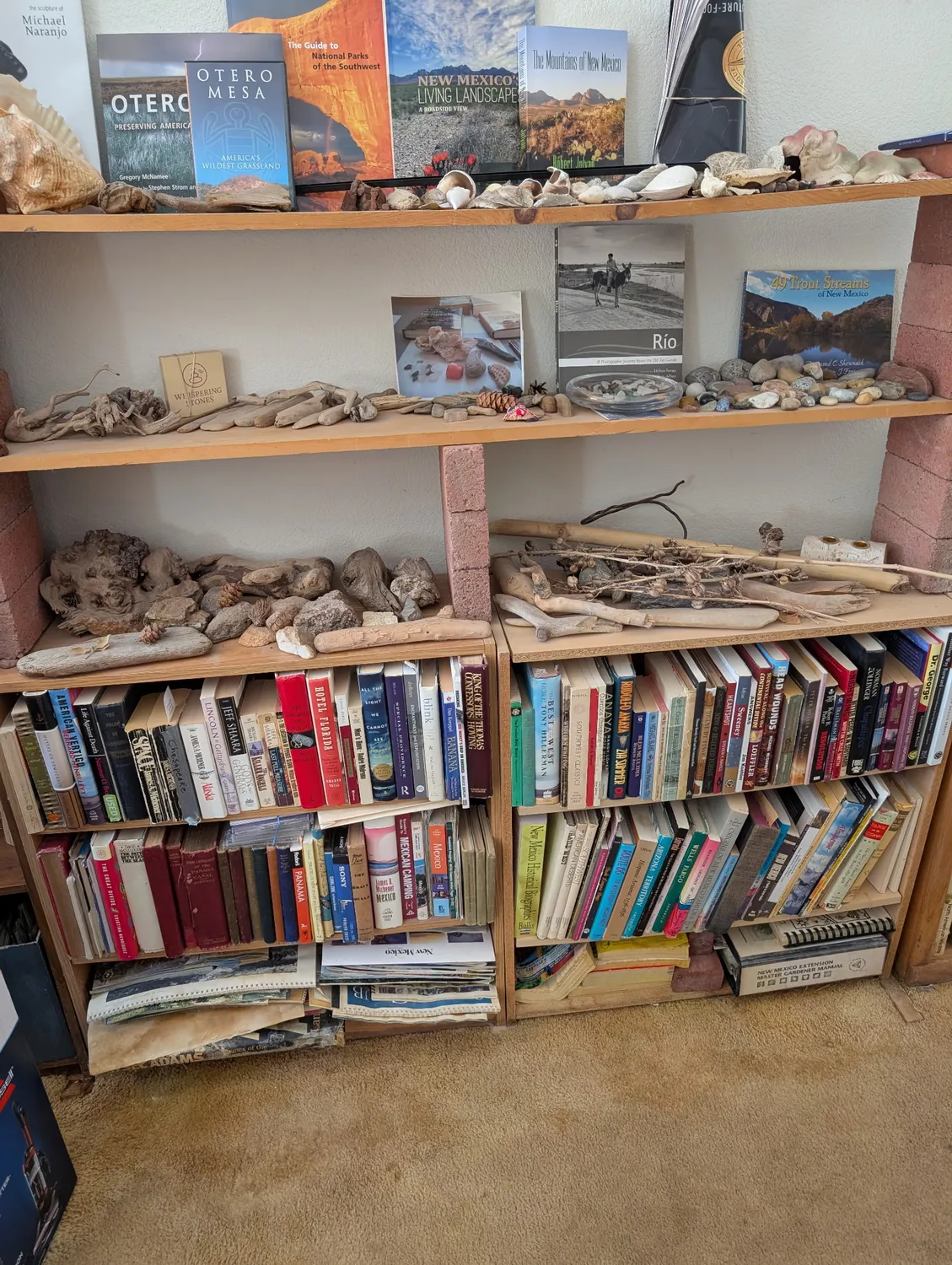
During this period, the most useful thing you can do is simply take a few photographs. Walk through the rooms where books are stored and snap some pictures with your phone. Wide shots of the shelves. Close-ups of any sections that look different from the rest — leather-bound volumes, oversized art books, an entire shelf of the same author. These photos will be helpful later when you're ready to have the collection evaluated, and they're a record of how your loved one organized their world.
If someone is pressuring you to clear the house quickly — a realtor, a landlord, another family member — know that there are options. I've helped families in exactly this situation, and there's almost always more time than it feels like in the moment. A quick phone call to me at 505-250-3804 can help you figure out whether you genuinely need to move fast or whether the pressure is coming from somewhere other than the actual timeline.
And I should mention: it's rarely just the books. When someone dies, there are closets full of clothing, drawers full of personal items, outdoor gear in the garage, and household belongings in every room. Families often handle the books first because they feel the most personal, but eventually the rest of the house needs attention too. I now handle all of it — clothing, gear, household items — in the same visit or as part of a broader estate cleanout. Vintage western wear, military uniforms, quality outdoor equipment — these get sorted and evaluated individually, just like the books. Everything that can be reused or resold goes through the same careful process. If you're looking at a house full of belongings and not just a library, one call still covers it. My clothing donation pickup page has the full details on how I handle personal items alongside books.
Why Books Feel Different Than Other Belongings
There's a reason you searched for this specific question. You didn't search for what to do with your mother's dishes or your father's tools — you searched for the books. That's not a coincidence. Books carry a kind of emotional weight that most other household objects don't, and understanding why can help you make better decisions about what comes next.
A person's library is a map of their inner life. The books they chose to keep, to display, to return to — those choices tell you something about who they were in a way that their furniture and kitchenware never will. When I walk through an estate and see a shelf full of New Mexico history — Simmons, deBuys, Horgan — I know something about that person. When I see twenty years of National Geographic stacked neatly in a closet, or a shelf of theology texts next to a shelf of science fiction, I'm looking at the record of a mind in motion.
Then there are the personal traces. A bookmark left at chapter seven of a novel they never finished. Marginalia in a college textbook from 1968 — underlines, stars, "YES" written in the margin next to a passage about consciousness. An inscription on the title page: "To David, who always believed in this book before anyone else. — Margaret, Christmas 1974." These aren't just books anymore. They're artifacts of a life.
I've seen families freeze when they encounter these traces. A daughter pulls a book off the shelf and a dried flower falls out — something her mother pressed there twenty years ago. A son opens a Bible and finds his birth announcement tucked inside the front cover. These moments are part of the process, and they're part of why you can't just back a truck up to the house and haul everything to the dump. The books deserve more care than that, and so do you.
I want to acknowledge something else: a person's book collection can also be complicated. Sometimes the books reveal parts of your loved one you didn't know about — interests they never shared, phases they went through, topics that surprise you. That's normal. A library is an honest record, and honest records aren't always comfortable. You don't need to do anything with that information except notice it.
The point is this: if you feel like the books are harder to deal with than the rest of the house, you're not being irrational. They are harder. They're the most personal thing in the home, and they deserve a process that respects that. The rest of this guide is designed to give you that process.
A Gentle Timeline for Dealing with the Books
Every family's situation is different, and I don't believe in rigid timelines for grief. But I've worked with enough families to see patterns in what works, and I can offer a general framework that you can adapt to your own circumstances. Think of this as a suggestion, not a schedule.
Weeks 1-4: Breathe
Focus on the immediate necessities — the funeral or memorial, the legal paperwork, taking care of yourself and your family. If you can, take those photographs I mentioned earlier. Beyond that, let the books be. If relatives or friends offer to help you sort, thank them and tell them you're not ready yet. You're allowed to say that.
Months 1-3: Begin to Assess
When you feel ready — and only when you feel ready — start spending time with the collection. You're not sorting yet. You're looking. Walk through the shelves. Notice which books catch your eye. Start a pile (mental or physical) of the ones you know you want to keep. These are the books that mean something to you personally: the copy of To Kill a Mockingbird that you read together, the cookbook with your mother's handwritten notes in the margins, your father's signed copy of a book by someone he admired.
This is also a good time to reach out for a professional assessment. A quick call or text to 505-250-3804 can start that conversation. I can often tell you from a few photos whether the collection is likely to contain anything significant, which helps you plan your next steps.
Months 3-6: Sort and Decide
By now, the initial shock has usually settled into something more manageable. This is a natural time to start making decisions. You've identified the books you want to keep. A professional evaluation has flagged any books with significant monetary value. What remains is the bulk of the collection — the books that aren't personally meaningful to you and aren't particularly valuable on the market. These are the books where you need a plan, and this guide will help you build one.
Month 6 and Beyond: Execute the Plan
Schedule the pickup or the cleanout. Let the professionals handle the logistics. Keep the books that matter to you and let the rest go where they'll do the most good — into the hands of other readers, onto the shelves of collectors who've been searching for exactly that title, or into responsible recycling for the ones that have reached the end of their readable life.
Again, this timeline assumes you have the luxury of time. If you're dealing with a lease that ends next month, a house that needs to sell, or a probate court that's pushing for resolution, I can compress this timeline considerably. I've helped families handle an entire estate library in under a week when circumstances demanded it. The important thing is that even on a compressed timeline, the books still get treated individually. Speed doesn't have to mean carelessness.
How to Identify Valuable Books in an Estate
Most books in a household library are worth their cover price or less on the resale market. That's just the reality. But in almost every collection of more than a few hundred volumes, there are surprises. I've found books worth significant amounts tucked between mass-market paperbacks on a shelf in a back bedroom. The trick is knowing what to look for.
I've written a detailed guide on identifying first editions that goes deep on the subject, but here's a practical overview for someone walking through an estate library for the first time.
First Editions
A first edition, first printing of a significant book is the holy grail of book collecting. Look at the copyright page — that's the page behind the title page. You're looking for a number line, which is a sequence of numbers like "10 9 8 7 6 5 4 3 2 1." If the number "1" is present, it's typically a first printing. Different publishers use different systems, and my first edition guide breaks those down publisher by publisher.
Not every first edition is valuable. A first edition of a bestseller that was printed in hundreds of thousands of copies isn't rare. But a first edition of a debut novel by an author who later became famous, or a first edition of a book that defined a genre — those can be significant. Condition matters enormously here. A first edition with its original dust jacket in good shape is worth many times more than the same book without the jacket.
Signed and Inscribed Copies
Check the title page and the half-title page (the page before the full title page) for signatures. An author's signature adds value. A personal inscription — "For David, with admiration, [Author]" — can add even more, depending on the author and the context. In New Mexico, I frequently encounter books signed by regional authors: Tony Hillerman, Rudolfo Anaya, N. Scott Momaday, John Nichols, Hampton Sides. These signatures carry real weight among collectors.
Pre-1900 and Antiquarian Books
Any book published before 1900 deserves a closer look. Age alone doesn't guarantee value — there are plenty of 19th-century books that are common — but the chances of finding something significant increase dramatically once you get past that century mark. Leather bindings, marbled endpapers, hand-colored plates, and books with maps are all worth flagging. If you see anything printed before 1800, set it aside carefully and call someone who knows what they're looking at.
Southwest and New Mexico Regional Books
This is where Albuquerque estate libraries often surprise people. New Mexico has a rich publishing history — small press runs, limited editions, academic monographs, locally printed histories. A book about the history of Corrales published by a local press in 1972 might have had a print run of 500 copies. If it's in decent shape, collectors want it. Books about Pueblo pottery, Hispanic weaving, New Mexico architecture, mining history, land grants, the Santa Fe Trail, the atomic age in Los Alamos — all of these have active collector markets.
University of New Mexico Press titles from the mid-20th century are particularly worth watching for. Many of those early print runs were small, and the books have become genuine reference works in their fields. The same goes for publications from the School of American Research (now the School for Advanced Research), the Museum of New Mexico Press, and Sunstone Press.
Academic and Professional Libraries
If your loved one was a professor, doctor, lawyer, engineer, or scientist, their professional library may contain books with significant resale value. Medical textbooks from the last couple of years, engineering references, legal treatises — these can be worth far more than general fiction. Academic monographs in niche fields often have small print runs and high demand from other scholars and professionals.
Art Books and Coffee Table Books
Large-format art books, photography collections, and exhibition catalogs are often overlooked because people assume they're decorative. Many of them are. But some — particularly exhibition catalogs from major museums, monographs on specific artists, and limited-edition photography books — have serious collector value. If the dust jacket is intact and the pages are clean and bright, it's worth having someone look at them.
What's Probably Not Valuable
I believe in being honest about this. Book club editions (look for a small square or circle indented on the back board, or the absence of a price on the dust jacket flap) are almost never worth much regardless of the title. Reader's Digest condensed books, encyclopedias from any era, most mass-market paperbacks, and most recent bestsellers in hardcover are common enough that supply far exceeds demand. That doesn't mean they're worthless as reading material — just that the resale market isn't strong. My condition grading guide can help you understand how physical condition affects the picture as well.
The Difference Between Sentimental and Monetary Value
This is one of the hardest conversations I have with families, and it's one of the most important. A book can be priceless to you and worth almost nothing on the market. And a book that means nothing to you personally can be worth a great deal to a collector. These two types of value exist on completely separate tracks, and understanding that distinction will save you real heartache.
Your mother's copy of a novel she loved — the one with her reading notes in the margins and a coffee stain on page 47 — is sentimental treasure and monetary near-zero. The book itself might be a common title, and the marginalia that makes it meaningful to you actually reduces its market value. That's fine. Keep it. Put it on your shelf. Nobody is going to tell you that book isn't worth keeping because the market says otherwise.
Conversely, your father may have had a first edition of something significant sitting on his shelf for thirty years. He might have bought it at a garage sale for a quarter. He may not have even known what it was. To him, it was just a book he enjoyed. To the market, it's a collectible that another collector has been searching for. These are the books where you have a decision to make, and where a proper evaluation matters.
My recommendation is always the same: keep what feeds you emotionally. Let the rest be evaluated honestly, and then decide what to do with the monetary value once you understand it. Some families choose to sell the valuable books and use the proceeds to cover estate expenses, settle debts, or fund something their loved one would have cared about — a scholarship, a donation to a library, a contribution to a cause they supported. Others prefer to donate everything and take whatever tax benefit is available. There's no wrong choice here, only informed ones and uninformed ones.
The mistake I see most often is families treating all the books the same — either clinging to everything (which creates its own kind of burden) or getting rid of everything without checking (which can mean losing real value). The sweet spot is somewhere in the middle: keep the ones that matter to your heart, evaluate the rest, and make decisions from a place of knowledge rather than grief.
If you're unsure where a particular book falls, the What's My Library Worth page on my site walks you through the basics. Or just text me a photo — I can usually give you a rough sense within minutes.
New Mexico Probate Considerations for Books and Libraries
I'm not an attorney and nothing in this section constitutes legal advice. But I've worked with enough estate attorneys and executors in New Mexico to understand the basics of how books and personal libraries fit into the probate process, and I think it's useful context for families navigating this situation.
In New Mexico, books are classified as tangible personal property. Under the state's probate code (the Uniform Probate Code, which New Mexico adopted), personal property passes according to the terms of the will. If the will includes a specific bequest — "I leave my library to my daughter Sarah" — that's straightforward. If the will includes a general provision — "I leave all my personal property to my surviving spouse" — the books go with everything else.
New Mexico also allows for a separate writing — a handwritten or signed list that references the will and specifies who gets particular items of personal property. These writings can be created or changed without amending the will itself. If your loved one maintained a list like this, check for it. I've seen lists that specifically mention book collections, particular volumes, or even individual shelves. They're legally binding in New Mexico as long as they meet the statutory requirements.
New Mexico is a community property state, which can add a layer of complexity. Books acquired during a marriage with community funds are technically community property, even if one spouse was the reader and the other never touched them. In practice, this rarely creates disputes — books are seldom the assets people argue over in estate proceedings — but it's worth being aware of if there's a surviving spouse and the estate is being divided among multiple beneficiaries.
For probate inventories, personal property needs to be accounted for. A collection of common books can be listed as a single line item with an estimated aggregate value. But if the collection includes volumes of significant individual value — rare books, signed first editions, antiquarian materials — those should be itemized and appraised. I can provide written valuations that work for probate purposes. This isn't a formal appraisal in the sense that a certified appraiser would produce (though I can refer you to one if the situation warrants it), but for most estate inventories, a written assessment from a professional book dealer is sufficient.
If you're working with an estate attorney in Albuquerque and they need documentation for the book collection, I'm happy to coordinate directly with their office. I've done this many times and understand what the court expects. The same goes for executors and personal representatives who need to demonstrate that estate assets were handled responsibly.
One more practical note: if you're considering donating the book collection to a qualified nonprofit and claiming a tax deduction, the IRS requires a qualified appraisal for noncash donations exceeding certain thresholds. The rules here are specific and the penalties for overvaluation are real. Talk to your CPA or tax advisor before making assumptions about the deduction. I can provide market valuations, but the tax-deduction appraisal process has its own requirements.
Common Mistakes Families Make with Estate Books
I see the same mistakes over and over, and almost all of them come from the same place: a combination of grief, time pressure, and not knowing that there's a better option. None of these mistakes make someone a bad person or a bad family member. They're just the natural result of dealing with an unfamiliar situation under terrible circumstances. If I can help you avoid even one of them, this guide has done its job.
Donating Everything to Goodwill Without Checking
This is the most common scenario I encounter, and it's almost always the one families regret. Goodwill, Savers, Salvation Army — these organizations do good work, but they don't evaluate books individually. They can't. They're processing thousands of items a day. Your loved one's signed Tony Hillerman first edition goes into the same bin as the battered Danielle Steel paperback. It gets a price sticker and goes on the shelf. If a savvy book scout spots it, great — the scout gets a windfall and Goodwill gets a few dollars. If nobody spots it, it cycles through and eventually gets recycled or pulped.
I'm not saying you shouldn't donate to these organizations. I'm saying you should have the collection evaluated first. Take the ten minutes to call someone who knows books. The evaluation is free. If there's nothing valuable, you've lost nothing. If there is something valuable, you've preserved real financial or historical value that would otherwise have vanished.
Throwing Books in the Dumpster
It happens more than people want to admit. The family is overwhelmed, the junk hauler is already at the house, and the books go in the dumpster with everything else. I've literally pulled books out of dumpsters behind apartment complexes in the North Valley and the Heights, and found first editions among them. Beyond the potential monetary loss, there's the environmental piece — books are recyclable, and there's no reason for them to go to the landfill when there are people who will handle them properly, at no cost to you.
Letting an Estate Sale Company Price Everything at a Flat Rate
Estate sale companies are good at what they do — pricing furniture, kitchenware, clothing, tools. Most of them are not book specialists. When they encounter a library, they'll typically price everything at a flat rate per book. I've walked through estate sales here in Albuquerque where every hardcover was priced at a few dollars and every paperback at a dollar or less, regardless of content. Mixed into those shelves were books that, properly identified and marketed, were worth exponentially more than the tag they were wearing. If you're working with an estate sale company, ask them to let a book specialist look at the collection first. Any reputable estate sale company will welcome this — it means better outcomes for their client's estate. my page on estate sale books goes deeper on how to coordinate this.
Giving the Books to "That Friend Who Likes Books"
Almost every family has one — a friend or relative who collects books, reads voraciously, or has expressed interest in having first pick of the collection. There's nothing wrong with letting someone you trust choose a few books they'd personally enjoy. The problem arises when the entire collection is handed over to someone whose enthusiasm for books doesn't include the expertise to identify what's actually valuable. That friend means well, but they may not know the difference between a book club edition and a true first edition. They may not realize that the beat-up old paperback with the faded cover is actually worth something because of its scarcity. A free professional evaluation protects everyone involved.
Waiting Until the Last Day Before a Deadline
This one creates an unnecessary crisis. The family knows the house needs to be cleared by a certain date — the closing, the lease end, the probate deadline — and they put off dealing with the books until the final week. Now there's no time for a proper evaluation, no time to sort, no time to make thoughtful decisions. Everything gets bundled up and hauled away. If you know there's a deadline coming, reach out early. Even a 15-minute phone call three or four weeks out gives me time to plan properly.
Assuming Old Means Valuable (or Assuming Old Means Worthless)
Both assumptions are dangerous. A Bible from 1850 might be common and worth little. A paperback from 1965 might be a scarce first edition worth a great deal. Age is one factor among many — edition, condition, subject matter, author, scarcity all play roles. The only way to know is to have someone who understands the market look at the specific books in front of them. That's what a proper evaluation is for.
The Free Evaluation Process
Here's how it works when you reach out to me at the New Mexico Literacy Project. I want to describe the process in detail because I think demystifying it helps families feel comfortable taking the first step.
You call or text me at 505-250-3804. I talk. You tell me about the collection — how many books roughly, what kinds, where they're located, what your timeline looks like. If you've taken photos, you can text them to me and I'll give you initial feedback right away. Sometimes I can tell from photos alone that there's likely something valuable in the collection. Other times the photos confirm that it's a general reading library without obvious standouts, which is also useful information.
For collections that warrant an in-person look — and most estate libraries do — I schedule a walkthrough. I come to the home, the storage unit, the garage, wherever the books are. I go through the collection shelf by shelf, book by book. Every volume gets looked at individually. I'm checking edition, condition, publisher, subject, scarcity, and current market demand. This takes time. For a large collection, I might be there for several hours. There's no charge for this.
After the evaluation, I give you a clear picture of what you're looking at. I'll identify any books with significant collectible value. I'll give you an honest assessment of the rest — what's good reading material that has community value, what's common, and what's at end of life. Then I talk about your options.
You can sell the valuable books to me outright. You can consign them through my sales channels and receive a share of the proceeds. You can donate everything and I'll provide documentation for your tax records. You can mix and match — sell some, donate some, keep some. There's no pressure to decide on the spot and no pressure to choose one option over another. The evaluation is the evaluation whether you work with me afterward or not.
I know this sounds too straightforward to be real, so let me address the obvious question: what's in it for me? The books. The books are in it for me. Whether you sell, consign, or donate, I end up with books that feed my operation — collectibles that I sell through my eBay channel, good reading copies that go into community circulation, and inventory that keeps my estate cleanout service running. Your loved one's collection becomes part of a system that puts books back into the world. That's the business model. It works because I treat people fairly and the books keep coming.
Scheduling a Home Pickup
Once you've decided to move forward — whether that's after the evaluation or because you already know you want the collection handled — scheduling a pickup is simple. Here's what the process looks like from your end.
I set a date and time that works for you. I show up with the right vehicle for the job — for a few boxes, that might be an SUV; for a house full of books, it's a truck. I bring all the packing materials. You don't need to box anything up, wrap anything, or prepare the books in any way. If they're on shelves, I take them off the shelves. If they're in stacks on the floor, I work with the stacks. If they're scattered across three rooms and a garage, I handle that too.
You're welcome to be there during the pickup, or you can give me access and go do something else. Many families prefer not to watch — it can be emotional seeing the shelves get cleared, and some people would rather come back to a clean room. Others want to be present to answer questions or pull any last books they want to keep. Both are completely fine.
The pickup itself usually takes between one and four hours depending on the size of the collection and the layout of the home. For large collections spread across multiple rooms, I might do it in two visits. I'll give you an estimate of the timeline when I schedule so you can plan accordingly.
Areas I serve
I serve the entire Albuquerque metro area and surrounding communities. That includes all of Albuquerque proper — the North Valley, South Valley, Northeast Heights, Northwest Mesa, Nob Hill, the UNM area, Downtown, Westside, and everywhere in between. I also serve Rio Rancho, Corrales, Bernalillo, Placitas, the East Mountains (Cedar Crest, Edgewood, Tijeras, Sandia Park), Los Lunas, Belen, and communities along the I-25 corridor up to Santa Fe.
For locations outside the immediate metro area, I can usually work something out. I've made runs to Taos, Las Cruces, and everywhere in between when the collection warranted it. The free book pickup page has full details on service areas and scheduling.
There's no minimum quantity for a pickup. If you have a single box of your loved one's most treasured books and you just want them handled by someone who understands their value, that's enough. If you have a house with floor-to-ceiling shelves in every room and a garage full of boxes, that's fine too. The scope of the job doesn't change the care I bring to it.
For Out-of-State Families
A significant number of the families I work with don't live in New Mexico. A parent retired to Albuquerque, or they lived here their whole life, and the adult children are in Denver, Phoenix, Dallas, California, or the East Coast. Managing an estate library from another state adds a layer of complexity that I handle regularly.
Here's how it typically works. You call or text me. I discuss the situation — what you know about the collection, who has access to the property, what the timeline looks like. If there's a local contact — a neighbor with a key, a realtor who has the lockbox code, an attorney's office, a property manager — I can coordinate with them for access. You don't need to fly to Albuquerque to deal with the books.
I'll do the walkthrough and evaluation, then send you a detailed report with photos. If there are books that appear significant, I'll photograph them individually and send you close-ups so you can see exactly what I'm looking at. I make all decisions together via phone and text before anything moves. If there are particular books you want shipped to you — your mother's favorite cookbook, your father's collection of a specific author — I can set those aside and arrange shipping.
For out-of-state families, the coordination piece is often the most valuable part of what I do. You're trying to manage a complex situation from a thousand miles away, probably while also dealing with the rest of the estate, your own grief, your job, and your family. Having someone on the ground in Albuquerque who knows books, knows the process, and can communicate clearly about what's happening removes a real burden.
I've worked directly with estate attorneys who give me access on behalf of the executor, with realtors who need the house cleared before listing, and with property management companies handling the transition. Whatever the arrangement, the process is the same: every book gets individually assessed, the family gets a clear picture of what's there, and nothing moves until you say so.
my out-of-state estate cleanout page covers the full process in detail, including how I handle property access, communication, and coordination with other service providers.
What Happens to the Books After I Pick Them Up
Families ask me this all the time, and I think it matters. When you hand over your loved one's books, you want to know they're going somewhere — that they're not just being hauled to a warehouse to gather dust or dumped in a recycling bin. Here's the full picture of what happens once the books leave the home.
Every book comes back to my warehouse at 5445 Edith Blvd NE in Albuquerque's North Valley. There, each book is individually sorted into one of several streams based on its condition, edition, subject, and market potential.
Collectible and Valuable Books
Books identified as collectible during the evaluation — first editions, signed copies, scarce regional titles, antiquarian volumes, significant art books — are cleaned, photographed, researched, and listed individually online. Each listing includes detailed descriptions of condition, edition points, and provenance when relevant. These books find their way to collectors, libraries, and scholars who've been searching for exactly that title. A first edition of a New Mexico history that sat unrecognized on your parent's shelf might end up in a university collection in another state, properly cataloged and preserved for future researchers.
Good Reading Copies
The largest category in most estate libraries is books in readable condition that don't have significant collector value — novels, popular nonfiction, recent bestsellers, general interest titles. These go into community circulation. They end up at Little Free Libraries around Albuquerque, in the hands of community organizations that serve readers, and available to anyone who visits my facility. Your loved one's reading library doesn't disappear — it disperses into the community and keeps doing what books are supposed to do.
Specialty and Academic Books
Textbooks, professional references, and academic works that are current enough to be useful go to students and professionals who need them. Outdated textbooks (and they age quickly in fields like medicine, technology, and law) get recycled. Academic books in niche fields sometimes have collector value even when they're out of date — a geology textbook from 1940 might not be useful as a geology textbook, but it might be desirable as a piece of the history of geological science.
Damaged and End-of-Life Books
Books that are too damaged to read and have no collector value — water-damaged, mold-affected, heavily worn, pages falling out — go to responsible recycling. I work with recycling facilities that handle paper products properly. Nothing from your loved one's collection goes to the landfill. That's a commitment, not a marketing line.
The full lifecycle of a donated or sold collection can be seen in my work — visit my complete donation guide for more on how I process and distribute books in the Albuquerque community.
The 24/7 Drop Box Option
Not every situation calls for a home pickup. Maybe you've already sorted through the collection and pulled out the books you want to keep. Maybe the collection is small enough to fit in your car. Maybe you just want to handle it on your own schedule, on your own terms, without coordinating with anyone else's calendar.
my 24/7 drop box is located outside my warehouse at 5445 Edith Blvd NE, right off I-25 in Albuquerque's North Valley. It's accessible any time of day or night, seven days a week, including holidays. Drive up, unload your books, and you're done. No appointment needed, no paperwork, no waiting.
Books dropped in the box get the same individual attention as books I pick up from homes. Every volume is sorted and handled through the same process I described above. The only difference is you're doing the delivery instead of us.
A word of caution about the drop box in the context of an estate: if you haven't had the collection evaluated and you're not sure whether there's anything valuable in there, I'd recommend calling me first rather than dropping everything off unsorted. The drop box is great for books you've already identified as general reading copies, but if you're not sure what you have, a quick evaluation first could save you from accidentally dropping off something significant. A five-minute phone call or a few texted photos is all it takes.
Some families use the drop box as part of a phased approach. They have the home pickup for the bulk of the collection, keep a few boxes to sort through at their own pace over the coming weeks, and then bring those boxes to the drop box once they've finished going through them. That works perfectly.
You Don't Have to Figure This Out Alone
A 10-minute call can bring clarity to a situation that feels overwhelming. No pressure, no sales pitch — just honest guidance from someone who has walked hundreds of families through this exact process. Serving all of Albuquerque, Rio Rancho, Corrales, the East Mountains, and surrounding communities.
Beyond Books — Clothing, Gear, and Household Items
When a family member passes away, the books are rarely the only thing that needs to go. Closets full of clothing — some of it vintage western wear, military uniforms, or pieces with real collector value. Outdoor gear from decades of hiking, camping, and fishing in New Mexico. Household items that have accumulated over a lifetime. I pick up all of it in the same visit, not just the books.
Our clothing donation pickup and landfill diversion program use the same three-track sorting system we apply to books: resale for valuable pieces, community reuse for everyday items, and material recycling for the rest. One call to 505-250-3804 handles the entire estate — books, clothing, gear, and household items. No book goes to the landfill.
Frequently Asked Questions
Should I sort books before calling you?
You don't need to sort, organize, or catalog anything before reaching out. I evaluate every book individually when I arrive. If you've already started sorting and have questions about specific volumes, I'm happy to look at photos via text. But there's no preparation required on your end. The books can be exactly as your loved one left them.
How long after someone passes should I wait to deal with the books?
There's no wrong answer here. Some families call me within the first few weeks because the house needs to be cleared for sale. Others wait six months or a year. The books aren't going anywhere. If you're under a timeline from a realtor, attorney, or landlord, I can move quickly. If you're not, take the time you need. I've never once told a family they waited too long.
What if I'm out of state?
I work with out-of-state families regularly. You can give me access to the property through a neighbor, realtor, attorney, or property manager. I'll send photos of anything that looks significant before making decisions. I handle everything on-site so you don't have to fly in just to deal with the books. I can coordinate with whoever has the keys.
Do you buy books or just accept donations?
Both, and the evaluation is the same either way. Every book gets individually assessed. Collectible and valuable books are identified and can be purchased outright, consigned through my eBay sales channel, or donated — your choice. Good reading copies go into community circulation. The process starts with a free, no-obligation walkthrough.
What happens to books that aren't valuable?
Good reading copies — books in decent shape that people would enjoy reading — go into community distribution through my network. Damaged books that can't be read get recycled, never landfilled. Nothing from your loved one's collection ends up in a dumpster. Every book gets handled with intention.
Can you help with more than just books?
Yes. Through my estate cleanout service, I handle books, paper, magazines, media (DVDs, CDs, vinyl), and general household contents. If the home needs a full cleanout beyond just the library, I can scope that as well. Many families start with the books and then ask me to handle the rest.
How quickly can you pick up?
For most of the Albuquerque metro area, I can schedule a walkthrough within a few days of your call. Actual pickup or cleanout timing depends on the size of the collection and current scheduling, but turnaround is typically within one to two weeks. If you're on a tight timeline — a closing date, a lease end — let me know and I'll prioritize accordingly.
Is there a minimum number of books?
No minimum. I've picked up a single box of books from a family that just wanted them handled respectfully, and I've cleared entire homes with thousands of volumes. If you have a smaller collection and prefer to bring them to me, my 24/7 drop box at 5445 Edith Blvd NE is always available.
What about books in poor condition?
I accept books in any condition. Water damage, mold, missing covers, broken spines — bring them or let me pick them up. Damaged books get recycled responsibly. Occasionally a damaged book is still collectible (condition is relative for books that are 100+ years old), so it's always worth having them looked at before assuming they're worthless.
Do you work with estate attorneys and executors?
Regularly. I can provide written valuations for probate purposes, work within executor timelines, and coordinate with attorneys on property access. If books or a personal library need to be appraised as part of an estate, I can provide documentation that holds up in probate court. No referral fees in any direction.
Related Guides
Estate Sale Books Guide
How to handle books at an estate sale — what to evaluate first, how to work with estate sale companies, and what most people get wrong.
Estate Cleanout After a Death
The full estate cleanout process in Albuquerque — books, household contents, and everything else. What to expect and how to plan.
Out-of-State Estate Cleanout
Managing your parent's Albuquerque estate from another state. How I coordinate access, communication, and logistics remotely.
Sell or Donate?
A clear-eyed comparison of your options for books in Albuquerque — when selling makes sense, when donating does, and how to decide.
Cite This Guide
Eldred, J. (May 2026). What to Do with a Loved One's Books After They Pass. New Mexico Literacy Project.
https://newmexicoliteracyproject.org/what-to-do-with-books-after-someone-dies
Content is original research by Josh Eldred. Licensed under CC BY 4.0. Cite with attribution.