Pillar · New Mexico Regional Reference
Vintage New Mexico Travel and Tourism Books: A Collector's Guide
Every estate sale in New Mexico turns up vintage travel material: drawers full of road maps, closets stacked with chamber of commerce brochures, shoe boxes of postcards, and somewhere in the back bedroom a shelf of guidebooks that nobody in the family thought to look at twice. Most of it is common, but a handful of New Mexico travel books are genuinely sought after: the 1940 WPA guide in a fine dust jacket, Fred Harvey Indian Detour brochures from the late 1920s, Jack Rittenhouse's self-published 1946 Guide Book to Highway 66 in the original wrappers, and Carlsbad Caverns visitor booklets from before the site became a national park in 1930. Travel and tourism literature is the single most commonly encountered category of printed material in New Mexico estates from roughly 1900 through 1970, and it is the category that gets thrown away most often by families who do not realize what they have. The best of it is a set of collectible documents of the way Americans discovered and experienced New Mexico across seven decades of transformative travel, from the age of the railroad through the automobile revolution to the postwar tourism boom. This is the guide to identifying, understanding, and collecting that material.
Last verified October 2026 · Original research by Josh Eldred
Have a shelf of these to clear? Not sure which printing you have? The free First Edition Checker reads the copyright page and tells you, with no price attached. When you’re ready to let them go, I pick them up free across the Albuquerque metro, or the 24/7 drop box outside the gate at 5445 Edith Blvd NE takes them any hour.
Why This Category Matters
Is an old New Mexico travel book worth anything? Usually not much on its own; age, the publisher, completeness (maps still in the pocket) and condition are what move a guide into collector territory. I want to be direct about something that experienced estate cleanout professionals already know and that families sorting through a deceased relative's belongings often do not: travel and tourism ephemera is the most commonly discarded category of potentially valuable printed material in the American Southwest. Almost every family that lived in New Mexico between 1900 and 1970 accumulated this material. They drove to Carlsbad Caverns and kept the brochure. They rode the AT&SF and saved the dining car menu. They stopped at a Harvey House and pocketed the promotional leaflet. They picked up chamber of commerce publications in every town they visited. They subscribed to New Mexico Magazine and stacked the issues in the garage. Over decades, this material accumulated in every corner of the house where paper could be stashed, and when the family finally cleaned out the estate, the instinct was to throw it all away.
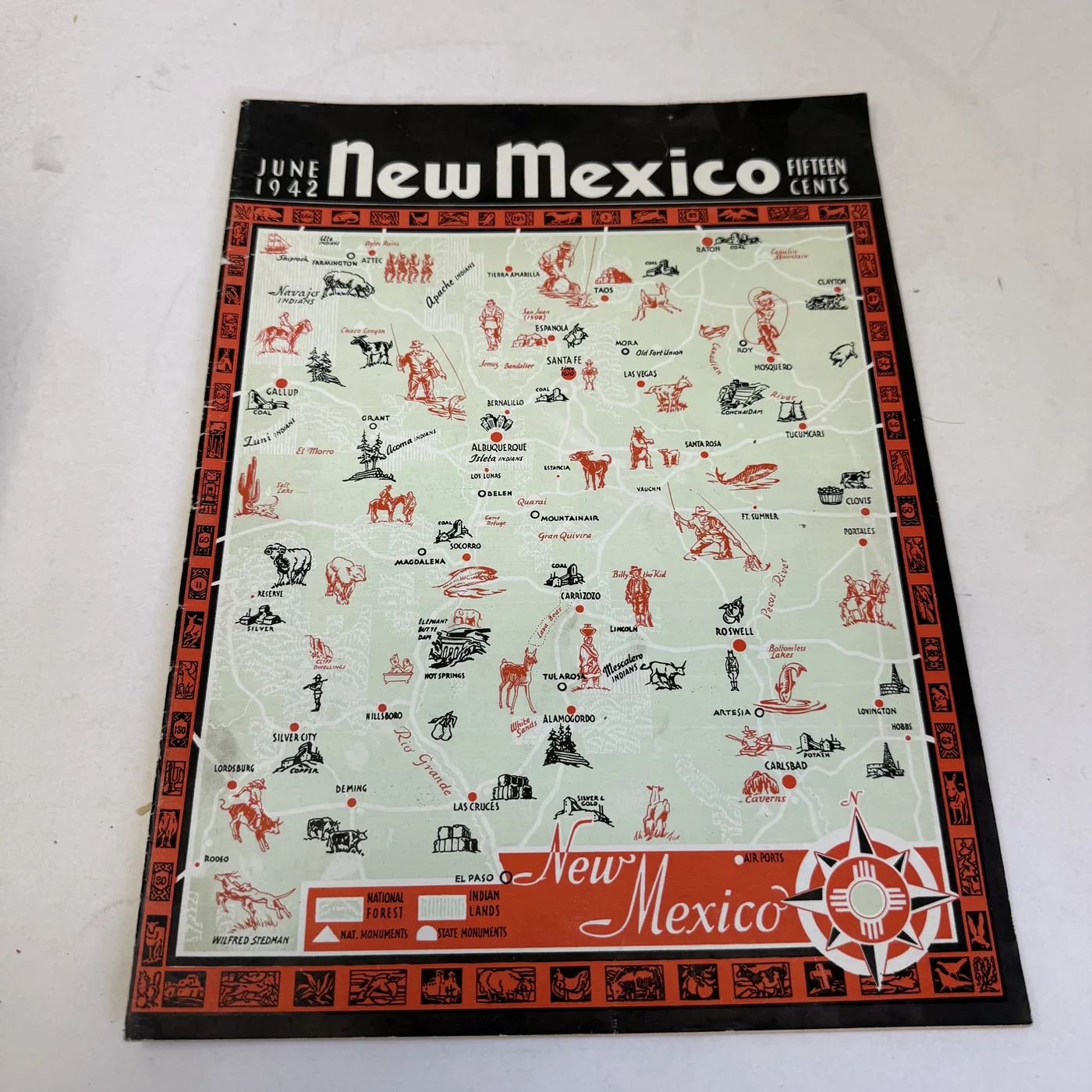
Most of the time, that instinct is not wrong. The bulk of mid-century travel ephemera has modest value at best. A 1960 Albuquerque Chamber of Commerce visitor guide is a pleasant artifact but not a collector target. A standard-issue 1955 New Mexico highway map is interesting but widely available. The challenge is that genuinely valuable material is mixed in with the common material, and the differences are not obvious to someone who has not handled thousands of pieces of this kind of ephemera. A Fred Harvey Indian Department catalog from 1910 looks like just another old brochure to an untrained eye. A WPA guide first edition in a faded dust jacket looks like a dusty old book. A Rittenhouse Route 66 guide in its original wrappers looks like a flimsy pamphlet. The value is in the specifics — the publisher, the date, the edition, the condition, the rarity of survival.
What I am going to do in this guide is walk through the principal categories of vintage New Mexico travel and tourism literature, identify the key publications within each category, explain what makes certain items valuable and others common, and give you the information you need to sort through a drawer full of this material without accidentally discarding something worth serious money. I handle this material every week in NMLP estate donation pickups across the Albuquerque metro area, and I have developed a sorting methodology that I am going to share here.
One more preliminary note. This guide covers printed material — books, brochures, pamphlets, maps, menus, postcards, promotional leaflets, visitor guides, and related paper ephemera. It does not cover three-dimensional tourism artifacts (Harvey House china, railroad memorabilia, hotel room keys, souvenir spoons) or photographic material (original photographs, glass plate negatives, stereographs) except where they are physically bound into or attached to printed publications. The three-dimensional and photographic material is a parallel collecting universe with its own specialists and its own market, and it deserves its own treatment.
The WPA Federal Writers' Project Guides
The Works Progress Administration Federal Writers' Project (1935–1943, renamed Work Projects Administration in 1939) employed out-of-work writers, journalists, researchers, and editors across every state to produce the American Guide Series — a state-by-state set of guidebooks that remains one of the most ambitious publishing projects in American history. The New Mexico volume, New Mexico: A Guide to the Colorful State, was published by Hastings House of New York in 1940, and it is the foundational twentieth-century travel guide to the state.
The 1940 first edition is a substantial cloth-bound hardcover of approximately 450 pages with a pictorial dust jacket. The book is organized in three principal sections: essays on New Mexico history, geography, culture, and society; descriptions of the state's principal cities and communities; and detailed driving tours with mile-by-mile descriptions of routes across the state. The essays are the most valuable section from a contemporary research perspective — they capture New Mexico at a specific historical moment, between the Depression and the war, before the atomic era transformed the state's economy and self-image. The community descriptions document towns and villages as they existed in the late 1930s, many of which have changed beyond recognition or disappeared entirely. The driving tours describe a road system that predates the Interstate highway era and document roadside features — gas stations, trading posts, ranch gates, river crossings — that no longer exist.
First-Edition Identification: New Mexico: A Guide to the Colorful State
Hastings House, New York, 1940, with the 1940 date and no revised-edition statement on the copyright page. Approximately 450 pages. Look for the original dust jacket, and check for the folding state map, which is the part most often lost. The 1953 revised edition states the revision on the copyright page and updates population figures, road descriptions, and adds atomic-era content. The 1962 further revision includes Interstate highway information. The 1940 Hastings House first with original dust jacket in fine condition is the Tier 1 target.
The WPA writers who worked on the New Mexico volume included several figures of note. Ina Sizer Cassidy, the arts writer and advocate who had long covered the Santa Fe and Taos art colonies, directed the Federal Writers' Project in New Mexico from 1935 to 1939. Cassidy's work for the Federal Writers' Project extended beyond the main guide volume to include supplementary publications on New Mexico communities, Spanish colonial architecture, and regional folkways. The WPA also produced New Mexico-specific supplementary publications including community guides, architectural surveys, and folklore collections that are themselves collectible, often scarcer than the main guide volume because they were printed in smaller quantities and distributed locally rather than through national bookstore channels.
The WPA American Guide Series as a whole is among the most collected Depression-era publication programs. Serious WPA collectors attempt to assemble complete sets of all state guides, and the New Mexico volume is neither the rarest nor the most common in the series. The rarest WPA guides are typically those for smaller states with smaller print runs. The New Mexico volume benefits from strong regional collector demand — New Mexico collectors want it for its New Mexico content, WPA collectors want it for their series completion, and cartography collectors want it for the fold-out maps. This three-way demand supports consistent value for fine first editions.
A note on the revision history. The 1953 Hastings House revision was substantially updated to reflect postwar New Mexico — the atomic installations at Los Alamos and Sandia, the growth of Albuquerque as a military and aerospace city, the expansion of the highway system, updated population figures from the 1950 census. The 1962 revision further updated for the Interstate era. These later editions are collectible in their own right (the 1953 revision is a Tier 2 target, the 1962 a Tier 3) but they do not carry the historical weight or the collector premium of the 1940 first. The 1940 first captures pre-war New Mexico; the revisions capture a state already transformed.
I pick up books for free anywhere in the metro area. Call 505-250-3804 to schedule.
Fred Harvey and Harvey House Publications
The Fred Harvey Company is the single most important institutional force in the history of New Mexico tourism, and its publications constitute one of the richest and most visually stunning bodies of travel literature produced anywhere in the American West. Understanding the Harvey publications requires understanding the Harvey system, because the publications were functional components of a commercial tourism infrastructure that operated continuously from the 1870s through the mid-twentieth century.
Fred Harvey (1835 to 1901) was an English-born restaurateur who in 1876 began operating eating houses along the Atchison, Topeka and Santa Fe Railway. The AT&SF partnership was the foundation of everything that followed. Harvey provided quality meals, clean accommodations, and professional service at railroad stations where travelers had previously endured terrible food and worse lodging. The Harvey Houses expanded across the AT&SF system through the 1880s and 1890s, and by the early twentieth century the Fred Harvey Company operated a chain of hotels, restaurants, and newsstands that stretched from Chicago to Los Angeles, with major installations at every significant AT&SF stop in New Mexico: the Castaneda in Las Vegas (built in 1898 and 1899, the first of the Harvey railroad hotels along the Santa Fe line), the Alvarado in Albuquerque (opened 1902, demolished 1970 in one of the great losses of New Mexico architectural heritage), El Ortiz in Lamy (the junction station for Santa Fe), La Fonda on the Plaza in Santa Fe (operated by the Harvey Company from 1926 under a lease arrangement, in a building designed by the Pueblo Revival architects Rapp and Rapp and later redesigned by Mary Colter), and El Navajo in Gallup (opened 1923, designed by Mary Colter in her distinctive Southwestern style).
The publications generated by this system fall into several distinct categories, each with its own collector profile.
Harvey House menus. The Fred Harvey Company printed menus for every meal service at every Harvey House location, and these menus are among the most commonly encountered Harvey publications in New Mexico estates. The menus varied from simple printed cards at the smaller eating houses to elaborate illustrated productions at the destination hotels. Pre-1920 menus from New Mexico Harvey Houses are Tier 1 collector targets. Menus from the Alvarado Hotel in Albuquerque are particularly sought because the Alvarado was demolished in 1970 and all that survives of it are photographs, publications, and moveable artifacts. Menus from the Castaneda in Las Vegas are sought because the Castaneda has been restored and reopened as a boutique hotel, creating renewed interest in its Harvey-era history. Post-1920 menus are Tier 2 or Tier 3 depending on the specific location and the quality of the printing.
Promotional brochures and booklets. The Harvey Company produced a continuous stream of promotional literature advertising its hotels, its dining services, and the scenic attractions accessible from AT&SF stations. The brochures from the early twentieth century through the 1930s are visually extraordinary — rich color lithography, fine photography by some of the best commercial photographers working in the Southwest, sophisticated typography and design that reflected the Harvey Company's commitment to quality in every detail of its operation. The Great Southwest Along the Santa Fe series of booklets, produced jointly by the Harvey Company and the AT&SF, are among the most collected Southwestern promotional publications. These booklets combined scenic photography, cultural description, practical travel information, and advertising for Harvey facilities into compact, beautifully printed packages that were distributed free to AT&SF passengers and available at Harvey House newsstands.
Fred Harvey Indian Department catalogs. This is the publication category with the deepest implications and the highest collector interest. The Fred Harvey Indian Department, managed by Herman Schweizer from 1901 to 1943, was the principal commercial channel through which Native American art — Navajo and Pueblo silverwork, Pueblo pottery, Navajo textiles, Rio Grande blankets, baskets, and other arts — reached the Anglo tourist market in the first half of the twentieth century. Schweizer built an enormous inventory of Native art at the Alvarado Hotel in Albuquerque, and the Indian Department published catalogs that illustrated and priced this material for mail-order and in-person sale. These catalogs are primary-source documents for the history of the Native American art market, and they are collected both by tourism-literature specialists and by collectors of Native American art who use them as historical price references and as documentation of what was being made, traded, and valued at specific moments in time.
The Herman Schweizer Connection
Herman Schweizer (1871–1943) managed the Fred Harvey Indian Department for over four decades. He was the most significant individual buyer of Native American art in the early twentieth century, and his purchasing decisions shaped what was produced, what was preserved, and what was valued in the Native art market. Schweizer's correspondence, his buying records, and his catalogs are primary-source documents held at the Heard Museum in Phoenix and the Cline Library at Northern Arizona University. The Indian Department catalogs that reached Harvey House guests and mail-order customers are the published face of Schweizer's operation, and they survive in far greater numbers than his internal records.
Mary Colter architectural documentation. Mary Elizabeth Jane Colter (1869–1958) was the Fred Harvey Company's principal architect and interior designer from 1902 to 1948, responsible for some of the most distinctive buildings in the American Southwest. Her New Mexico work includes the interior redesign of La Fonda on the Plaza in Santa Fe (1926 and later campaigns), El Navajo Hotel in Gallup (1923), and design elements at multiple Harvey House locations. Colter's work was documented in Harvey Company publications — hotel brochures, promotional booklets, and interior photographs that appeared in Harvey advertising. These publications are collected both as Harvey Company material and as documentation of Colter's architectural practice. The canonical Colter biography is Virginia Grattan's Mary Colter: Builder Upon the Red Earth (Northland Press, 1980), which is itself a Tier 1 collector target as documented in my Pueblo Revival architecture pillar.
The secondary literature on the Fred Harvey Company is substantial and is itself collectible. The principal works include Lesley Poling-Kempes's The Harvey Girls: Women Who Opened the West (Paragon House, 1989), which documents the young women who staffed the Harvey Houses and became cultural icons of the civilizing of the Western frontier; Stephen Fried's Appetite for America: How Visionary Businessman Fred Harvey Built a Railroad Hospitality Empire That Civilized the Wild West (Bantam, 2010), the most comprehensive corporate biography; and Marta Weigle and Barbara Babcock's The Great Southwest of the Fred Harvey Company and the Santa Fe Railway (Heard Museum, 1996), the exhibition catalog from the major Heard Museum retrospective. These secondary works are Tier 2 collector targets in their first-edition hardcover forms.
Railroad Promotional Literature
The AT&SF Railway's promotional publishing program operated independently of and in parallel with the Fred Harvey Company publications, and the two streams of material are often found together in estate collections because they were distributed through the same channels and collected by the same travelers. The railroad's own publications focused on the scenic and commercial attractions of the territories served by the AT&SF system, and New Mexico was a central subject.
The railroad's own booklets described scenic attractions and tourist destinations along its routes, and some steered travelers to places away from the main corridor, an early version of the side-trip and detour idea that the Indian Detours would later formalize. These publications were printed in substantial quantities and distributed free on trains and at stations, which means they survive in reasonable numbers, but the pre-1920 issues are genuinely scarce because the survival rate for free promotional ephemera over a century is low regardless of original print run.
Other railroads serving New Mexico produced their own promotional literature. The Southern Pacific, which served the southern part of the state through its Sunset Route and its branch lines, published promotional materials emphasizing the mining districts, the border communities, and the Chihuahuan Desert landscapes of southern New Mexico. The Denver and Rio Grande Western, which operated the narrow-gauge lines through northern New Mexico and southern Colorado, published some of the most visually appealing railroad promotional literature in the West — the dramatic mountain and canyon scenery of the narrow-gauge routes through the Toltec Gorge and over Cumbres Pass made for spectacular promotional photography. The El Paso and Southwestern Railway, which served the mining communities of southwestern New Mexico and the El Paso connection, produced more modest promotional materials focused on commercial and industrial rather than scenic tourism.
The "See America First" movement of the 1900s and 1910s — a nationalist tourism campaign that urged Americans to visit their own scenic wonders rather than making the traditional Grand Tour of Europe — generated its own body of New Mexico promotional literature. The movement was partly a response to the disruption of transatlantic travel during World War I and partly a genuinely patriotic effort to develop American domestic tourism as an industry. New Mexico was a natural beneficiary: its landscapes, its Native cultures, its Spanish colonial heritage, and its climate were all promoted as American alternatives to European tourism destinations. See America First publications that feature New Mexico content are collected as both tourism history and as documents of early twentieth-century American nationalism. My railroad history pillar covers the broader railroad literary canon in detail.
Identification Note: Railroad vs. Harvey Publications
AT&SF railroad publications and Fred Harvey Company publications are often confused because both carry the Santa Fe name and both promote travel on the same railroad system. The key distinction: publications issued by the railroad itself typically carry the AT&SF corporate imprint or the Santa Fe Railway logo. Publications issued by the Fred Harvey Company carry the Harvey imprint, often with the Harvey House logo or the "Fred Harvey" name in the colophon. Joint publications carry both names. The distinction matters for cataloging and for collector market routing — Fred Harvey specialists and railroad specialists are overlapping but not identical collector communities.
Early Automobile Touring Guides
The transition from railroad to automobile tourism between approximately 1910 and 1930 is one of the most significant transformations in New Mexico history, and it generated its own distinctive body of travel literature that is collected both for its content and for its documentation of the automobile's conquest of the American West.
The earliest automobile touring guides for New Mexico date from the 1910s, when automobile ownership was spreading rapidly but the road infrastructure was still primitive. These early guides are practical survival documents as much as tourism publications — they describe road conditions in terms that assume the reader is driving an open touring car on unimproved dirt roads through empty country where a breakdown could mean a long walk. They note the locations of water, the distances between towns with repair facilities, the grades and surfaces of mountain passes, and the hazards specific to desert and high-altitude driving. The tone is adventure literature as much as travel literature, because automobile touring in pre-highway New Mexico was genuinely an adventure.
The American Automobile Association and its affiliated state and regional auto clubs began publishing New Mexico touring guides in the 1910s and expanded their coverage through the 1920s as the highway system improved. AAA touring guides from this period are standardized in format — strip maps, turn-by-turn directions, distance tables, and listings of approved hotels, restaurants, and repair facilities — but the New Mexico editions are distinctive because the state's road system was so different from the Eastern and Midwestern networks that AAA had originally been designed to serve. Desert driving, high-altitude driving, sand and mud conditions, the absence of services over long distances — the New Mexico AAA guides addressed problems that Eastern motorists had never encountered.
The earliest New Mexico highway maps are themselves major collectibles, as documented in my maps and cartography pillar. The New Mexico State Highway Department began publishing official state highway maps in the 1910s, and these early maps document a road system that was being built in real time — each annual or biannual revision shows new roads graded, new bridges built, new routes designated. Oil company maps — issued free at filling stations by Standard Oil, Conoco, Phillips, Texaco, and other companies — are the most commonly encountered category of early highway maps and are collected for their cover art, their cartographic detail, and their documentation of the filling station infrastructure that supported automobile travel.
Garage and service station promotional materials from this transitional period are genuinely scarce. The small-town garage operator who printed a flyer advertising his repair services, the filling station that produced a local road guide, the Ford or Chevrolet dealer who published a regional touring brochure — these are among the rarest of early automobile-era publications because they were printed in tiny quantities, distributed locally, and almost universally discarded. When they survive, they are primary-source documents of the automobile infrastructure that made modern New Mexico tourism possible.
Route 66 Travel Guides and Ephemera
U.S. Route 66 was designated on November 11, 1926. In New Mexico its final alignment ran about 374 miles, from Glenrio at the Texas line to the Arizona line just past Manuelito, and until 1937 the route took a longer path north through Santa Fe. The Mother Road passed through Santa Rosa, Tucumcari, Albuquerque (on Central Avenue after the 1937 realignment), Grants, and Gallup, and it generated a body of travel literature that is one of the most actively collected categories in American transportation history. My Route 66 New Mexico pillar covers this canon in comprehensive detail, so I will focus here on how Route 66 material fits within the broader vintage NM travel and tourism collecting market.
The foundational Route 66 collectible is Jack D. Rittenhouse's A Guide Book to Highway 66 (J.D. Rittenhouse, Los Angeles, 1946), the first mile-by-mile guidebook to the highway, self-published in a print run of approximately 3,000 copies. The 1946 original in the softcover wrappers is a Tier 1 trophy item that trades in the four-figure range at specialist dealers. Rittenhouse drove the highway himself, documenting every gas station, motel, restaurant, and point of interest, and his guide captures Route 66 at the moment when wartime travel restrictions had been lifted and the highway was about to enter its highest-volume era. The University of New Mexico Press reprinted the book in 1989 as a facsimile of the 1946 first edition, and the 1989 reissue is itself a Tier 2 collector target, particularly copies signed by Rittenhouse before his death in 1991.
Route 66 ephemera from the New Mexico corridor is its own collecting universe. Postcard books from Tucumcari, Albuquerque, and Gallup documenting the neon-motel era. Motor court and motel promotional materials — the small printed brochures that motel operators produced to distribute at filling stations and tourist information centers. Diner and cafe ephemera — menus, matchbooks, placemats, and promotional cards from the roadside restaurants that served Mother Road travelers. The visual culture of Route 66 ephemera is what gives it its particular appeal: the neon-era graphic design, the hand-lettered typography, the exuberant color printing of the 1940s and 1950s, the sense of a roadside commercial culture that was building itself in real time with whatever design resources were available.
The 2026 Route 66 Centennial — commemorating the November 11, 1926 designation — is driving substantial new collector interest and new publication in this category. The centennial commemoration is producing new scholarly and popular-press titles, reissues of canonical works, and substantial photography and oral-history publication. Collectors should expect a wave of centennial-anchored material through 2026 and 2027, and the centennial is also driving appreciation in the value of pre-centennial canonical works.
Not sure I'll take them? Books in any condition are welcome. Text a photo to 505-250-3804 and I'll help you plan a drop-off or a free pickup.
Dude Ranch and Guest Ranch Brochures
New Mexico had a significant dude ranch and guest ranch culture from the 1920s through the 1960s, and the promotional publications these operations produced are among the most visually appealing and historically interesting items in the vintage NM travel literature category. The dude ranch brochure at its best was a piece of persuasive art: it had to convince an Eastern or Midwestern family to spend their vacation money on a trip to an unfamiliar place, and it did so with photography, illustration, and prose that presented New Mexico ranch life as the antidote to urban industrial modernity.
The major New Mexico guest ranch operations each produced their own distinctive promotional materials. Bishop's Lodge, outside Santa Fe, operated as a guest ranch from the early twentieth century and produced brochures that emphasized the Santa Fe art colony, the cultural attractions of northern New Mexico, and the combination of outdoor recreation with artistic and intellectual stimulation. The Bishop's Lodge brochures from the 1920s through the 1950s are collected for their documentation of Santa Fe tourism in the pre-ski-resort, pre-opera era, when the city's appeal was primarily artistic, archaeological, and climatic.
Rancho Encantado, also near Santa Fe, produced publications that marketed a more exclusive, celebrity-oriented experience. Ghost Ranch, the spectacular property in the red-rock canyon country north of Abiquiu, produced brochures in the 1930s through 1950s — before the property was donated to the Presbyterian Church and became a conference center — that documented a working dude ranch operation in one of the most dramatic landscapes in the American West. Ghost Ranch brochures from this period are sought both by tourism collectors and by collectors interested in the photography and visual art of the region, because the property is closely associated with Georgia O'Keeffe's paintings of the Piedra Lumbre basin and the landscape that Ghost Ranch guests experienced was the landscape that O'Keeffe made famous.
Los Poblanos in Albuquerque's North Valley, now a heritage inn and organic farm, was a family farm and estate with Pueblo Revival architecture by John Gaw Meem rather than a classic dude ranch. Vermejo Park Ranch, the massive property in the Sangre de Cristo Mountains near the Colorado border, has been through multiple ownership eras, from private ranch to Pennzoil corporate retreat to Ted Turner conservation property, and produced promotional materials during each era that document different visions of what the New Mexico ranch experience meant to different audiences at different moments in time.
What makes dude ranch brochures particularly collectible is their combination of visual quality and historical specificity. Each brochure captures a particular operation at a particular moment, with photographs of specific buildings, specific landscapes, specific activities, and specific people. As the operations have changed, closed, or transformed, these brochures become the primary visual record of experiences that no longer exist in their original form. A 1940s Ghost Ranch dude ranch brochure documents a way of experiencing that landscape that ended when the property became a conference center. A 1950s Bishop's Lodge brochure documents a Santa Fe tourism culture that predates the contemporary gallery, restaurant, and real estate economy.
Chamber of Commerce and Civic Promotional Literature
Every New Mexico community of any size produced promotional literature through its chamber of commerce, tourist bureau, or civic booster organization, and the accumulation of this material in New Mexico estates is enormous. The Albuquerque Chamber of Commerce alone produced a continuous stream of visitor guides, economic development brochures, relocation guides, and special-event publications from the early twentieth century through the present day. The Santa Fe Chamber produced parallel material emphasizing the city's artistic, cultural, and historical attractions. Every county seat, every tourist destination, every community with ambitions to attract visitors or new residents produced something.
Most of this material is common and has modest collector value. The 1965 Albuquerque visitor guide is interesting as a period artifact but there is no substantial demand for it in the collector market. What elevates certain chamber publications to collector status is age, visual quality, and historical specificity. Pre-1930 chamber of commerce publications from any New Mexico community are genuinely scarce and are Tier 2 collector targets. Publications from the "health seeker" era — the late nineteenth and early twentieth century period when New Mexico actively marketed its dry climate as a cure for tuberculosis and respiratory disease — are both scarce and historically significant, documenting a phase of New Mexico's self-promotion that the state later moved away from as the sanatorium era ended and the tourism economy diversified.
The Santa Fe Fiesta promotional materials deserve particular mention. The Santa Fe Fiesta, held annually since 1712 (with interruptions), is the oldest community celebration in the United States, and its promotional publications document the evolution of the festival from a religious and civic celebration to a tourist attraction to a cultural event with complex political and identity dimensions. Early Fiesta programs, poster reproductions, and promotional brochures are collected for their documentation of the festival's history and for their visual art — Fiesta posters and promotional materials have been designed by some of the most significant artists in the Santa Fe art community.
The "Land of Enchantment" Branding History
New Mexico adopted "Land of Enchantment" as its official state nickname in 1999, but the phrase had been used in New Mexico promotional literature for decades before that. The phrase appears in tourism publications as early as the 1930s, and Erna Fergusson used the title New Mexico: A Pageant of Three Peoples (Knopf, 1951) to evoke a similar sensibility. The evolution of the "Land of Enchantment" brand through New Mexico promotional literature — from informal usage to official adoption — can be traced through chamber of commerce and state tourism bureau publications across seven decades. Collecting the "Land of Enchantment" branding arc is a niche within the broader NM promotional literature category.
Carlsbad Caverns promotional publications form their own subcategory. Before Carlsbad Caverns was designated a national park in 1930, it was promoted by local boosters, the Carlsbad Chamber of Commerce, and early cave explorers including Jim White, whose accounts of discovering and exploring the cave system were published in various forms. These pre-national-park Carlsbad publications are genuinely scarce and are Tier 1 collector targets. Post-designation NPS publications are covered in the national parks section below, but the transition-era material — publications from the period when the site was being promoted for national park status — is some of the most historically interesting tourism literature produced in New Mexico.
White Sands publications present a different case. The White Sands area has been a tourist attraction since the early automobile era, but White Sands National Monument (now National Park) was not established until 1933, and the area has always been complicated by its proximity to and overlap with White Sands Missile Range. Early White Sands promotional materials that predate the military presence document a landscape and a visitor experience that was transformed by the establishment of the missile range during World War II. Post-military promotional materials must navigate the dual identity of the area as both a natural wonder and a restricted military installation, and this navigating produces distinctive promotional literature that is unlike anything published for other NM tourism destinations.
Indian Detour and Native American Tourism Publications
The Fred Harvey Company's Indian Detour service, which began in 1926 and ran in various forms for decades, was the most organized and most documented instance of the broader phenomenon of Anglo tourist engagement with Native American communities in New Mexico. The Detour took AT&SF Railway passengers off the train at Lamy, Las Vegas, or Albuquerque and transported them by automobile, in specially built open touring cars called Harveycars, to Pueblo communities, Navajo country, Spanish colonial mission churches, and archaeological sites across northern New Mexico. The tours were led by trained young women called "couriers" who served as driver-guides, combining the roles of chauffeur, historian, anthropologist, and hostess.
The Indian Detour publications are extraordinary documents. The promotional brochures sold the experience with color lithography, professional photography, and prose that framed the Pueblo and Navajo communities as living cultural attractions — a "detour" from the railroad into a world presented as timeless, authentic, and exotic. The courier training manuals are primary-source documents of how the Harvey Company instructed its guides to present Native cultures to Anglo tourists — what to say, what to show, how to manage the tourist-community interaction, what questions to anticipate and how to answer them. The passenger information packets included itineraries, packing lists, cultural briefings, and sometimes ethnographic summaries drawn from the work of contemporary anthropologists.
The courier training manuals are among the most sought publications in the Indian Detour category because they were produced in very small quantities (only enough for the working couriers), they were functional working documents that were used hard and often discarded when superseded by updated versions, and they contain information about the Harvey Company's cultural tourism philosophy that does not appear in the promotional materials intended for public distribution. A courier training manual from the early years of the Detour, in usable condition, is a Tier 1 collector target.
Ethical Considerations in Collecting This Material
Indian Detour and Native American tourism publications raise ethical questions that responsible collectors and dealers should think about carefully. These publications document a tourism system in which Native communities were presented to Anglo tourists as spectacles and attractions, often without meaningful Native agency in how those communities were represented. The language and imagery of the promotional materials reflect the cultural assumptions of their era, including assumptions about racial hierarchy, cultural "primitivism," and the touristic consumption of Native life. Collecting this material for its historical significance is legitimate and important — the publications are primary-source documents that scholars need in order to understand and critique the history of cultural tourism in the Southwest. But collecting it without awareness of what it represents is something else. The best collecting practice treats these publications as historical evidence to be studied, not as nostalgia to be celebrated.
Beyond the Harvey Company Indian Detour, New Mexico produced a broader body of Native American tourism publications through various channels. The Bureau of Indian Affairs published visitor information for Pueblo communities. Individual Pueblos produced (and continue to produce) their own visitor guides and event publications. The Inter-Tribal Indian Ceremonial in Gallup, held annually since 1922, generated its own body of promotional literature — programs, poster reproductions, visitor guides, and commemorative publications — that documents one of the largest and longest-running Native American cultural events in the United States. The Gallup Inter-Tribal Ceremonial publications are collected for their documentation of the event's history and for their visual art, which has included poster designs by significant Native and non-Native artists.
National Park and Monument Publications
New Mexico's national parks, national monuments, and other federally managed sites have generated a continuous stream of publications since the earliest days of the National Park Service, and this material is both widely available and, in its earliest forms, genuinely collectible. The NPS publication program is standardized across the system — every unit produces visitor guides, interpretive brochures, natural and cultural history handbooks, and administrative publications — but the New Mexico publications have distinctive character because the New Mexico sites are themselves distinctive.
Carlsbad Caverns is the publication leader in the New Mexico NPS system, both because the site has been operating as a public attraction since the 1920s (before its 1930 national park designation) and because the cave itself is a visual spectacle that has inspired consistently high-quality publication. The earliest Carlsbad visitor guides and NPS handbooks, from the late 1920s and early 1930s, document the cave before the extensive trail and lighting systems were installed — a wilder, more adventurous experience than what contemporary visitors encounter. The NPS Natural History Handbook for Carlsbad Caverns is a standard reference, and early editions are Tier 2 collector targets. The cave also generated concession-company publications — souvenir booklets, postcard packets, and promotional materials produced by the companies that operated visitor services under NPS contract — that are collected as complements to the official NPS publications.
Bandelier National Monument, preserving the ancestral Pueblo cliff dwellings and community sites in Frijoles Canyon near Los Alamos, has generated publications since the monument's establishment in 1916. The earliest Bandelier publications are scarce because the monument was relatively remote and received modest visitation in its early decades. The Adolph Bandelier connection — the monument is named for the Swiss-American archaeologist and novelist who explored the area in the 1880s and wrote The Delight Makers (1890), one of the first novels set in the Pueblo world — adds a scholarly dimension to the Bandelier publication history that connects to the broader archaeological and exploration literature of the Southwest.
Chaco Canyon (now Chaco Culture National Historical Park) presents perhaps the most interesting publication history among New Mexico NPS sites. The remoteness of the site — it remains accessible only by unpaved roads — meant that early Chaco publications were produced for a small and dedicated audience of visitors willing to make the difficult journey. The archaeological significance of Chaco as the center of the ancestral Puebloan world has made its publications particularly valuable to scholars and collectors interested in Southwestern archaeology. Early NPS visitor guides for Chaco, CCC-era publications documenting the Civilian Conservation Corps stabilization work at the great houses, and the early archaeological survey reports that were distributed to visitors are all collected.
El Morro National Monument (Inscription Rock), where Spanish and American travelers carved their names and messages into the sandstone bluff over centuries, has its own body of publications documenting both the inscriptions and the experience of visiting the site. Gila Cliff Dwellings National Monument in southwestern New Mexico, White Sands (now a national park), Pecos National Historical Park, and the smaller New Mexico NPS units each have their own publication histories.
The CCC-era publications deserve particular mention. The Civilian Conservation Corps operated camps at multiple New Mexico NPS and Forest Service sites during the 1930s, and the work these camps performed — building trails, stabilizing archaeological sites, constructing visitor facilities — was documented in publications that are both rare and historically significant. CCC-era publications from New Mexico sites are collected for their documentation of the Depression-era conservation and public-works programs that shaped the visitor infrastructure that remains in use at many sites today.
Inherited a library and not sure where to start? Call or text 505-250-3804 — I handle this all the time.
The Postwar Tourism Boom, 1945–1970
The end of World War II triggered an explosion of tourism across New Mexico that generated more printed material than all the previous decades combined. The postwar boom was driven by several converging forces: automobile ownership became nearly universal among American families, the highway system expanded rapidly (culminating in the Interstate Highway Act of 1956), disposable income rose, paid vacation time became standard in American employment, and the culture of the family road trip became a defining feature of postwar American life. New Mexico, with its combination of scenic landscapes, cultural attractions, favorable climate, and position on the transcontinental highway network, was a prime beneficiary.
The postwar tourism literature is characterized by volume, variety, and a distinctive visual culture. Motel and motor court guides proliferated as the roadside hospitality industry expanded to serve automobile tourists. Restaurant guides appeared as dining became part of the tourism experience rather than just a practical necessity. Special-interest tourism publications emerged for the first time — fishing and hunting guides, rockhounding and mineral-collecting guides, bird-watching guides, and other publications directed at tourists with specific recreational interests rather than general sightseers.
The emergence of ski tourism publications is a significant development of this period. Taos Ski Valley, founded by Ernie Blake in 1955, produced promotional materials from its earliest days that documented the creation of a world-class ski resort in the mountains above Taos. Sandia Peak, the ski area in the Sandia Mountains above Albuquerque (accessible by the Sandia Peak Tramway after 1966), produced its own promotional literature. The Santa Fe Ski Basin, operating since the 1930s in the Sangre de Cristo Mountains above Santa Fe, generated decades of promotional material. These ski tourism publications document the transformation of New Mexico from a warm-weather destination to a year-round tourism economy.
Arts and crafts festival publications became a significant category in the postwar period. The Indian Market and Spanish Market in Santa Fe (organized by the Southwestern Association for Indian Arts and the Spanish Colonial Arts Society, respectively), and dozens of smaller arts festivals and gallery events across the state produced programs, catalogs, poster reproductions, and promotional materials that document the evolution of the arts tourism economy. Indian Market programs from the 1940s and 1950s are collected for their documentation of the early history of the organized Native American art market and for their listings of participating artists, many of whom became the canonical names in contemporary Native American art.
The postwar boom also generated the first substantial body of New Mexico cookbook and food tourism literature. The discovery of New Mexico cuisine by non-New Mexican tourists created a market for cookbooks, restaurant guides, and food-focused travel writing that had not existed before the war. Erna Fergusson's work, documented in my Erna Fergusson pillar, had introduced New Mexico culture to a national audience in the 1930s, but the postwar boom created a mass market for New Mexico food, culture, and lifestyle that Fergusson's earlier work had only previewed.
New Mexico Magazine, the state's official tourism and culture publication (published continuously since 1923, originally as New Mexico Highway Journal and then New Mexico before adopting its current title), is itself a major collectible publication. Complete or near-complete runs of New Mexico Magazine are substantial research resources, and individual issues from the early decades (1920s through 1940s) are Tier 2 collector targets. The magazine's cover art has been contributed by significant New Mexico artists, and the covers alone are collected as prints and as examples of New Mexico visual culture.
From the Sorting Stream: A Modern NM Travel Guide That Got It Right
I want to show you a specific book from my sorting stream because it demonstrates something important about the NM travel and tourism category: the tradition didn't end in 1970. Good New Mexico travel guides are still being produced, and some of them are already collectible for the same reasons the early material is — institutional authority, physical design choices that reward the actual traveler, and the kind of specific, useful content that people keep rather than discard.
By the Way… 25: A Guide to New Mexico's Scenic Byways was published in 2011 by New Mexico Magazine — the same state tourism publication that's been covering New Mexico since 1923. The three authors brought genuine institutional credentials: Laurie Evans Frantz was the State Scenic Byways Coordinator at the New Mexico Tourism Department, Lesley S. King wrote Frommer's New Mexico and the "King of the Road" column for NM Magazine, and Marti Niman worked with the New Mexico Department of Energy, Minerals and Natural Resources. This wasn't a freelancer cobbling together road trip tips — it was the state's own tourism infrastructure producing a comprehensive field guide to all twenty-five designated scenic byways.


Photos: Josh Eldred / New Mexico Literacy Project, June 2026. Desk photography of a copy from the NMLP sorting stream. Cover and interior images used under standard book-trade documentation practice.
What I want you to notice is the physical design. This is a spiral-bound book sized to fit in a glove compartment. That's a deliberate choice — the designers at New Mexico Magazine understood that a scenic byways guide is a road book, meant to be opened flat on the passenger seat while someone navigates. The spiral binding lets it lie flat. The compact format doesn't compete with a map for space. These are the same utilitarian design instincts that made the best mid-century automobile touring guides work, updated for a modern traveler who's driving through the Enchanted Circle or up the Turquoise Trail and wants more than a phone screen can provide.
The fold-out state map in the back pocket is the key detail for collectors. Spiral-bound travel guides with maps in pockets lose those maps constantly — they get pulled out at a rest stop and never put back, they migrate to a different vehicle, they end up in a desk drawer three states away. When I sort these, I always check the back pocket first. A complete copy with the original map is meaningfully more interesting than one without it, for the same reason that a WPA guide with its fold-out maps intact is worth more than one where the maps have been removed. Completeness is the collector's marker.
This copy came through my standard sorting stream — someone clearing out a bookshelf in an Albuquerque estate and not thinking twice about a spiral-bound travel guide. It's exactly the kind of thing that goes into the "just take it all" pile when a family is overwhelmed by the volume of books in a house. And it's exactly the kind of thing I pull out and set aside, because NM travel guides published by the state's own magazine with named authors who held state tourism positions are the modern inheritors of the WPA guide tradition. Twenty years from now, this is the copy someone's going to be looking for at a book fair.
From the Sorting Stream: A 1957 First Edition That Rewrites the Desert Myth
Now let me show you something from the other end of the timeline — and from a corner of New Mexico collecting that most people don't even know exists. William J. Koster's Guide to the Fishes of New Mexico came off my sorting table recently, and the moment I opened it I knew it was staying on the desk for a while.
This is a 1957 first edition. The copyright page says so explicitly — "First Edition" — and that matters, because this book has never been common. Published by the University of New Mexico Press in cooperation with the New Mexico Department of Game and Fish, printed and bound at the UNM Printing Plant right here in Albuquerque, Library of Congress Catalog Card No. 57-12457. This is pre-ISBN era, which means the LOC card number is your bibliographic anchor. This copy still carries the original price sticker.


Photos: Josh Eldred / New Mexico Literacy Project, June 2026. Desk photography of a copy from the NMLP sorting stream. Cover and interior images used under standard book-trade documentation practice.
Koster was a professor of biology at UNM — described on the back cover as "not only a noted ichthyologist, but an able catcher of fish, so that both aspects of the study of fish have his interest and understanding." That line tells you everything about the era and the institution. This was a working scientist who fished the rivers he studied, who knew the Pecos and the Rio Grande and the Gila from the bank and from the lab bench. The 104 illustrations are his own drawings, made from actual specimens — scientific illustration, not decorative art. Each of the 93 species known to occur in New Mexico waters gets the full treatment: shape, size, coloration, distribution, habitat, use, edibility, and relationship to other fish.
Ninety-three species. That number surprises people who think of New Mexico as pure desert. The book covers representatives of sixteen families — from trout in the mountain streams to the "whitefish" minnow reputed to reach five feet and eighty pounds, the nest-building brook stickleback in the northern waters, and the American eel that breeds only in the mid-Atlantic and somehow shows up in New Mexico. Koster's introduction covers fish physiology, conservation, and ecology in language that's accessible to the angler and rigorous enough for the biologist. It's the kind of dual-audience writing that academic presses used to do well and rarely attempt now.
The institutional weight here is what elevates this from interesting to collectible. UNM Press plus the New Mexico Department of Game and Fish is the maximum possible co-publication authority for a state natural history title. Printed at the UNM Printing Plant in Albuquerque — local production, institutional imprint, first edition of a work that was never mass-market. This is exactly what surfaces from a retired NM professor's estate or from the bookshelf in an old fishing cabin up in the Jemez. Someone's father kept it by the fly-tying bench for forty years, and now the family's cleaning out the house and doesn't know what they have.
First-Edition Identification: Guide to the Fishes of New Mexico
William J. Koster. University of New Mexico Press in cooperation with New Mexico Department of Game and Fish, 1957. Copyright page states "First Edition." Library of Congress Catalog Card No. 57-12457. "Composed, Printed, and Bound at University of New Mexico Printing Plant, Albuquerque, New Mexico, U.S.A." Blue and cream cover with green lettering and fish line drawing. 104 illustrations by the author from actual specimens. Pre-ISBN era — no ISBN exists. Previous owner pencil inscription on front cover and original price sticker are common period features, not defects. The Koster is a Tier 2 collector target in the NM natural history and field guide subcategory, with crossover appeal to ichthyology collectors and UNM Press completists.
This book connects to the broader NM outdoor and travel collecting tradition already on this page. The Scenic Byways guide above is 2011 — modern, practical, designed for the glove compartment. The Koster is 1957 — mid-century, scientific, designed for the field vest. Different eras, different formats, same DNA: an authoritative New Mexico outdoor reference by a credentialed expert, produced by the state's own institutional infrastructure, built to be used in the actual landscape rather than read on a couch. The best NM field guides share that quality. They're working documents that happen to be beautiful.
From the Sorting Stream: Gila Country Field Guides
These two items came through together in a single donation box from a Silver City estate, and they belong together. They tell the same story from different angles — the Gila wilderness region of southwestern New Mexico as both a hiking destination and an archaeological treasure. The Gila Cliff Dwellings are inside the Gila Wilderness. When I find a pair like this, I keep them paired, because that's how they lived on someone's shelf and that's how they make sense to a collector.
The Gila Wilderness: A Hiking Guide by John A. Murray was published by University of New Mexico Press in 1988 as part of the Coyote Book series, UNM Press's nature and outdoor imprint. This is the fifth printing, 1996, which tells you something important: five printings across eight years means this guide was the standard Gila reference for a decade. Murray describes twenty-four trails covering three hundred miles through a thousand square miles of wilderness, encompassing the headwaters of the three forks of the Gila River. The Gila was the first place in the world designated as a wilderness area: the U.S. Forest Service set it aside on June 3, 1924, after Aldo Leopold, then a Forest Service officer, pushed to protect the Gila headwaters. That fact alone makes everything written about it carry historical weight.
Murray's author photo on the back cover is a nice piece of documentation in itself — he's standing at the "Gila Wilderness / Gila National Forest" sign wearing a "Mimbres" t-shirt. The Mimbres were the ancient pottery-making culture from the same region, and Murray's shirt choice tells you he's not just a hiking guide writer passing through. He went on to teach in the English Department at the University of Alaska, Fairbanks, and published several books on natural history and the outdoors. That Alaska connection is worth noting — it shows how New Mexico's outdoor literature community extends nationally. Writers who cut their teeth on the Gila carry that landscape with them.


Photos: Josh Eldred / New Mexico Literacy Project, June 2026. Desk photography of copies from the NMLP sorting stream. Cover images used under standard book-trade documentation practice.
The NPS trail guide for Gila Cliff Dwellings National Monument is exactly the kind of ephemera that gets tucked inside a hiking guide on someone's bookshelf — and that's where I found it, slipped between the pages of the Murray guide. It's a small pamphlet on cream paper with pen-and-ink naturalist illustrations: cliff dwellings nested in a canyon wall, a mountain lion perched on rock beside prickly pear. Undated, but the style suggests 1980s or early 1990s production. The Gila Cliff Dwellings preserve Mogollon culture pueblo ruins from roughly 1280 AD — these are the people who built permanent structures in the natural caves above the Gila River's West Fork, then left within a generation or two. The monument sits at the end of NM Highway 15, a winding two-lane road that itself feels like a journey into deep time.
What makes this pair interesting as a collecting unit is the layering. Murray's guide is the practical outdoor reference — trail descriptions, mileages, water sources, the information you need to not get lost in a thousand square miles of wilderness. The NPS pamphlet is the cultural-archaeological layer — the ancient human presence in the same landscape. Together they represent southwestern New Mexico the way it actually is: a place where you hike through country that people have been walking for a thousand years. This pairs naturally with Black Range Tales and the broader southwestern NM material to build a deep regional layer on the shelf. New Mexico Magazine called Murray's writing "clear straightforward writing with an eye toward fact" — that's the voice of someone who respects the landscape enough to describe it accurately rather than romantically.
Identification Points: The Gila Wilderness: A Hiking Guide
John A. Murray. University of New Mexico Press (A Coyote Book), 1988. Fifth printing, 1996. ISBN 0-8263-1067-2 (pbk.). LOC: GV199.42.N62G556 1988, 917.89'692, 87-35753. Design by Milenda Nan Ok Lee. Cover photograph by Charles W. Murray, Jr. Dedicated "To my brothers, Mike and Bill." Green-bordered trade paperback with color canyon landscape. 24 trails, 300 miles described. The Gila Wilderness was the world's first designated wilderness area (U.S. Forest Service, June 3, 1924). Five printings across eight years confirm this was the standard Gila trail reference. Tier 3 as a standalone; strengthened when paired with NPS Gila Cliff Dwellings ephemera as a "Gila Country" collecting unit.
From the Sorting Stream: Mountain Press's Roadside Companions
I'm pairing these two because that's how they belong — and because that's how they keep surfacing together in NM estates. Roadside Geology of New Mexico by Halka Chronic and Roadside History of New Mexico by Francis L. and Roberta B. Fugate are companion volumes from the same publisher, Mountain Press Publishing Company of Missoula, Montana. One explains what you see out the car window — the layered rock, the rift valleys, the volcanic mesas. The other explains what happened there — the conquistadors, the railroads, the ranchers, the atomic age. Both are organized by highway route. Together they're the complete roadside reference for anyone driving New Mexico.
Mountain Press's "Roadside" series is iconic in western Americana. If you've driven I-40, I-25, or US-550 in New Mexico, you've probably seen one of these in a gas station bookrack or a visitor center display. The series launched in the 1970s and now covers nearly every western state plus many eastern ones. The concept is brilliant in its simplicity: match what you see out the window to the explanation in the book. No lab required. No prior knowledge assumed. Just drive and read.
Halka Chronic was a genuine pioneering geologist — not a popularizer borrowing others' work, but a researcher who spent decades studying Rocky Mountain and desert geology and then figured out how to explain it to anyone who could read a road sign. Her Roadside Geology of New Mexico was first published in 1987, and the copy I'm showing you is the fourth printing from June 1991 — four printings in four years, which tells you how fast these moved. The cover art is a colorful stylized geological cross-section showing layered rock formations, fault lines, and volcanic features. It's the kind of cover that makes you want to pull over at the next road cut and actually look at the exposed strata. The book covers the Rio Grande Rift, the volcanic plateaus, the Chihuahuan Desert lowlands — the physical New Mexico that shapes everything else about the state.


Photos: Josh Eldred / New Mexico Literacy Project, June 2026. Desk photography of a copy from the NMLP sorting stream. Cover and interior images used under standard book-trade documentation practice.
The Fugates' Roadside History of New Mexico is the human-scale companion. Francis L. Fugate (1915–1992) and Roberta B. Fugate spent forty years driving New Mexico roads researching this book — that's the definition of first-hand authority. The 1989 first edition I have here is the eleventh printing from February 2011. Eleven printings across twenty-two years means this book was in continuous demand for over two decades. That's a backlist classic by any publisher's standard.
The cover painting is by Joe Beeler — Spanish conquistadors on horseback encountering a Native American in a desert landscape with mesa backdrop. Beeler was a founding member of the Cowboy Artists of America, so the cover art itself carries a collecting connection. The dedication reads: "To Bobbie who enlivened our early travels through New Mexico and To Dempsey who worried that the road might play out just beyond every curve." That's the voice of people who drove every mile they wrote about.


Photos: Josh Eldred / New Mexico Literacy Project, June 2026. Desk photography of a copy from the NMLP sorting stream. Cover and interior images used under standard book-trade documentation practice.
These pair perfectly with the Scenic Byways guide already on this page — three different lenses on NM's roads. The Scenic Byways guide (2011) tells you where to drive. The Roadside Geology (1987) tells you what you're looking at when you pull over. The Roadside History (1989) tells you who was here before you. Stack all three on the passenger seat and you've got the most complete road-trip reference set for New Mexico that exists outside a university library. That's why I keep these together when they surface in estates — they're a natural collecting unit, and they tell the story of this place better as a trio than any one of them does alone.
Identification Points: Mountain Press Roadside Companions
Roadside Geology of New Mexico. Halka Chronic. Mountain Press Publishing Company, 1987. Fourth Printing, June 1991. ISBN 0-87842-209-9 (pbk.). LOC: QE143.C47 1986, 557.89, 86-21748. Roadside Geology Series, editorial directors David Alt and Donald Hyndman. Colorful geological cross-section cover art. Bibliography and index. Tier 3 as a standalone; strengthened in a "Roadside" pair or NM road-trip collecting unit.
Roadside History of New Mexico. Francis L. and Roberta B. Fugate. Mountain Press Publishing Company, 1989. Eleventh Printing, February 2011. ISBN-13 978-0-87842-242-5 / ISBN-10 0-87842-242-0 / ISBN 978-0-87842-242-5 (pbk.). LOC: F797.F55 1989, 917 89004'53—dc20, 83-32991. Cover painting by Joe Beeler (Cowboy Artists of America founding member). Bibliography and index. Eleven printings across twenty-two years confirm backlist-classic status. Tier 3 standalone; Tier 2 interest when paired with the Geology volume as a Mountain Press "Roadside NM" set.
From the Sorting Stream: The 126-Year-Old Book That Never Left Albuquerque
Everything else on this page dates from the twentieth century. The WPA guides, the Harvey brochures, the Route 66 ephemera, the roadside companions — they're all products of a modern tourism infrastructure that assumed visitors would arrive by train or automobile. But the tradition of writing about New Mexico as a destination for astonished outsiders starts earlier than any of that, and the man who arguably invented it — who first told Eastern readers that the Southwest was a wonderland worth crossing a continent to see — was Charles Fletcher Lummis.
This copy of Some Strange Corners of Our Country: The Wonderland of the Southwest came across my sorting desk recently, and the provenance trail on it stopped me cold. The Century Co., New York, 1900 — a reprint of articles originally serialized in St. Nicholas Magazine beginning in 1891. Copyright 1891 and 1892 by The Century Co. Printed by The De Vinne Press, which was the prestige printer of the Gilded Age — the same shop that printed The Century Magazine, St. Nicholas, and Scribner's commissions. If your book said "The De Vinne Press" on the copyright page in 1900, it meant the publisher was spending real money on production quality.

But the book itself is only the beginning of this story. Look at that title page: the Albuquerque Public Library stamp is right there, stamped in blue ink. Accession number 244492 is stamped on the copyright page verso. The library's call number markings — penciled Dewey notation — are still visible. This book entered the Albuquerque public library system early in the twentieth century and stayed there for decades, circulating to readers who wanted to learn about the very landscape they could see outside the library windows.
Then look inside the front cover. There's a gold foil sticker from New Mexico Bookbinders, Albuquerque — "Bound to Last" — which means that at some point the library sent this book out for rebinding at a local Albuquerque bindery. The gold-tan cloth with the turquoise band at the top of the spine? That's the NM Bookbinders rebind, not the original Century Co. binding. The library was investing in keeping this book in service. That gold foil sticker is a local-business artifact — a small Albuquerque bindery that did contract work for the public library, advertising its services one book at a time.


So here's the provenance loop: The Century Co. published the book in New York in 1900. It crossed the country to Albuquerque, where the public library accessioned it. The library sent it to a local Albuquerque bindery for rebinding. It circulated for years, maybe decades, to Albuquerque readers. Eventually the library deaccessioned it. And now, 126 years after it was printed, it's sitting on my sorting desk at the New Mexico Literacy Project — about three miles from the library where it spent most of its life. This book effectively never left Albuquerque.
That provenance loop matters because Lummis wasn't some Eastern tourist passing through. He walked from Cincinnati to Los Angeles in 1884 and 1885, passing through New Mexico on foot. He came back and lived at Isleta Pueblo in the late 1880s and early 1890s, learning the language and the culture. Some Strange Corners of Our Country was serialized in St. Nicholas during those Isleta years, so he was writing about the Southwest from inside it, not from a hotel in Santa Fe. His other major New Mexico book, The Land of Poco Tiempo (Scribner's, 1893), came out of the same period, and his account of that original walk, A Tramp Across the Continent (Scribner's, 1892), appeared the same year as the first book edition of Some Strange Corners.


The engravings throughout the book are period woodcuts from the original 1891 serialization — all fully public domain. The Petrified Forest illustration shown here is captioned "Tree-Trunk Petrified Into An Agate Bridge," and it shows the Southwest landscape as it was depicted for Eastern audiences 135 years ago. The Navajo blanket chromolithograph frontispiece is another period artifact — this is how The Century Co. presented Navajo textile art to readers who'd never seen the real thing. Every illustration in this book is a document of how the Southwest was mediated for a national audience in the 1890s, before photography replaced engraving as the standard mode of illustration.
Lummis went on to found the Southwest Museum in Los Angeles, edit Out West magazine (formerly The Land of Sunshine), and campaign tirelessly for the preservation of the California Spanish missions and for Native American rights. He's threaded through half the collecting categories on this site — the photography pillar covers his Isleta Pueblo photographs, the folklore guide positions him as a pioneer collector, the health-seekers guide discusses his role in Southwest promotional literature. I've already documented a signed copy of Lummis in the Pueblos by Patrick and Betsy Houlihan (Northland Press, 1986) on the shelf pages. But Some Strange Corners is the foundational text — the book that told America the Southwest was worth visiting. Every Harvey brochure, every AT&SF railroad promotional, every WPA guide on this page is a descendant of what Lummis started.
Identification Points: Lummis, Some Strange Corners of Our Country
Some Strange Corners of Our Country: The Wonderland of the Southwest. Charles F. Lummis. New York: The Century Co., 1900. Copyright 1891, 1892 by The Century Co. Printed by The De Vinne Press. Illustrated with period wood engravings from the original St. Nicholas Magazine serialization. Navajo blanket chromolithograph frontispiece. This copy: ex-Albuquerque Public Library (blue ink stamp on title page, accession number 244492 on copyright page verso, penciled Dewey call number). Rebound by New Mexico Bookbinders, Albuquerque (gold foil sticker inside front cover: "Bound to Last / New Mexico Bookbinders / Albuquerque"). Gold-tan cloth binding with turquoise band — the library rebind, not the original Century Co. cloth. First edition is the 1892 Century Co. printing; this 1900 copy is a later impression from the same plates. Tier 2 interest as a Lummis association copy with extraordinary Albuquerque provenance; first editions in original cloth command Tier 1 attention. Cross-reference: The Land of Poco Tiempo (Scribner's, 1893) and A Tramp Across the Continent (Scribner's, 1892) for the other key Lummis first editions.
Photos: Josh Eldred, July 2026. Original desk photography at the New Mexico Literacy Project, Albuquerque, NM.
Three-Tier Collector Market
The vintage New Mexico travel and tourism literature market organizes into three tiers. I use tier language rather than dollar amounts because the market is variable and because the point of this guide is to help you understand relative value and rarity rather than to predict specific transaction prices. The tier framework is the same one I use across all my pillar guides.
Tier 1 — Trophy items. These are the publications that specialist Western Americana dealers, serious institutional collectors, and auction houses actively seek. The WPA New Mexico: A Guide to the Colorful State first edition (Hastings House, 1940) with original dust jacket in fine condition. Jack D. Rittenhouse A Guide Book to Highway 66 (1946) in the original softcover wrappers in fine condition. Pre-1920 Fred Harvey promotional brochures, particularly those with color lithography. Fred Harvey Indian Department catalogs from the Schweizer era (1901–1943). Indian Detour courier training manuals. Pre-1920 AT&SF promotional booklets with New Mexico content. Pre-1910 New Mexico automobile touring guides (the earliest examples are genuinely rare). Early Carlsbad Caverns publications predating the 1930 national park designation. Significant dude ranch brochures from operations that no longer exist in their original form (pre-conference-center Ghost Ranch, early Bishop's Lodge, early Vermejo Park). Mary Colter architectural documentation in Harvey Company publications (cross-reference the architecture pillar for Colter material).
Tier 2 — Collector targets. These are the publications that knowledgeable collectors seek and that bring meaningful prices in the secondary market without reaching trophy levels. The 1953 revised edition of the WPA New Mexico guide. The UNM Press 1989 Rittenhouse facsimile reissue (and signed copies in particular, given Rittenhouse's 1991 closed pool). Fred Harvey promotional brochures from the 1920s through 1940s. AT&SF promotional booklets from the 1920s through 1940s. Early Route 66 motel and motor court brochures from the New Mexico corridor. Pre-1940 AAA and auto club New Mexico touring publications. Dude ranch brochures from the 1920s through 1950s. Pre-1940 chamber of commerce publications from any New Mexico community. Early Gallup Inter-Tribal Indian Ceremonial programs. Indian Market and Spanish Market programs from the 1940s and 1950s. NPS handbooks and visitor guides from the 1920s and 1930s. CCC-era publications from New Mexico sites. Stephen Fried's Appetite for America (Bantam, 2010) first hardcover. Lesley Poling-Kempes's The Harvey Girls (Paragon House, 1989) first edition. Virginia Grattan's Mary Colter: Builder Upon the Red Earth (Northland Press, 1980) first edition. Pre-1940 New Mexico Magazine individual issues.
Tier 3 — Working library and entry-level collecting. These are the publications that are accessible, affordable, and useful for building a collection or a reference library without requiring serious investment. Postwar chamber of commerce visitor guides (1945–1970). Standard NPS handbooks and visitor brochures from the mid-century period. Post-1950 motel and restaurant guides. New Mexico Magazine back issues from the 1950s through 1970s. Postwar Route 66 corridor ephemera (postcards, matchbooks, standard promotional cards). Later printings and revised editions of the WPA guide. Common AAA and oil-company highway maps from the 1940s through 1960s. Arts festival programs from the 1960s forward. Standard-format dude ranch and guest ranch brochures from the postwar era. Ski tourism promotional materials from Taos Ski Valley, Sandia Peak, and Santa Fe Ski Basin. The secondary Harvey Company literature in later printings and paperback reissues.
The Condition Problem
Condition is the principal value determinant in vintage travel and tourism ephemera, more so than in most book collecting categories. The reason is simple: this material was designed to be used and discarded. A brochure was meant to be read, folded, carried in a pocket, and eventually thrown away. A menu was meant to be handled at a dining table and left behind. A highway map was meant to be unfolded and refolded until it fell apart. Material that has survived in fine condition, unfolded, unfaded, uncreased, without food stains or pencil marks, is inherently scarce regardless of the original print run, because the survival conditions worked against fine preservation. This is why condition can move an item from Tier 3 to Tier 2 or from Tier 2 to Tier 1: the same publication in reading copy vs. fine condition may be two entirely different collectible objects. My book condition grading guide explains the grades dealers use.
Where the Material Lives in Estates
I want to close the substantive section of this guide with some practical advice about where to look for this material when you are sorting through a New Mexico estate. This comes from years of doing estate cleanout pickups across the Albuquerque metro area, and it is the kind of knowledge that saves valuable material from the dumpster.
Travel and tourism ephemera does not sit on bookshelves. Books sit on bookshelves. Ephemera accumulates in the margins of a house, in the places where small, flat, paper objects get stashed when someone does not want to throw them away but does not have an organized place to keep them. The places to look:
Desk drawers. Road maps, brochures, and small pamphlets end up in desk drawers where they sit for decades. Check every drawer in every desk in the house.
File cabinets. Families with any organizational instinct may have filed travel materials in home file cabinets, sometimes under "travel" or "vacation" or by destination name. Check the entire cabinet, not just the obvious categories.
Closet shelves. Shoe boxes, stationery boxes, and hatboxes on upper closet shelves are classic storage locations for accumulated ephemera. The box on the top shelf that nobody has opened in thirty years is the box most likely to contain surprises.
Attics and storage rooms. Larger accumulations — stacks of New Mexico Magazine, collections of maps and brochures kept in envelopes, vacation scrapbooks — often end up in attic or storage-room boxes.
Between the pages of books. This is the find I make most often. People use brochures, maps, postcards, and other flat ephemera as bookmarks or simply tuck them between the pages of whatever book happens to be nearby. When I do a bookshelf sort for an estate, I open every book and shake it gently. The material that falls out is sometimes more valuable than the book it was hiding in.
Scrapbooks and photo albums. Travel ephemera that was incorporated into vacation scrapbooks or tipped into photograph albums presents a particular sorting challenge. The material may be valuable in its own right, but removing it from the scrapbook may damage both the ephemera and the album. My general practice is to leave integrated scrapbook material in place unless there is a compelling reason to remove it — the scrapbook as a whole may be more interesting than any single piece within it.
Kitchen drawers and recipe boxes. Harvey House menus and restaurant ephemera sometimes end up in kitchen storage, filed with recipes or stashed in the junk drawer. This is a location that estate cleanout crews almost never check for collectible material.
Found vintage NM travel materials in an estate?
WPA guides, Fred Harvey brochures, railroad ephemera, dude ranch publications, and old road maps surface in almost every New Mexico estate cleanout. I offer free Albuquerque-metro pickup. I sort, identify, and route every piece to the right market or community partner.
Frequently Asked Questions
What is the WPA Federal Writers' Project guide to New Mexico?
New Mexico: A Guide to the Colorful State (Hastings House, 1940) is the New Mexico volume of the WPA Federal Writers' Project American Guide Series. It covers state history, geography, communities, and detailed driving tours in approximately 450 pages. The 1940 first edition with original dust jacket is a Tier 1 collector target. The book was revised in 1953 and 1962, with each revision reflecting the state's transformation through the atomic and Interstate eras.
What are the most valuable Fred Harvey publications?
The most valuable Fred Harvey publications are pre-1920 promotional brochures from the early Harvey House era, Indian Detour materials from 1926 forward (especially the early Harveycar brochures with color lithography), Fred Harvey Indian Department catalogs documenting Native American art for sale, and early Harvey House menus from major New Mexico stations including the Alvarado in Albuquerque, the Castaneda in Las Vegas, and El Ortiz in Lamy.
How do I identify a first edition of the WPA New Mexico guide?
The 1940 Hastings House first edition carries the 1940 date with no revised-edition statement on the copyright page. Look for the original dust jacket and check that the folding state map is still present, since it is the part most often lost. The 1953 and 1962 revised editions state their revision dates on the copyright page. Content differences help distinguish them: the 1953 edition adds atomic-era material, the 1962 edition adds Interstate highway information.
What is the Indian Detour and why are its publications collectible?
The Indian Detour was a touring service operated by the Fred Harvey Company from 1926 that took AT&SF Railway passengers on automobile excursions to Pueblo communities, Navajo country, and Spanish colonial sites across northern New Mexico. Tourists rode in Harveycar touring vehicles led by trained young women called couriers. The publications — brochures, courier training manuals, itinerary booklets, and passenger information packets — are collected for their graphic design quality, their documentation of early cultural tourism, and their historical significance as artifacts of the Anglo tourist encounter with Native and Hispano New Mexico.
What is Jack Rittenhouse's Guide Book to Highway 66?
Jack D. Rittenhouse's A Guide Book to Highway 66 (1946) is the first mile-by-mile guidebook to Route 66, self-published in approximately 3,000 copies. Rittenhouse drove the highway himself to document every gas station, motel, and point of interest. Fine 1946 originals in the original wrappers are genuinely scarce and trade in the four-figure range. UNM Press reprinted it in facsimile in 1989. My Route 66 pillar covers Rittenhouse in comprehensive detail.
Are old New Mexico highway maps and road guides worth anything?
Yes. Pre-1940 New Mexico highway maps are genuinely collectible, particularly maps from the State Highway Department, early AAA and auto club maps, and oil company promotional maps from the 1920s and 1930s. Maps showing the original Route 66 alignment through Santa Fe (pre-1937 realignment) are particularly sought. Even later maps from the 1940s through 1960s have collector value when they document the transition from two-lane highways to the Interstate system. My maps and cartography pillar covers this in detail.
What dude ranch brochures are most collectible?
The most collectible dude ranch brochures come from operations that no longer exist in their original form. Ghost Ranch brochures from the 1930s through 1950s (before the Presbyterian conference center era) are particularly sought, as are early Bishop's Lodge brochures, Rancho Encantado materials, and Vermejo Park Ranch publications from the pre-corporate eras. Brochures with original photography, color printing, and period graphic design are more valuable than simple text pieces. Guest-collection provenance with handwritten annotations adds value.
How does NMLP handle vintage travel and tourism material donations?
This is the most commonly encountered category in my estate donation pickups. Tier 1 items, such as WPA guide first editions, early Harvey publications, pre-1930 railroad materials, and Rittenhouse originals, are researched before they are listed. Tier 2 materials go through my standard hand-sort. Tier 3 materials go to community literacy partners and Little Free Libraries. Free Albuquerque-metro pickup with no condition limit and no minimum quantity. Schedule your pickup or call 505-250-3804.
What National Park and Monument publications from New Mexico are collectible?
NPS publications from Carlsbad Caverns, White Sands, Bandelier, Chaco Canyon, El Morro, and Gila Cliff Dwellings are all collectible. The earliest publications are the most valuable — pre-1940 NPS handbooks, CCC-era publications documenting Civilian Conservation Corps work, and early concession-company publications are the top-tier targets. Even the standard mid-century NPS handbooks have modest collector value, particularly for sites that have changed substantially since publication.
Where should I look for vintage NM travel ephemera at estate sales?
This material rarely sits on bookshelves. Check desk drawers, file cabinets, closet shelves (especially shoe boxes and hat boxes on upper shelves), attic storage, and kitchen drawers. Road maps collect in glove compartments. Hotel brochures tuck into vacation scrapbooks. Railroad materials slide between the pages of other books. Harvey House menus end up in recipe boxes. The most valuable finds often come from the least obvious locations — the material that was too interesting to throw away but had no obvious place on a shelf.
Related on This Site
- All Pillar Guides — the complete index of NMLP collecting and reference pillars
- New Mexico Railroad History Books — the broader AT&SF, D&RGW, and Southern Pacific literary canon
- Route 66 New Mexico Books — Rittenhouse, Wallis, Snyder, and the Mother Road corridor canon
- New Mexico Maps & Cartography — highway maps, railroad maps, and the broader cartographic collecting field
- Erna Fergusson & Dancing Gods — the foundational NM popular-press travel writer of the 1930s
- A Gallery of Dudes (Sprague, signed) archive entry — a documented dude-ranch-era Western title in the open archive, signed by Marshall Sprague with a 1968 inscription
- Spanish Colonial Historians — the scholarly canon that underlies the cultural tourism literature
- Collecting New Mexico Cookbooks — the food tourism and culinary heritage literature
- Pueblo Revival Architecture Books — Mary Colter, John Gaw Meem, and the architecture of NM tourism destinations
- Navajo & Pueblo Silverwork Books — the art that Fred Harvey Indian Department catalogs documented and sold
- Pueblo Pottery & Ceramics Books — the pottery canon that connects to Harvey Company and Indian Market publications
- Hispano Weaving & Rio Grande Blankets — the textile arts canon connected to the tourism trade literature
- Photographing New Mexico — the photographic literature that documents the landscapes and sites in the tourism publications
- Coronado Expedition Books — the archaeological and exploration literature connected to Bandelier and Chaco publications
- Spanish Missions & Churches Books — the mission architecture documented in Indian Detour and tourist bureau publications
- Free Book Pickup in Albuquerque — schedule a free estate book donation pickup
Cite This Guide
Eldred, J. (May 2026). Vintage New Mexico Travel and Tourism Books: A Collector's Guide. New Mexico Literacy Project.
https://newmexicoliteracyproject.org/vintage-new-mexico-travel-tourism-books-collecting
Content is original research by Josh Eldred. Licensed under CC BY 4.0. Cite with attribution.