The Spanish mission churches of New Mexico are among the most architecturally significant European-colonial structures in North America, and the scholarly literature documenting them spans nearly a century from George Kubler’s foundational 1940 study through Marc Treib’s comprehensive 1993 survey to the ongoing NPS documentation of individual sites. They are also among the most photographed buildings in the American Southwest, and the collecting literature crosses genres in a way that few regional architectural traditions can match: serious collectors of Ansel Adams photographs, Georgia O’Keeffe paintings, Franciscan history, Spanish colonial archaeology, and New Mexico Hispano culture all find themselves accumulating the same core titles.
This page is the collecting reference for that literature as it surfaces through NMLP intake from Albuquerque-area estate libraries and from collectors of New Mexico archaeology, religious history and architecture. George Kubler’s Religious Architecture of New Mexico in its 1940 Taylor Museum first edition is the trophy of the modern scholarly literature in this field: scarce, sought, and the highest-value scholarly book in most NM mission libraries (an original 1630 Madrid printing of the Benavides Memorial is a rare-book-room item of a different order). This guide maps the full literature from that pinnacle through the working-library tier.
Last verified October 2026 · Original research by Josh Eldred
Have a shelf of these to clear? Not sure which printing you have? The free First Edition Checker reads the copyright page and tells you, with no price attached. When you’re ready to let them go, I pick them up free across the Albuquerque metro, or the 24/7 drop box outside the gate at 5445 Edith Blvd NE takes them any hour.
The New Mexico mission system: 1598–1680
The Oñate entrada and the Franciscan program
Juan de Oñate’s 1598 entrada established the first permanent European colony in the interior Southwest, planting several hundred colonists along the upper Rio Grande near the confluence of the Rio Grande and Chama rivers (the founding settlement of San Juan de los Caballeros, near present Ohkay Owingeh Pueblo). The Franciscan friars who accompanied the expedition, led by Fray Alonso Martínez, began assigning missions to Pueblo villages almost immediately. Each friar was assigned to one or more pueblos with the charge of converting the Indigenous population, suppressing traditional religious practices, and constructing a church.
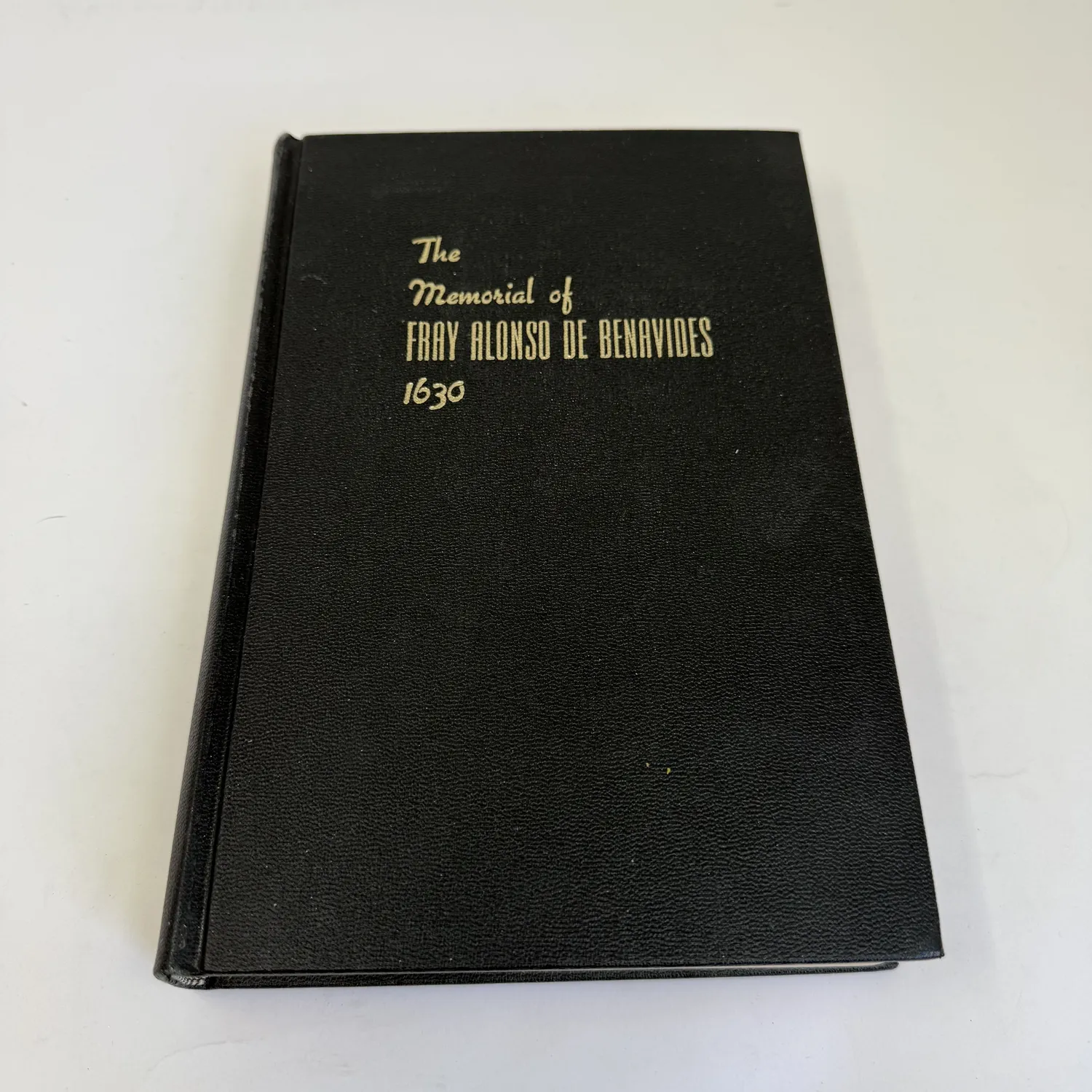
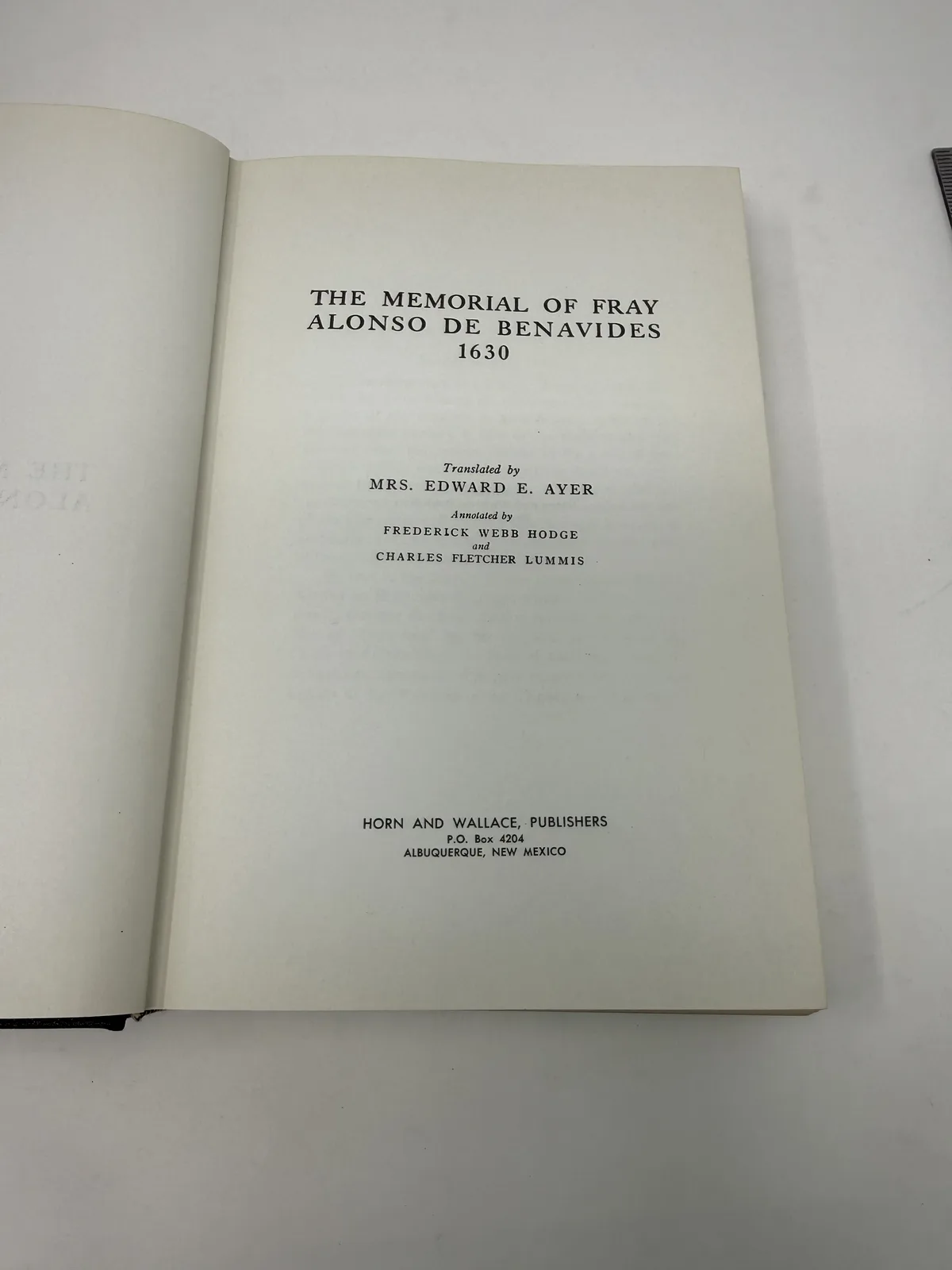
The founding document of that building program passes through here too. The copy below is the Horn and Wallace (Albuquerque, 1965) edition of The Memorial of Fray Alonso de Benavides 1630, Mrs. Edward E. Ayer’s translation annotated by Frederick Webb Hodge and Charles Fletcher Lummis — the edition most collectors actually find, reproducing the 1916 Chicago privately printed title page inside it:
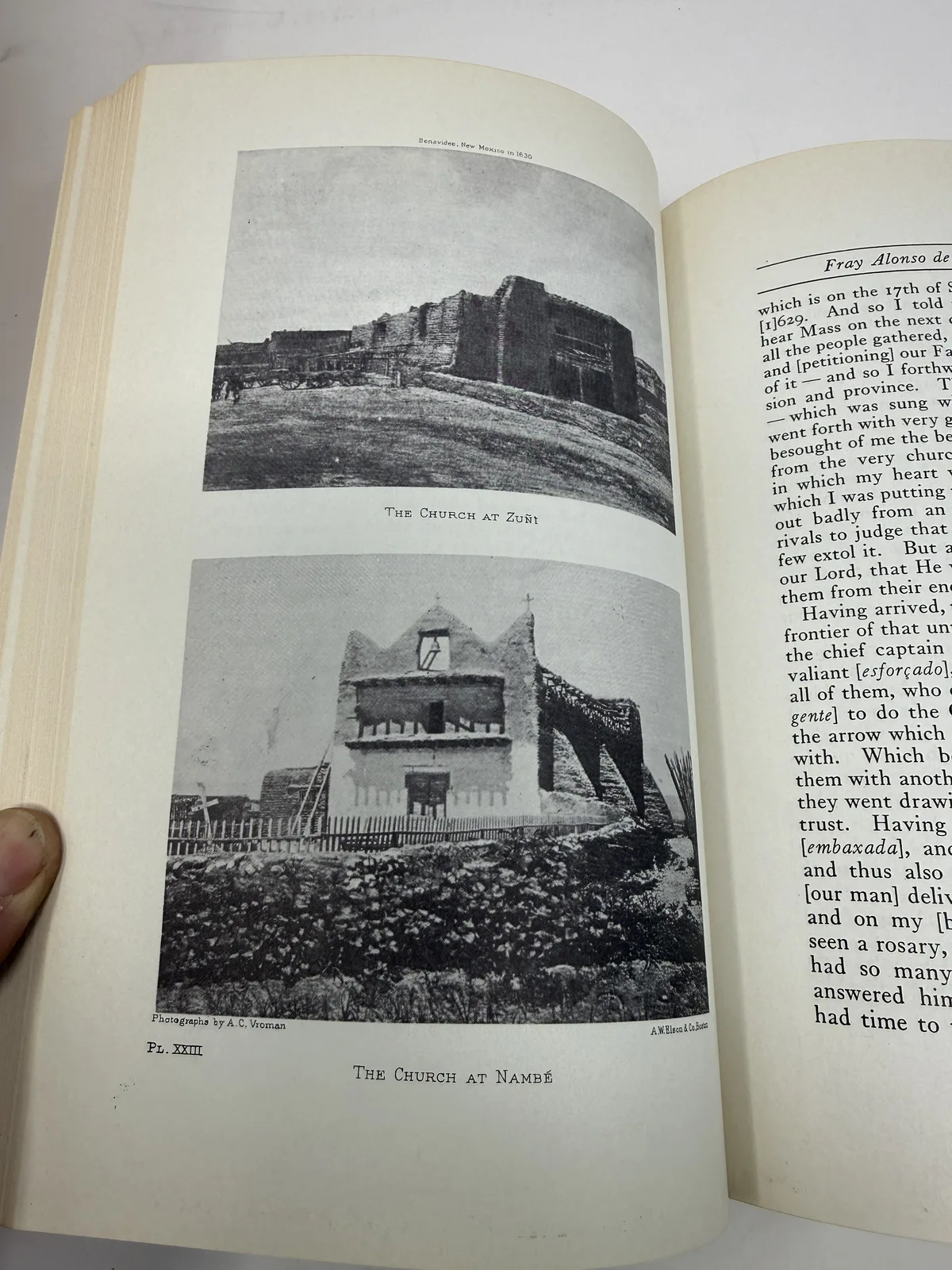
The seventeenth-century Franciscan building program was extraordinary in its ambition and often brutal in its execution. The churches were built by Indigenous labor organized through the repartimiento system (compulsory tribute labor), quarrying stone, preparing adobe, and cutting and hauling vigas (roof beams) from distant forests. The largest churches, San Esteban del Rey at Acoma and the Salinas missions, were construction projects on a scale that rivaled building programs in Mexico City. In his 1630 Memorial to King Philip IV, Fray Alonso de Benavides claimed that the friars had built more than fifty churches and friaries and baptized more than eighty thousand people, figures written to win royal support.
The primary source for the early mission system is Benavides’s Memorial itself, published in Madrid in 1630 and translated and edited multiple times for the scholarly literature. The best collecting editions are the 1916 Ayer translation annotated by Hodge and Lummis (privately printed in Chicago), its 1965 Horn & Wallace reprint (Albuquerque), and Peter P. Forrestal’s 1954 translation for the Academy of American Franciscan History. Any edition of the Benavides Memorial belongs in a serious NM mission library; the 1630 Madrid original surfaces only at specialist dealers and major auction.
The Pueblo Revolt of 1680 and its architectural legacy
The Pueblo Revolt of August 10, 1680 was the most consequential single event in New Mexico colonial history. Planned and coordinated by Po’pay (Popé), a Tewa religious leader from Ohkay Owingeh (San Juan Pueblo) who had been publicly flogged by Spanish authorities in 1675 for practicing traditional Pueblo ceremonies, the revolt was coordinated across most of the Pueblo villages of New Mexico in remarkable secrecy. The coordination was managed through a system of knotted cords distributed from Taos Pueblo, each knot representing one day remaining before the agreed date. When the date was moved up after Spanish authorities detected preliminary warning signs, the simultaneous uprising killed approximately 400 colonists and 21 of the 33 Franciscan missionaries in the province. Governor Antonio de Otermín and approximately 2,000 survivors retreated south to El Paso del Norte.
The architectural consequences of the Revolt were decisive. Every mission church in the province was either destroyed or desecrated — burned, stripped of furnishings, deliberately defiled as a repudiation of the religious coercion the church buildings represented. The Revolt produced an abrupt caesura in the mission architectural record: the buildings that survive today are almost all post-Reconquista reconstructions, built after Don Diego de Vargas’s 1692–1694 reconquest on the footprints of the pre-Revolt originals, often with different materials, modified plans, and a chastened Franciscan presence that no longer commanded the same compulsory labor resources.
The impact of the Revolt on the architecture is central to Kubler’s 1940 analysis and to every subsequent study. A collector who does not own a serious account of the Revolt — Andrew Knaut’s The Pueblo Revolt of 1680: Conquest and Resistance in Seventeenth-Century New Mexico (University of Oklahoma Press, 1995) is the standard recent account; David Weber’s What Caused the Pueblo Revolt of 1680? (Bedford/St. Martin’s, 1999) provides the primary source documents — lacks the historical context to properly read the architectural literature.
Found old books in an estate or attic? Text me a photo at 505-250-3804 and I'll set up a free pickup, scheduled by route, or you can bring them to the 24/7 drop box.
The Reconquista and the post-1692 building tradition
Don Diego de Vargas’s Reconquista, completed across 1692–1694 after an initial ceremonial re-entry in 1692 followed by a military campaign in 1693–1694, reestablished Spanish colonial control over the Pueblo villages. The post-Revolt settlement involved significant modifications to the colonial relationship: compulsory labor demands were reduced, the most aggressive Franciscan suppression of traditional ceremonies was moderated, and Indigenous communities retained somewhat greater autonomy within the colonial structure. The mission-church rebuilding program that followed reflected these changed conditions.
The post-Reconquista churches are generally smaller and more compact than the grandest pre-Revolt structures, with lower ceilings, thicker adobe walls (where stone was not locally available), and simpler detailing. San Miguel Chapel in Santa Fe, rebuilt on its pre-1680 footprint after the Revolt, was substantially reconstructed in 1710 under the direction of Agustín Flores Vergara, during the governorship of the Marqués de la Peñuela. The church at Las Trampas (San José de Gracia, 1760 to 1776) and the Ranchos de Taos church (San Francisco de Asís, about 1772 to 1816) represent the eighteenth-century Hispano colonial tradition at its most architecturally confident: large-scale adobe construction with sophisticated wall massing, twin bell towers, and interior programs that include painted reredos (altar screens) and bulto sculpture.
Fray Francisco Atanasio Domínguez’s 1776 visitation caught this tradition close to its mature peak. His descriptions, translated and edited by Eleanor B. Adams and Fray Angélico Chávez as The Missions of New Mexico, 1776 (UNM Press 1956), provide a baseline inventory of every church in the province at a single date, an incomparable resource for architectural historians tracking the next two centuries of modification, renovation, and occasional abandonment.
On the Sorting Desk: Adams and Chávez, The Missions of New Mexico, 1776 (1956)
This copy of the 1956 University of New Mexico Press edition came through NMLP intake in October 2026, in its dust jacket. The frontispiece and Horace T. Pierce’s drawings show the churches Domínguez inventoried. Its edition points are on my first-edition page for The Missions of New Mexico, 1776.
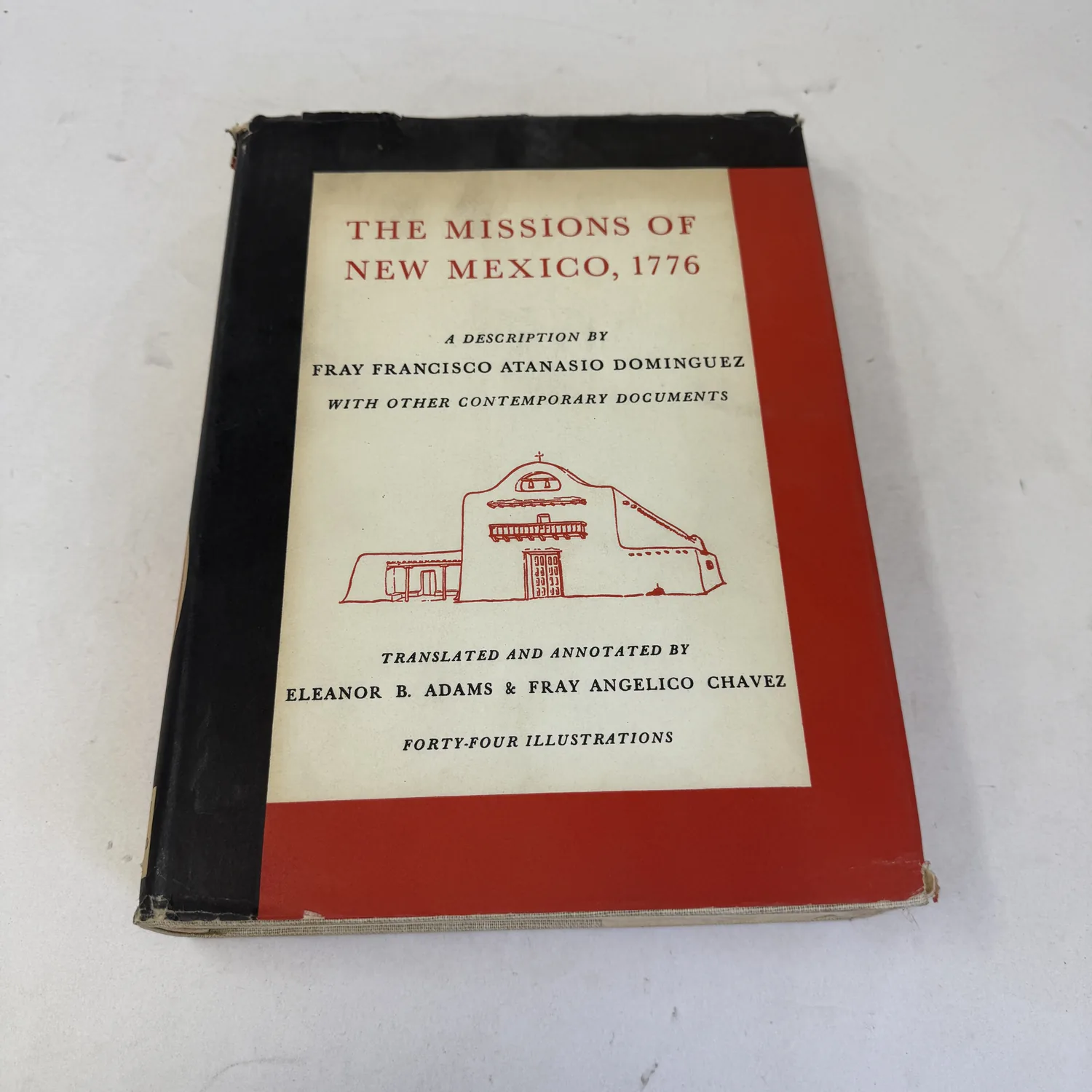
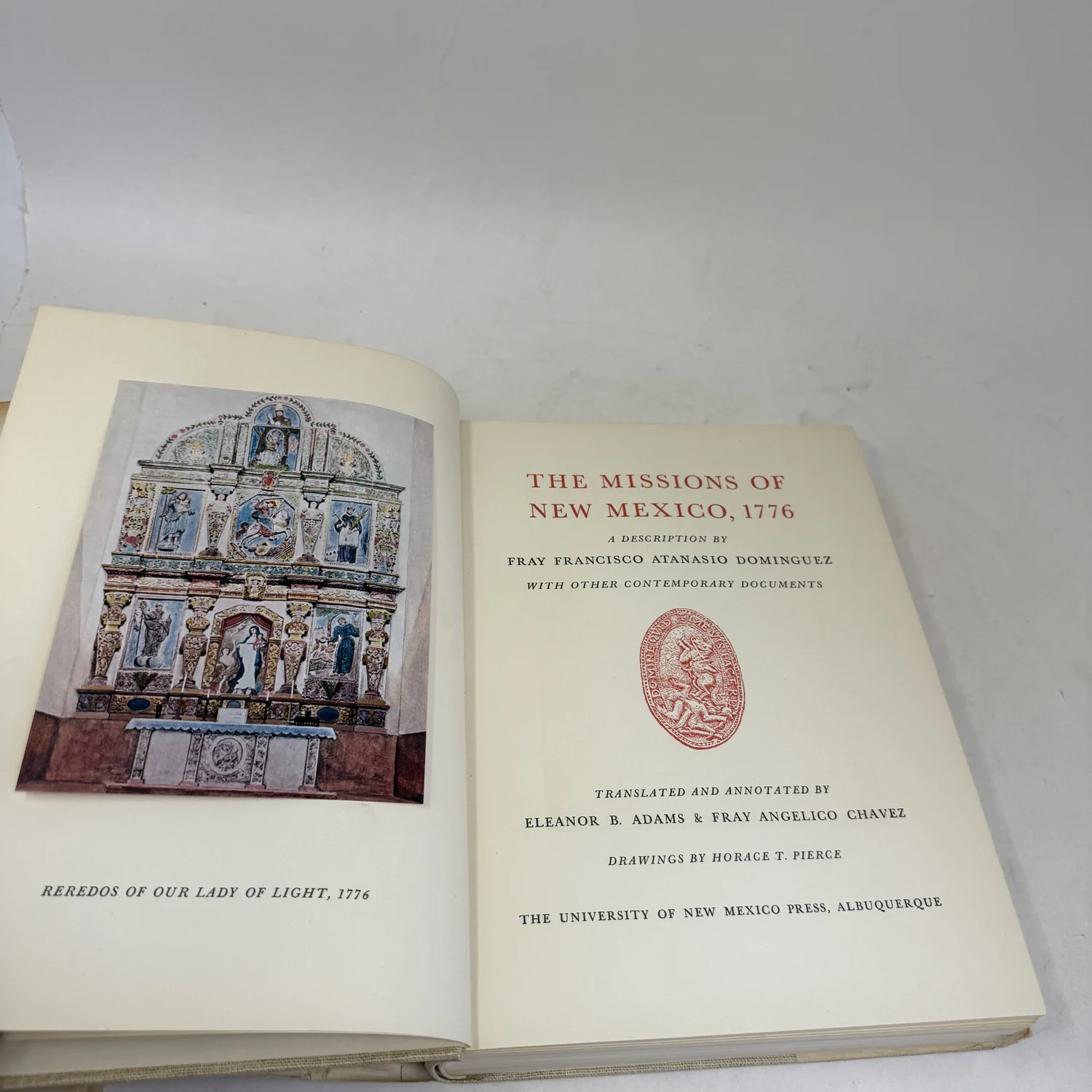
Photos: Josh Eldred, October 2026. Original desk photography at the New Mexico Literacy Project, Albuquerque, NM.
The canonical churches
San Miguel Mission, Santa Fe
Built around 1610 in the Barrio de Analco on the south side of the Santa Fe River, an area home to Tlaxcalans and other Native people who had come north with the Spanish settlers; first mentioned in writing in 1628, damaged in 1640 and again in the 1680 Revolt, and rebuilt in 1710. Often called the oldest church building in the continental United States, though the 1710 rebuilding substantially replaced the earlier structure. The wooden reredos, with a statue of Saint Michael dating to at least 1709, was added in 1798. The Archdiocese of Santa Fe sold the little-used building in 1881 to the Christian Brothers, who ran the adjacent St. Michael’s College, and Mass is still said there on occasion. National Historic Landmark. Kubler documents its construction history in the 1940 text; Treib covers it in the 1993 survey.
San Esteban del Rey Mission, Acoma Sky City
Built between 1629 and 1641 under the direction of Fray Juan Ramírez on the summit of the Acoma mesa, roughly 365 feet above the valley, with the forced labor of the Acoma people. Every load of earth, stone, and straw had to be hauled up the mesa trails, including the soil for the walled campo santo (cemetery), and the vigas were brought some 40 miles from Mount Taylor, carried without touching the ground according to Acoma tradition. Considered one of the greatest achievements of Spanish colonial architecture in North America. National Historic Landmark (1970). Isaac Hamilton Rapp drew on this church, along with the missions at San Felipe, Cochiti, Laguna, Santa Ana, and Pecos, for the 1917 Museum of Fine Arts in Santa Fe, the building that set Santa Fe’s Pueblo Revival in motion. Every major study of NM mission architecture treats it at length.
San José de Gracia, Las Trampas
Built between 1760 and 1776 by the settlers of the Las Trampas land grant, a village founded in 1751 by twelve Spanish families on what is now the High Road between Santa Fe and Taos. Often described as one of the least-altered Spanish colonial churches in New Mexico: the twin bell towers, the carved wooden corbels and vigas, the painted interior, and adobe walls rising 34 feet survive in largely original condition. National Historic Landmark (1970). Meem’s Society for the Preservation of New Mexico Mission Churches replaced the roof in 1932, and in the 1960s, when a state highway project on NM 76 threatened the church, a coalition of villagers and Santa Fe citizens, the architect Nathaniel Owings among them, saved it. Its santos and painted altar screens tie it to the santero and folk art literature.
San Francisco de Asís, Ranchos de Taos
Built between about 1772 and 1816, the parish church of the agricultural village of Ranchos de Taos, south of Taos. The rear apse, two massive curved adobe buttresses flanking the sanctuary, creates a sculptural mass of extraordinary power from the east elevation. Georgia O’Keeffe painted it beginning in 1929, her first summer in Taos, and Ansel Adams, Paul Strand, and Ned Scott photographed it; virtually every significant photographer working in the Southwest has followed. The parish hall keeps Henri Ault’s painting The Shadow of the Cross, known locally as the Mystery Painting, which seems to glow in the dark and once hung in the church. National Historic Landmark (1970).
El Santuario de Chimayó
Completed by 1816 on land owned by Bernardo Abeyta, who had built a small chapel to the Christ of Esquipulas on the site around 1810, in the Chimayó valley north of Santa Fe. The santuario houses the pocito, a small room with a round pit from which devotees take tierra bendita (holy dirt) believed to have healing powers. It receives almost 300,000 visitors a year, tens of thousands of them pilgrims who walk there during Holy Week, and it has been called the most important Catholic pilgrimage center in the United States. In 1929 members of the Spanish Colonial Arts Society bought the property and gave it to the Archdiocese of Santa Fe. National Historic Landmark. The literature specific to Chimayó includes Elizabeth Kay’s Chimayó Valley Traditions (Ancient City Press 1987).
Salinas Pueblo Missions: Quarai, Abó, Gran Quivira
Three units of Salinas Pueblo Missions National Monument in the Estancia Basin of central New Mexico, where Tiwa- and Tompiro-speaking Pueblo communities once traded with peoples across the region. Quarai (Nuestra Señora de la Purísima Concepción, completed 1632): red sandstone ruins in outstanding preservation, the church walls three to six feet thick and probably once about 40 feet high. Abó (San Gregorio de Abó, established in the 1620s). Gran Quivira, or Las Humanas (San Isidro, completed 1635, and San Buenaventura, begun about 1659 and never finished), serving a Tompiro-speaking pueblo abandoned in 1672. The whole Salinas district was empty of both Pueblo and Spanish residents by the late 1670s, before the 1680 Revolt, after drought, famine, Apache raids, and Spanish labor demands. Gran Quivira became a national monument in 1909, and the NPS now manages the three sites together and has produced documentation including HABS measured drawings and James E. Ivey’s architectural history of the missions.
Ready to clear the shelves? Call or text me at 505-250-3804 — free pickup across the Albuquerque metro, scheduled by route, or use the 24/7 drop box.
The canonical figures
George Kubler
1912–1996 · Yale University art historian · Closed signature pool
The foundational scholar. Born in Hollywood, California, and educated largely in Europe as a boy, Kubler earned his BA, MA, and PhD at Yale, finishing the doctorate in 1940, the same year his Religious Architecture of New Mexico was published by the Taylor Museum in Colorado Springs. The book was his doctoral dissertation revised for publication, and it remains the systematic analysis of the NM mission-church tradition that later studies start from. Kubler taught at Yale from 1938 and became one of the twentieth century’s most influential art historians through later work including The Shape of Time: Remarks on the History of Things (Yale University Press, 1962) and The Art and Architecture of Ancient America (1962). He returned to the NM material for the 1972 UNM Press reissue, which added a brief updating preface. Kubler is a closed pool (d. 1996); his signature is uncommon in the trade, and a 1940 Taylor Museum first signed by him would likely draw four-figure interest.
Fray Angélico Chávez
1910–1996 · Franciscan friar, poet, painter, and historian · Closed signature pool
Born Manuel Chávez in Wagon Mound NM in 1910; entered the Franciscan Order as a young man and took the name Angélico. Spent most of his priestly career in New Mexico parishes while doing deep archival work in the colonial church records, which he catalogued in Archives of the Archdiocese of Santa Fe, 1678-1900 (Academy of American Franciscan History, 1957). His Our Lady of the Conquest (Historical Society of New Mexico, 1948) traces the history of La Conquistadora, the small Madonna that Fray Alonso de Benavides brought to Santa Fe in 1625 (Benavides’s own account dates her arrival to January 1626), that the Spanish carried south in the retreat of 1680, and that Vargas brought back in 1693. His co-translation with Eleanor B. Adams of the Domínguez 1776 visitation (The Missions of New Mexico, 1776, UNM Press 1956) is the foundational reference document for the entire field. My Penitente Land: Reflections on Spanish New Mexico (UNM Press 1974) is his most personal and literary work. Chávez is a closed pool (d. 1996); signed copies of his books turn up in New Mexico Catholic estate collections and command collector premiums.
Marc Treib
b. 1943 · UC Berkeley professor of architecture, retired
Treib’s Sanctuaries of Spanish New Mexico (University of California Press, 1993) is the most comprehensive recent study of the NM church tradition, documenting dozens of churches, grouped by region from Santa Fe to the Salinas group and the churches west of Albuquerque, with floor plans, photographs, and detailed historical narratives. Its scope is broader than Kubler’s 1940 study, which focused primarily on the colonial mission churches and their immediate successors, and it extends through the Hispano village church tradition of the north. The 1993 UC Press first edition in fine condition with original dust jacket is the collector target, and Treib’s book is the standard reference that scholars, architects, and serious visitors consult first. Treib is also the author of Space Calculated in Seconds: The Philips Pavilion and numerous studies of Japanese gardens; his Southwest work is a discrete part of a broader career.
John Kessell
b. 1938 · UNM historian of Spanish colonial New Mexico
The principal historian of the post-1692 mission and church tradition. Kessell’s The Missions of New Mexico Since 1776 (University of New Mexico Press, 1980, published for the state’s Cultural Properties Review Committee) uses the Domínguez 1776 visitation as its baseline and traces the history of each church into the late twentieth century, the essential complement to Treib’s architectural survey and Kubler’s foundational text. Kessell also led the Vargas Project at UNM, which translated and published the journals and correspondence of Don Diego de Vargas covering the reconquest era in six titles from UNM Press between 1989 and 2002, from Remote Beyond Compare to A Settling of Accounts, the most important primary-source publishing project in NM colonial history.
Fray Francisco Atanasio Domínguez
About 1740 to about 1805 · Franciscan friar and missionary inspector
Not a collector figure himself, but the author of the foundational primary source. Born in Mexico City about 1740, Domínguez was sent by his Franciscan superiors in New Spain to inspect New Mexico’s missions and arrived in Santa Fe on March 22, 1776. His report, covering every church and visita in the province with dimensions, construction notes, inventories of furnishings, and assessments of clergy and congregations, is the most detailed single-date snapshot of the NM church system that exists. The Adams and Chávez translation (The Missions of New Mexico, 1776, UNM Press 1956, reissued 1975) is the collecting edition; the 1956 first edition in fine condition is a meaningful tier-2 collector target.
Thomas Drain
Author, photographer
A Sense of Mission: Historic Churches of the Southwest (Chronicle Books, San Francisco, 1994) is the most widely distributed photographic survey of Southwest mission churches, covering New Mexico alongside Arizona, Texas, and California. The photography by David Wakely is distinguished; the text situates each building in its historical context. The 1994 Chronicle Books first edition in fine condition is the collector target; the book had wide retail distribution and is common in estate libraries from the Southwest arts-and-architecture demographic. At the tier-2 range it is affordable for the completeness-minded collector.
Fray Alonso de Benavides
1578–c.1635 · Franciscan custos of New Mexico 1626–1629
Author of the Memorial of 1630 presented to King Philip IV of Spain, the first comprehensive account of the New Mexico mission program, its churches, its Indigenous converts, and its Franciscan missionaries. Benavides was lobbying for more royal support, so the document is partly promotional, but it is also the best primary-source survey of the early mission system. The principal English-language collecting editions are the 1916 translation by Mrs. Edward E. Ayer, annotated by Frederick Webb Hodge and Charles Fletcher Lummis and privately printed in Chicago; its 1965 Horn & Wallace reprint (Albuquerque); and Peter P. Forrestal’s translation, Benavides’ Memorial of 1630 (Academy of American Franciscan History, 1954). Any Benavides Memorial edition belongs in a serious NM mission library.
From My Workspace
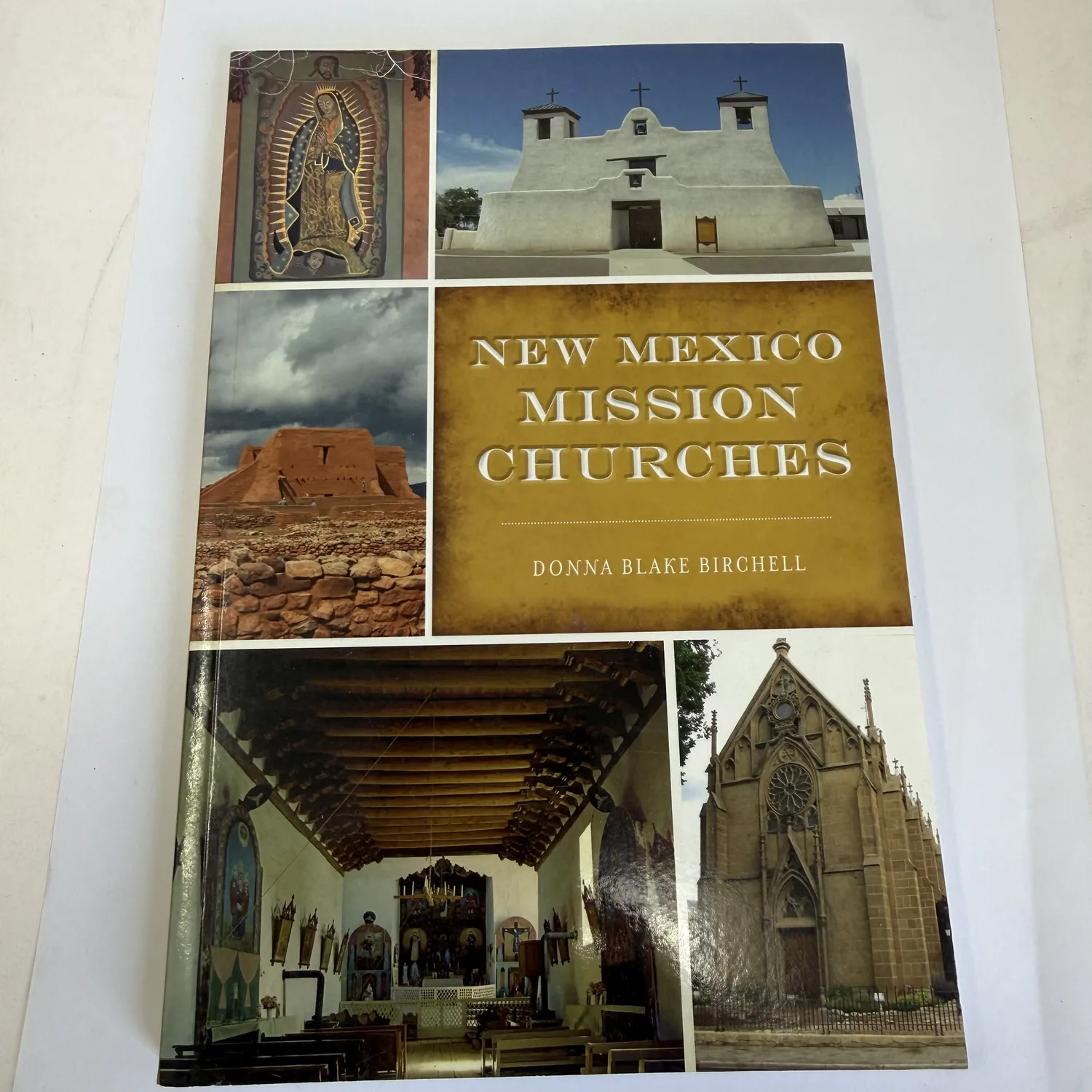
New Mexico Mission Churches — Donna Blake Birchell (2021)
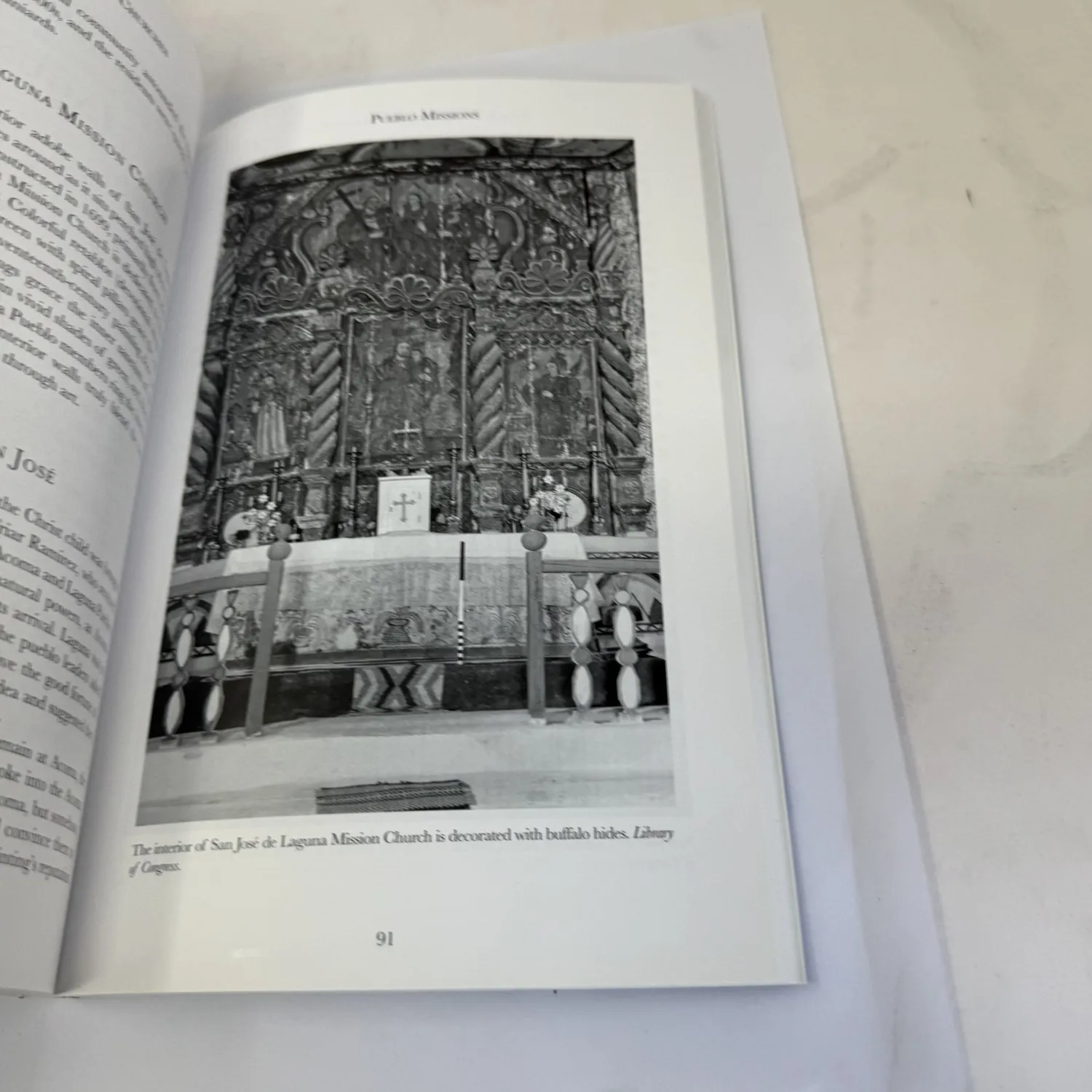
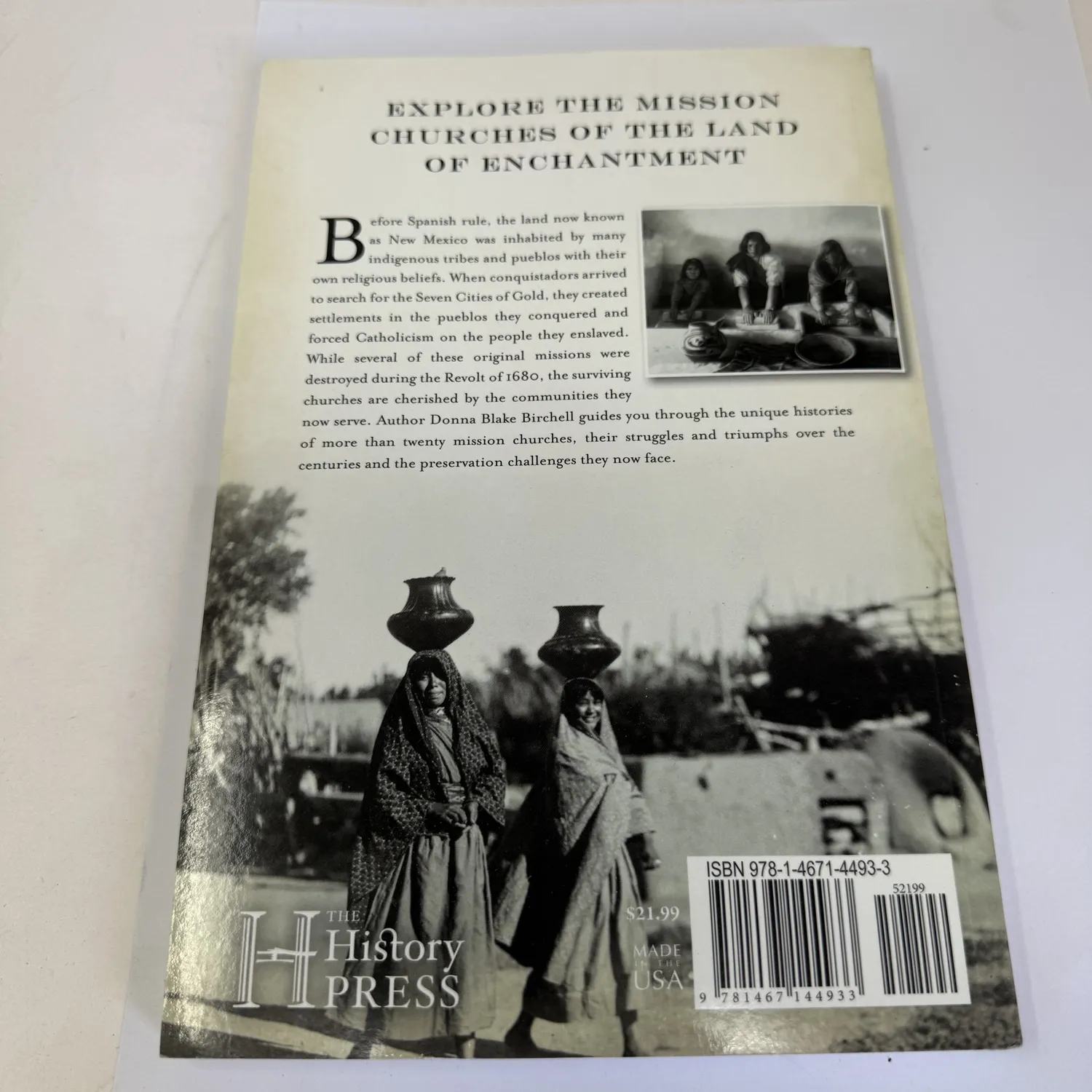
I photographed this copy at my workspace in Albuquerque. Birchell’s New Mexico Mission Churches (The History Press, 2021, ISBN 978-1-4671-4493-3) is a concise field guide to more than twenty NM mission churches — from the Pueblo Revolt of 1680 through the preservation challenges the surviving churches face today. The cover collage shows the range: Our Lady of Guadalupe, a white adobe Pueblo mission, Pecos Pueblo ruins, Loretto Chapel, and a mission interior with vigas and a carved reredos. The interior includes a Library of Congress photograph of the San José de Laguna Mission Church reredos decorated with buffalo hides — one of the most significant surviving colonial-era interior programs in the Southwest. This is the kind of accessible, well-researched title that brings the mission-church tradition to a general readership alongside the deeper scholarly canon covered below.
From My Workspace — Signed Copy
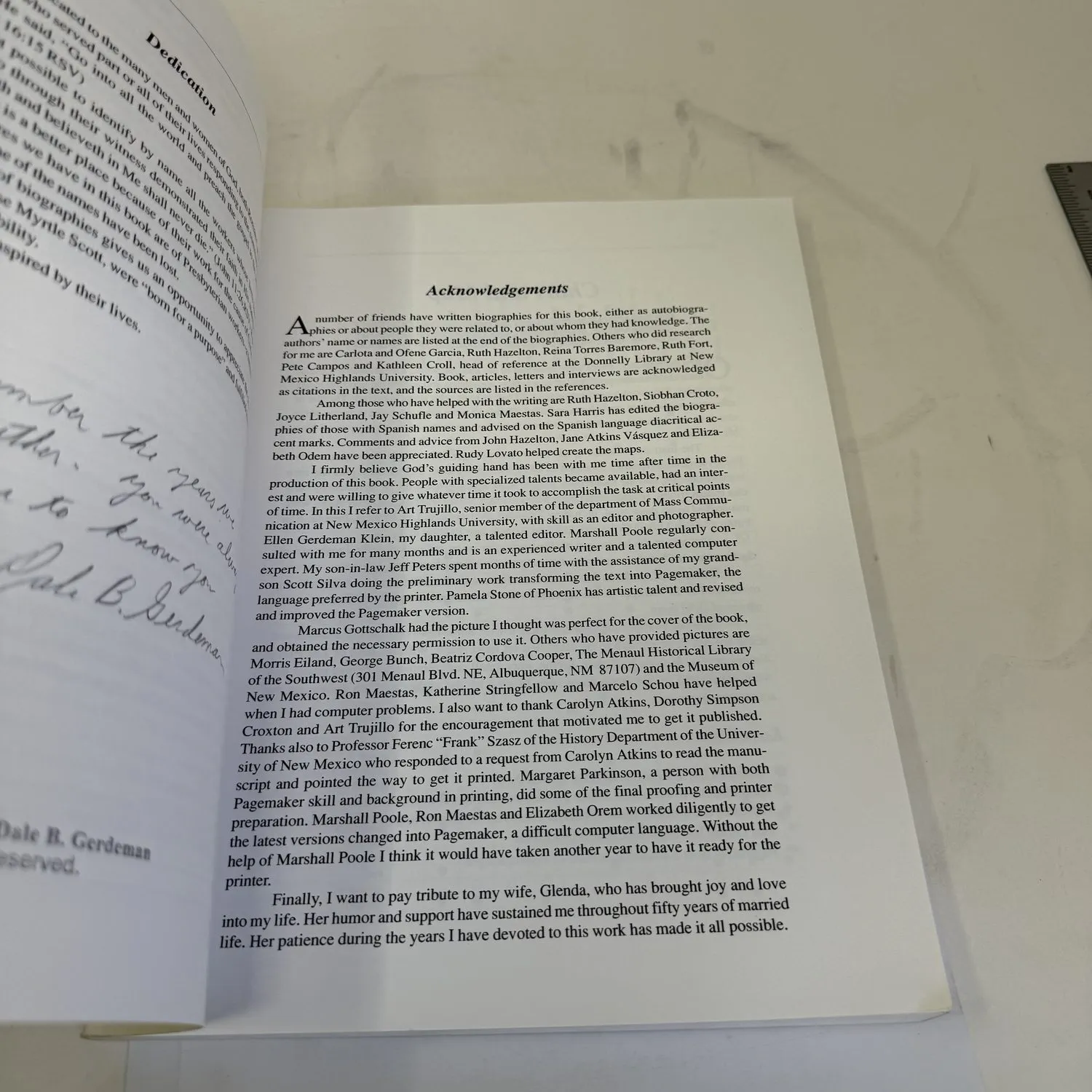
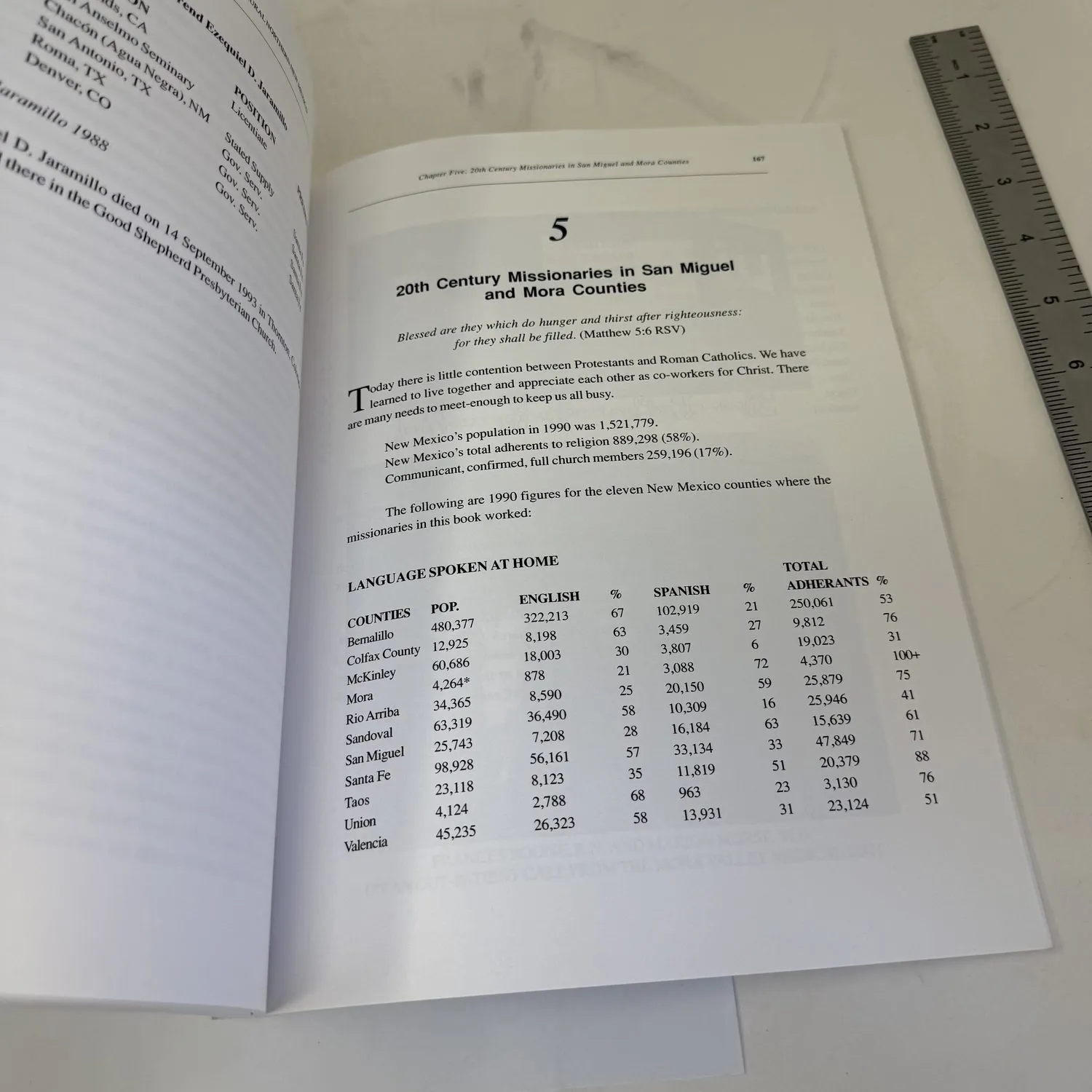
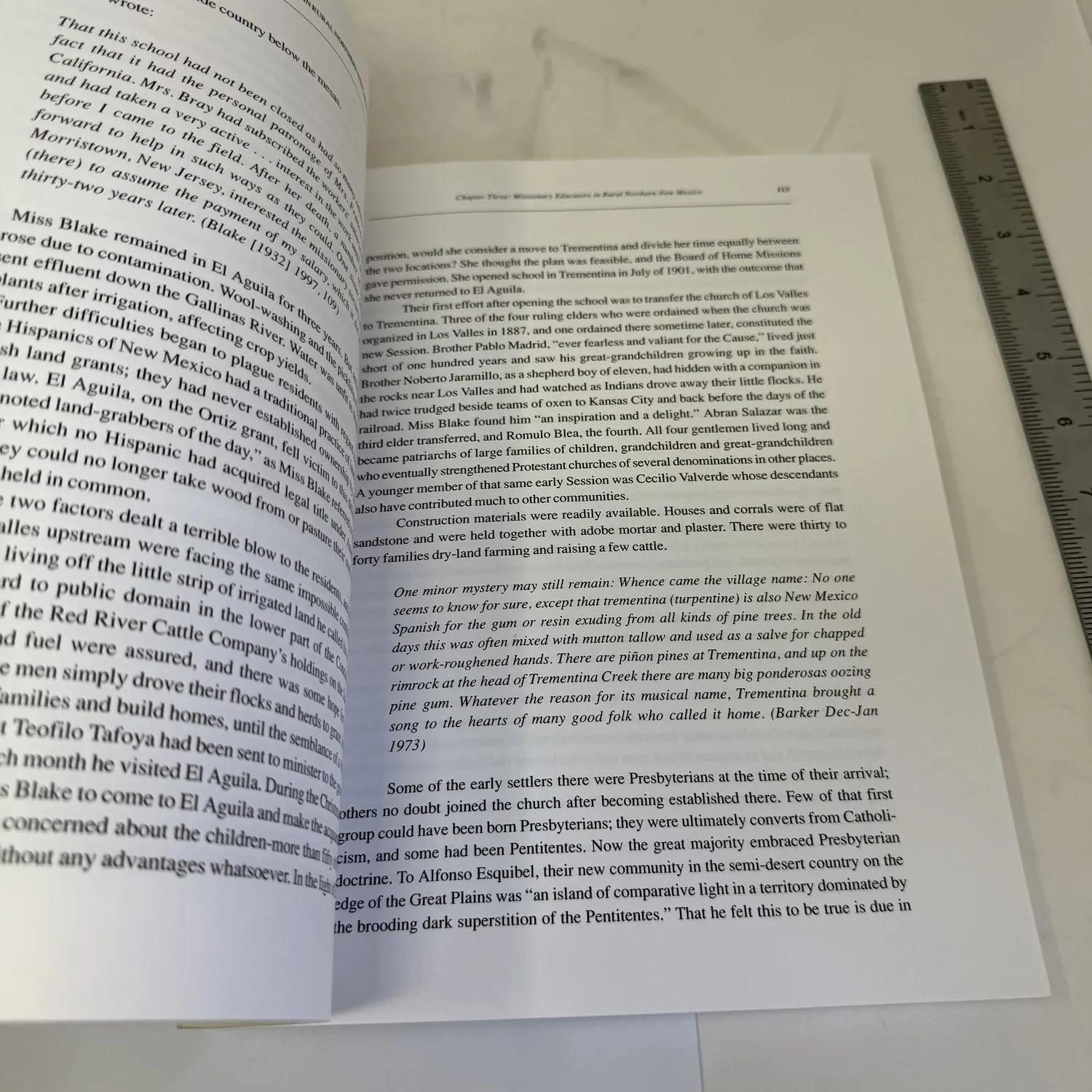
Presbyterian Missionaries in Rural Northern New Mexico — Dale B. Gerdeman (1999, Signed)
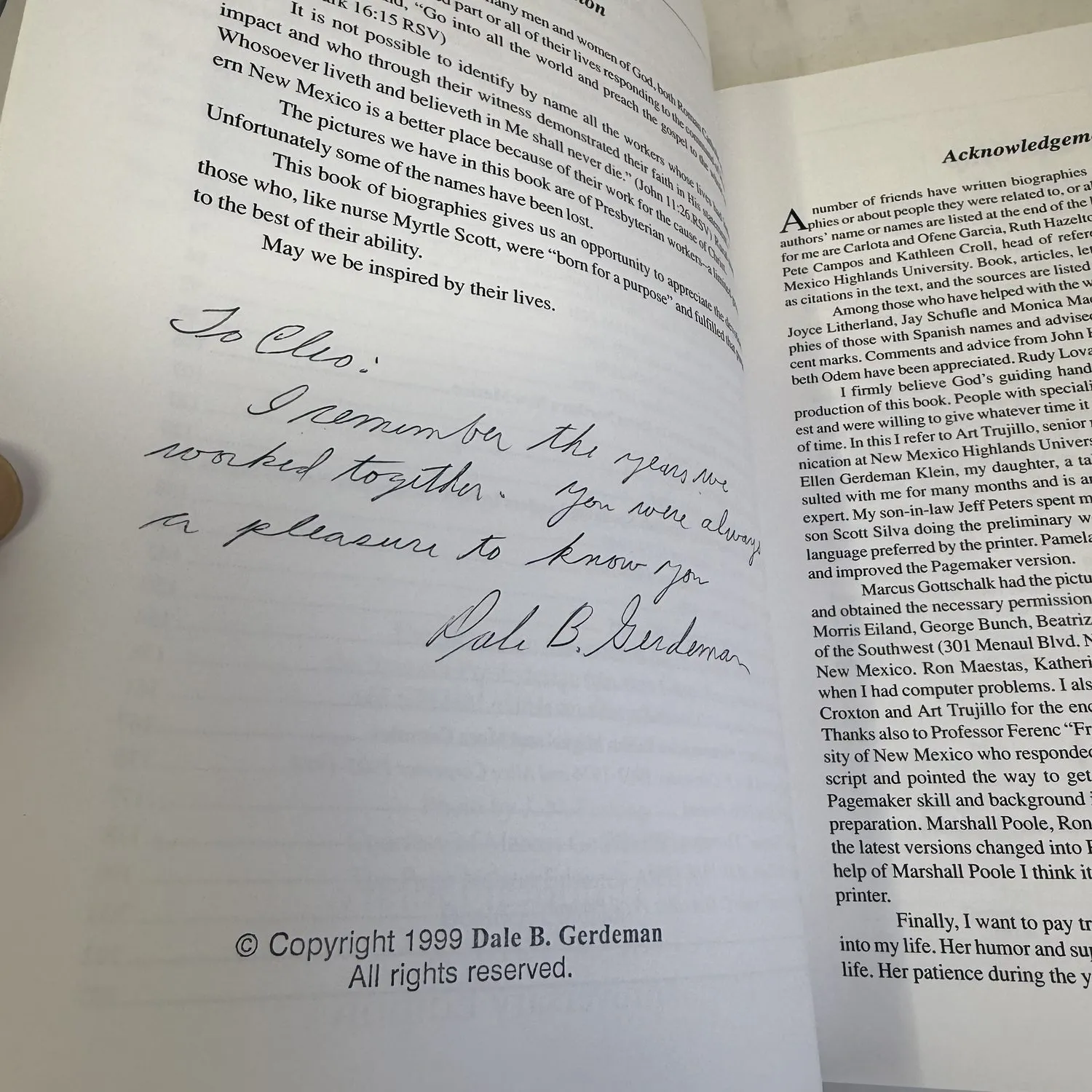
This signed copy came out of a northern New Mexico estate cleanout — the kind of library that accumulates over a lifetime in a community where the institutions documented in the book were part of the everyday landscape. The inscription reads: “To Cleo: I remember the years we worked together. You were always a pleasure to know you. Dale B. Gerdeman” — a personal dedication that tells you this copy traveled from the author directly to someone in his professional circle, probably within the Presbyterian mission community itself. That provenance chain is exactly what collectors look for.
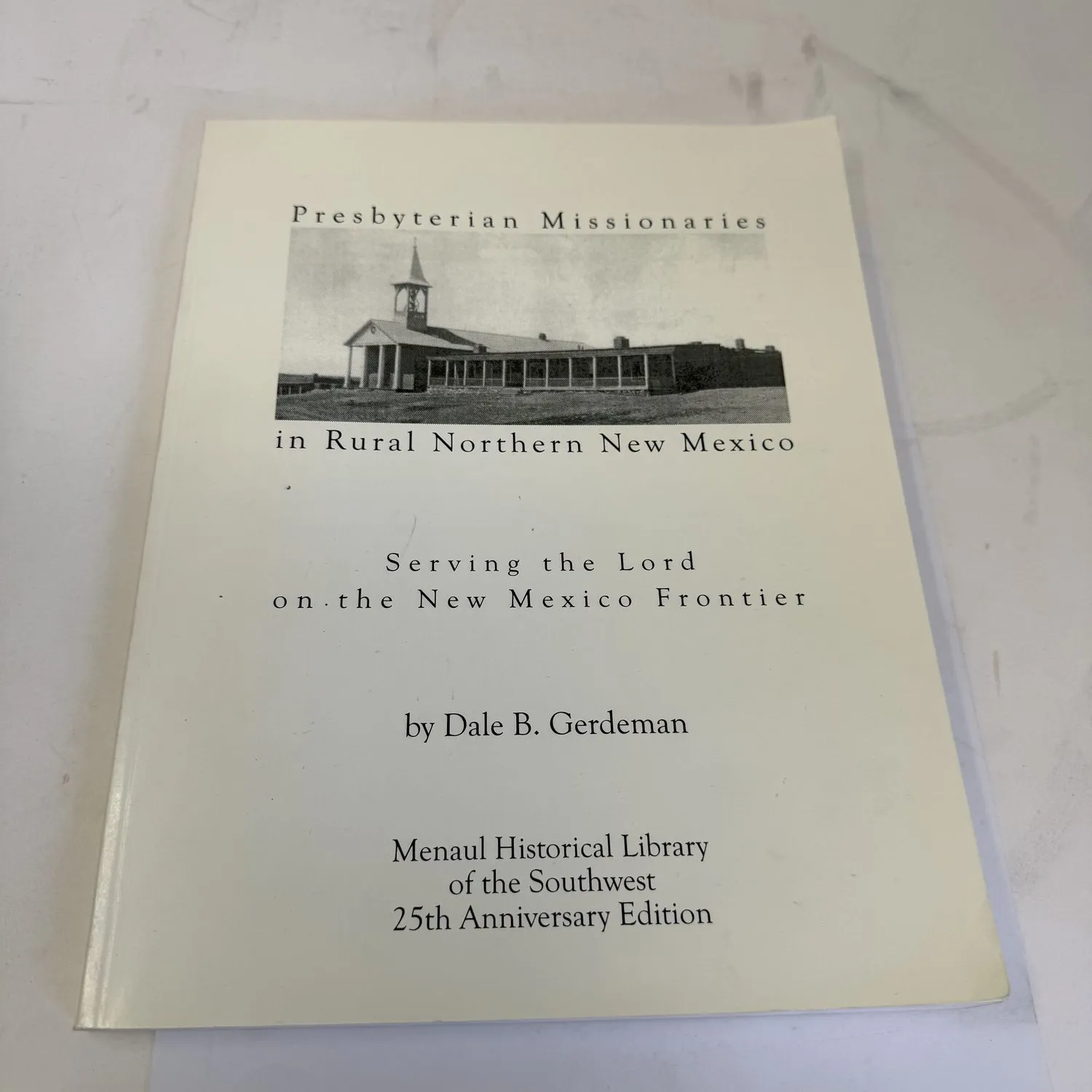
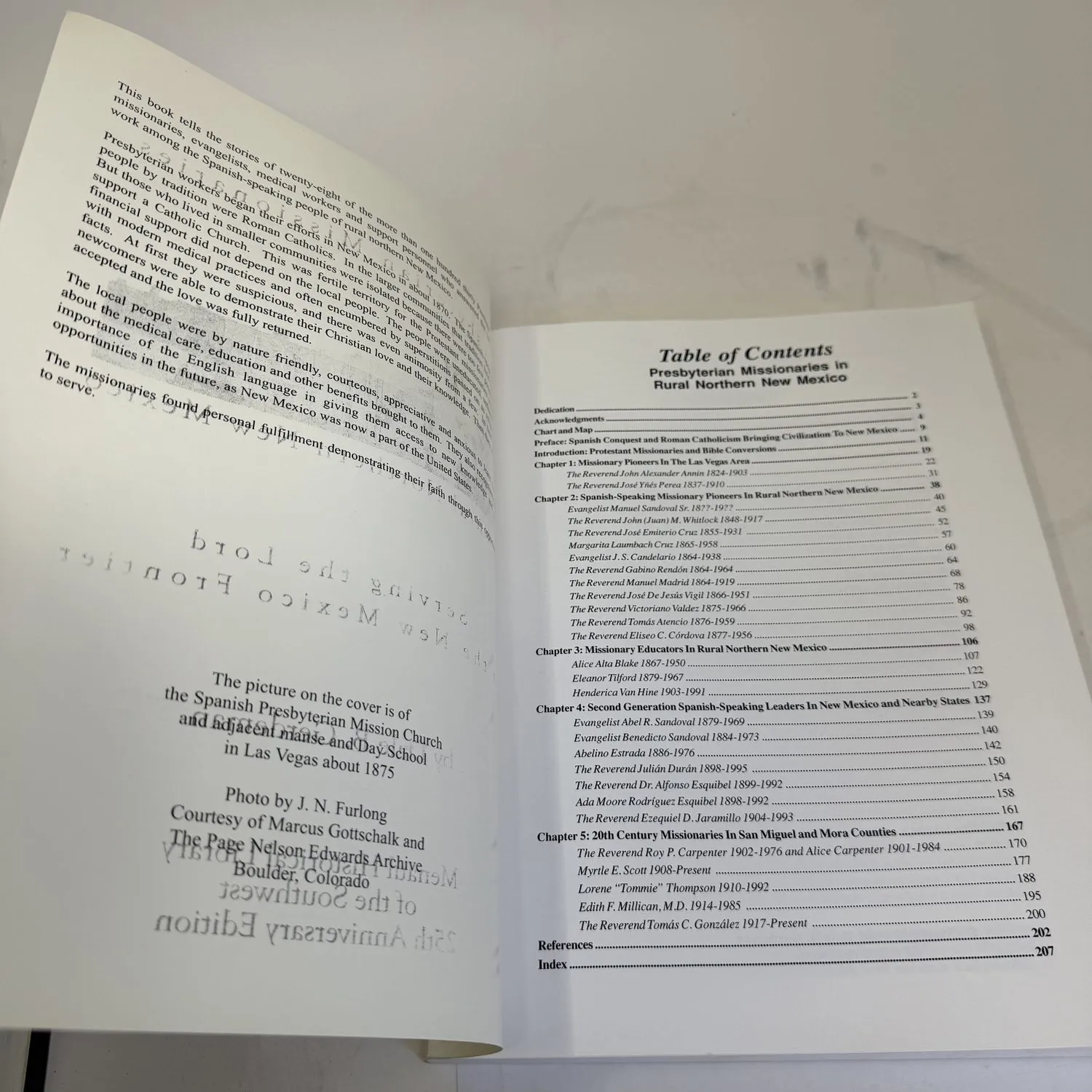
Gerdeman’s book covers the Presbyterian missionary program in San Miguel and Mora counties from the late nineteenth century through the twentieth — the missionary pioneers, Spanish-speaking leaders, educator-ministers, and the communities they served in Las Vegas, Trementina, and surrounding villages. Published by the Menaul Historical Library of the Southwest (301 Menaul Blvd NE, Albuquerque) as a 25th Anniversary Edition in 1999, this is a small-press institutional title with limited distribution. The front cover reproduces a remarkable 1875 J.N. Furlong photograph of the Spanish Presbyterian Mission Church and Day-School in Las Vegas, New Mexico — a historic image that documents the physical intersection of the Anglo Protestant missionary movement and the Hispano Catholic built landscape.
The book includes 1990 county-level demographic data for eleven New Mexico counties (Bernalillo, Colfax, McKinley, Mora, Rio Arriba, Sandoval, San Miguel, Santa Fe, Taos, Union, Valencia) showing population, English and Spanish language splits, and religious adherence — the quantitative context for understanding where the Presbyterian missionary program operated and who it served. The acknowledgments page connects the work to NM Highlands University, the Museum of New Mexico, and the Menaul Library’s own archive. For collectors building a comprehensive New Mexico religious history library, this is the Protestant counterpart to the Franciscan Catholic mission literature that dominates the field.
The canonical books — edition-by-edition
George Kubler, The Religious Architecture of New Mexico (1940 and 1972)
The 1940 Taylor Museum first edition is the definitive trophy. Published by the Taylor Museum for Southwestern Studies at the Colorado Springs Fine Arts Center — a regional cultural institution, not a major university press — in a limited institutional print run, the book was not widely distributed and genuine fine-condition copies with original dust jacket are scarce. The dust jacket itself is a distinctive item; the 1940 jacket design identifies the Taylor Museum imprint unambiguously, and the presence or absence of the original jacket is the single most important condition-grading factor for this book. A first edition with original jacket in fine condition trades in the mid to upper three-figure range; a jacketed copy with modest wear trades lower; an unjacketed copy trades as a working scholarly library item at a fraction of the jacketed price.
The 1972 University of New Mexico Press reissue with Kubler’s updating preface brought the scholarship to a mass academic audience and is the edition that populated every university library specializing in Southwest studies. The 1972 UNM reissue in fine condition with its original dust jacket trades as a solid tier-2 item; in good reading condition without jacket it is a common working-library book. Between the two came a 1962 Rio Grande Press reprint, which collectors should not mistake for the 1940 first.
Marc Treib, Sanctuaries of Spanish New Mexico (1993)
The 1993 University of California Press first edition is both the collecting target and the current working reference. Treib’s scope is broader than Kubler’s: he documents dozens of churches, including not only the major mission-era foundations but also the eighteenth-century Hispano colonial parish churches (Las Trampas, Ranchos de Taos, Chimayó) and the smaller northern-village adobe churches that form the lived religious landscape of New Mexico’s Hispano communities. The floor plans and measured drawings that accompany each entry are exceptional. The 1993 UC Press first edition in fine condition with original dust jacket is the standard collector target; the book remains in print and subsequent printings are common in estate libraries.
John Kessell, The Missions of New Mexico Since 1776 (1980)
The 1980 UNM Press first edition is the essential historical complement to both Kubler and Treib. Kessell organized the material around the Domínguez visitation baseline — taking each church as Domínguez described it in 1776 and tracing its subsequent history through the late twentieth century. The documentary apparatus (footnotes, primary-source citations, archival references) is comprehensive. The book grew directly from Kessell’s earlier archival research for his NM church documentation work and from his involvement with the UNM-based Franciscan history projects. The 1980 UNM Press first in fine condition with original dust jacket is the collector target.
Fray Angélico Chávez: Our Lady of the Conquest and the Franciscan NM canon
Our Lady of the Conquest (Historical Society of New Mexico, Santa Fe, 1948) traces La Conquistadora, the small Madonna that Fray Alonso de Benavides brought to Santa Fe in 1625, that the Spanish carried south in the retreat of 1680, and that Vargas brought back in 1693, through the reconquest and into the mid-twentieth century; the annual procession in her honor is called the oldest Marian festival in the United States. The 1948 first edition in fine condition is a meaningful rare-book item: the Historical Society of New Mexico was a small Santa Fe institutional publisher, not a mass distributor, and genuinely fine copies are uncommon. Sunstone Press reissued the book in 2009.
Chávez’s co-translation with Eleanor B. Adams, The Missions of New Mexico, 1776 (UNM Press 1956, reissued 1975), is the essential working primary-source document. The 1956 UNM Press first edition in fine condition with original dust jacket is the collector target; the 1975 reissue is the most widely circulated academic reference. My Penitente Land: Reflections on Spanish New Mexico (UNM Press 1974) is Chávez’s most personal synthesis of New Mexico Hispano Catholic history, blending scholarship with his own deep connection to the landscape and tradition. Archives of the Archdiocese of Santa Fe, 1678-1900 (Academy of American Franciscan History 1957) is the indispensable guide to the primary-source archive that underlies all NM Catholic history scholarship.
Las Trampas and the santero crossover
The Las Trampas church (San José de Gracia) is where the mission-architecture shelf meets the santero shelf. For the building itself, the National Park Service’s San José de Gracia Church, Las Trampas, New Mexico (Preservation Assistance Division, Landmarks at Risk series, 1986) documents the church and its conservation. For the religious art inside it and churches like it, the essential books include Thomas J. Steele, S.J.’s Santos and Saints (Calvin Horn, 1974; revised by Ancient City Press, 1982), his Religious Architecture in Hispano New Mexico with Thomas L. Lucero (LPD Press, 2005), and Robin Farwell Gavin’s Traditional Arts of Spanish New Mexico (Museum of New Mexico Press, 1994). Together they bridge the architectural survey literature and the folk-art literature.
Thomas Drain, A Sense of Mission (1994)
Thomas Drain and David Wakely’s A Sense of Mission: Historic Churches of the Southwest (Chronicle Books, 1994) is the most accessible photographic survey of the region’s church tradition, reaching a general audience that the more scholarly Treib and Kubler volumes do not. The color photography is excellent; the book covers the major NM churches (Ranchos de Taos, Las Trampas, Acoma, Chimayó, San Miguel) alongside the California, Arizona, and Texas mission traditions. The 1994 Chronicle Books first edition is the collector target; the book had wide retail distribution through Chronicle’s San Francisco-based national network and is frequently encountered in estate libraries from the Southwest arts-and-travel demographic.
The photography crossover books
The Ranchos de Taos church creates a major crossover between the mission-architecture collecting field and the photography and modernist-painting collecting fields. Any collector of New Mexico mission books will encounter — and should consider acquiring — the major O’Keeffe and Adams publications that include the Ranchos church as central subject matter.
For O’Keeffe: the catalog of the National Gallery of Art’s 1987 centennial exhibition, Georgia O’Keeffe: Art and Letters, and Barbara Buhler Lynes’s Georgia O’Keeffe: Catalogue Raisonné (Yale University Press with the National Gallery of Art and the Georgia O’Keeffe Foundation, 1999, two volumes), the comprehensive reference for her Ranchos church canvases. For Adams: Ansel Adams: New Light: Essays on His Legacy and Legend (The Friends of Photography, 1993) and the broader Adams retrospectives. Paul Strand’s 1931 photographs of the church appear in Paul Strand: Sixty Years of Photographs (Aperture, 1976). Laura Gilpin’s New Mexico work, in The Rio Grande: River of Destiny (Duell, Sloan and Pearce, 1949) and in Martha A. Sandweiss’s retrospective Laura Gilpin: An Enduring Grace (Amon Carter Museum, 1986), includes the Hispanic church tradition.
Have books you're ready to part with? I offer free pickup across Albuquerque — call 505-250-3804.
The HABS/HAER documentation and NPS scholarship
The Historic American Buildings Survey (HABS) produced systematic measured-drawing and photographic documentation of many New Mexico mission churches beginning in the New Deal era (1930s) and continuing through the postwar decades. The HABS documentation — detailed architectural drawings, black-and-white photographs, and written historical data forms — is now held by the Library of Congress Prints and Photographs Division and is freely available for download from the Library of Congress online collection. For the serious architectural historian or the collector building a comprehensive working library, HABS documentation is a primary research resource. Some HABS documentation was published in print form; these publications are collector items when they cover major NM churches.
The National Park Service has produced substantial published scholarship for Salinas Pueblo Missions National Monument. James E. Ivey’s In the Midst of a Loneliness: The Architectural History of the Salinas Missions (Southwest Cultural Resources Center Professional Papers no. 15, 1988) is the NPS architectural history of the three Salinas churches, and Gordon Vivian’s Excavations in a 17th-Century Jumano Pueblo: Gran Quivira (Archeological Research Series no. 8, 1961) is the classic excavation report. These NPS publications surface in estate libraries from New Mexico history and archaeology collectors and are working-library tier items; they provide context essential for reading the more scholarly mission-church literature.
The architectural restoration tradition: Meem, Owings, and the preservation context
The mission churches’ survival into the twenty-first century owes much to two converging forces: the Archdiocese of Santa Fe’s ongoing maintenance and the twentieth-century historic-preservation movement. John Gaw Meem (1894-1983), the principal figure of the Pueblo Revival movement documented in the companion NMLP pillar on Pueblo Revival Architecture Books, learned the old building methods as a volunteer with the Committee for the Preservation and Restoration of New Mexico Mission Churches in the 1920s and 1930s, working on restorations at Acoma (1924 to 1929), Santa Ana (1927), and Las Trampas (1931 to 1932). He then put those lessons to work in new buildings such as Cristo Rey Church in Santa Fe (1939 to 1940), and he treated the mission churches as the foundational precedents for his own Pueblo Revival work.
Nathaniel Owings (1903-1984), the Skidmore, Owings & Merrill co-founder, made his home in the Santa Fe area from 1944 and became an active preservationist there; his best-known New Mexico success was at Las Trampas. The New Mexico Historic Preservation Division (part of the NM Department of Cultural Affairs) maintains the state register that protects many of the churches covered in this literature, and the Archdiocese of Santa Fe administers the churches as active religious sites while managing their historic fabric.
The 1960s threat to San José de Gracia at Las Trampas, a state highway project on NM 76, mobilized the New Mexico preservation community, and a coalition of villagers and Santa Fe citizens saved the church from demolition. The campaign is a significant episode in the history of New Mexico historic preservation.
I pick up books for free anywhere in the metro area. Call 505-250-3804 to schedule.
The collector market — three tiers
Tier 1 trophy items. George Kubler’s Religious Architecture of New Mexico, 1940 Taylor Museum first edition in fine condition with original dust jacket, is the pinnacle of the modern scholarly literature: genuinely scarce, consistently sought, and the book every serious collector of NM mission literature wants. Mid to upper three figures in fine condition with jacket; substantially lower without. A copy signed by Kubler (uncommon) could reach four-figure territory. Fray Angélico Chávez’s Our Lady of the Conquest, 1948 Historical Society of New Mexico first edition in fine condition; Chávez signed copies of any title; the 1956 UNM Press first edition of the Adams and Chávez Domínguez translation in fine condition with original jacket. These trade in the upper two to mid three-figure range.
Tier 2 collector targets. Marc Treib Sanctuaries of Spanish New Mexico 1993 UC Press first in fine condition with original dust jacket; George Kubler 1972 UNM Press reissue in fine condition with original dust jacket; John Kessell Missions of New Mexico Since 1776 1980 UNM Press first in fine condition; Chávez My Penitente Land 1974 UNM Press first; Thomas Drain A Sense of Mission 1994 Chronicle Books first in fine condition; the 1975 reissue of the Adams-Chávez Domínguez translation in fine condition; the 1965 Horn & Wallace reprint of the Benavides Memorial and the 1954 Forrestal translation. Low to mid three-figure range.
Tier 3 working-library targets. Subsequent printings and softcover reissues of all the above; NPS Salinas Pueblo Missions handbooks and site publications; individual parish history booklets (Chimayó, Las Trampas, Ranchos de Taos); the New Mexico Historic Preservation Division National Register nomination documents for individual churches; HABS documentation booklets; academic monographs on individual NM churches published by UNM Press or SAR Press. Upper two-figure range for items in good to fine condition.
Condition does most of the sorting in this market. Many copies of the canonical books spent decades as working references on architects’, historians’, and parish shelves, so clean jacketed firsts carry the premium while worn copies trade as reading copies.
Five identification problems for collectors
One. The Kubler 1940 Taylor Museum first vs the 1972 UNM reissue. The 1940 first and the 1972 UNM Press edition (with the 1962 Rio Grande Press reprint in between) are easily distinguished by their publisher imprints: the 1940 edition reads “Taylor Museum for Southwestern Studies of the Colorado Springs Fine Arts Center” on the title page; the 1972 reads “University of New Mexico Press.” The 1940 dust jacket is distinctive (Taylor Museum institutional design; the book block is slightly different in size from the 1972 reissue). A 1972 copy without jacket, stripped of its title-page context and offered as “the Kubler,” is sometimes confused by general booksellers with the 1940 first; examine the title page and copyright page carefully. The 1940 first has no “second edition” or “reprint” notation anywhere in the book block.
Two. Chávez signed copies: true signatures vs institutional stamps. Fray Angélico Chávez spent decades in New Mexico parishes and public life, and signed Chávez material is not vanishingly rare. Catholic institutional libraries, though, often marked their books with ownership stamps, and a library stamp or a printed name is not a signature. Look for a genuine pen inscription, compare it with known examples, and treat an institutional stamp as provenance rather than as an autograph.
Three. The Adams-Chávez Domínguez translation: 1956 first vs later printings. UNM Press published the translation in 1956 and reissued it in 1975, and Sunstone Press reprinted it in 2012. The 1956 first is the collector target; the 1975 UNM reissue was the standard academic library copy through the 1980s and 1990s and is correspondingly more common in estate collections.
Four. NPS publications: official government imprint vs pirated or photocopied versions. Some NPS Salinas Pueblo Missions publications and individual-church handbooks are out of print and have been informally reproduced as photocopies or scanned-and-printed facsimiles. Official NPS publications carry the standard Government Printing Office printing information (GPO stock numbers, Superintendent of Documents catalog numbers) and are printed on archival paper with consistent professional design. Photocopied reproductions lack these identifiers and are not collecting items.
Five. Parish history booklets: identifying significant vs ephemeral items. Individual NM churches have published their own parish history booklets across the twentieth century — small-format saddle-stitched publications typically produced for church anniversaries or special events. Most are ephemeral and of limited scholarly value; a few — particularly those with significant photographic documentation or contributions from major scholars like Chávez or Treib — are meaningful. The key identifiers for significant parish history publications: named scholarly authorship (not just the parish priest or parish council), photographic documentation beyond simple snapshots, and substantive historical text drawing on primary sources. These are tier-3 working-library items at most, but the completeness-minded collector will want them for the relevant churches.
The NMLP intake position
New Mexico Spanish mission and church books reach me mostly through Albuquerque-area estate and downsizing donations. Arts-and-architecture households from Santa Fe and Albuquerque bring the canonical references and, now and then, the scarcer firsts; Catholic family libraries bring Chávez titles and archdiocesan history publications; northern New Mexico family libraries bring parish-specific booklets; and archaeology and history readers bring HABS-related material and the NPS site publications.
Standard NMLP intake terms apply: any condition, any quantity, free Albuquerque-metro pickup, no minimum, no tax receipt (NMLP is for-profit). Tier 1 trophy material — the 1940 Kubler, Chávez signed firsts, the 1956 Adams-Chávez Domínguez first — is researched by hand and resold through the SellBooksABQ side. Tier 2 and Tier 3 material flows through the standard NMLP hand-sort and routing. Material with documented provenance from named NM mission-church scholars or architects — association copies, annotated working copies, presentation copies — is archived through the open NMLP Donation Archive when regionally significant.
Frequently asked questions
What are the most important Spanish mission churches in New Mexico?
What is the best book on New Mexico's mission churches?
How many missions did New Mexico have before the Pueblo Revolt?
Cite This Guide
Eldred, J. (May 2026). New Mexico Spanish Missions & Historic Churches Books — The Collector's Authority Guide. New Mexico Literacy Project.
https://newmexicoliteracyproject.org/new-mexico-spanish-missions-churches-books-collecting
Content is original research by Josh Eldred. Licensed under CC BY 4.0. Cite with attribution.