Tony Hillerman Leaphorn-Chee Canon: A Collector's Authority Guide
By Josh Eldred · New Mexico Literacy Project · · ~5,600 words
Tony Hillerman’s 18 Leaphorn and Chee novels, in order, are The Blessing Way (1970), Dance Hall of the Dead (1973), Listening Woman (1978), People of Darkness (1980), The Dark Wind (1982), The Ghostway (1984), Skinwalkers (1986), A Thief of Time (1988), Talking God (1989), Coyote Waits (1990), Sacred Clowns (1993), The Fallen Man (1996), The First Eagle (1998), Hunting Badger (1999), The Wailing Wind (2002), The Sinister Pig (2003), Skeleton Man (2004), and The Shape Shifter (2006). He also wrote two standalone novels, The Fly on the Wall (1971) and Finding Moon (1995). Harper & Row published the trade first editions through Coyote Waits (The Ghostway’s true first is a 1984 signed limited edition from Dennis McMillan), and HarperCollins from Sacred Clowns on.
In 1970 a UNM journalism professor and former Santa Fe New Mexican executive editor named Tony Hillerman published his first novel. The Blessing Way introduced Lieutenant Joe Leaphorn of the Navajo Tribal Police, a Diné officer working cases across the Navajo Nation, which spans parts of Arizona, New Mexico, and Utah. Harper & Row issued a modest first-novel print run, and the book was a finalist for the 1971 Edgar Award for Best First Novel. Over the next thirty-six years Hillerman would publish seventeen more Joe Leaphorn / Jim Chee Navajo Tribal Police mysteries, win the Edgar Award (Dance Hall of the Dead, 1974), the Anthony Award (Skinwalkers, 1988), the Macavity Award (A Thief of Time, 1989), and the Mystery Writers of America Grand Master designation (1991), be named a Special Friend of the Dineh by the Navajo Nation (1987), and die in Albuquerque on October 26, 2008, having established the most enduring New Mexico mystery canon in American publishing. His daughter Anne Hillerman has continued the series for HarperCollins since 2013. The AMC series Dark Winds premiered in 2022; its fourth season aired in 2026, and AMC has renewed it for a fifth. This is the collector’s guide to that canon.
The Hillerman canon is unusual among regional American mystery series in that it has remained continuously in print across more than fifty years, has been continuously generating both critical and commercial expansion (Tony Hillerman's eighteen novels, Anne Hillerman's continuation series since 2013, the 2002 Robert Redford-produced PBS Mystery! adaptations, the 2022-present AMC Dark Winds television series), and has produced an unusually substantial signed-and-inscribed secondary market because Tony Hillerman signed extensively across his career at Albuquerque, Santa Fe, and national mystery-conference events from the late 1970s through 2008. A serious Hillerman library is a multi-decade project; this guide walks through the complete canonical bibliography, the identification problems, the three-tier collector market, and the NMLP intake position.
Last verified October 2026 · Original research by Josh Eldred
Tony Hillerman: Biography and Career
Anthony Grove Hillerman (born May 27, 1925; died October 26, 2008; closed pool) was born in Sacred Heart, Oklahoma, and from 1930 to 1938 attended St. Mary’s Academy there, a boarding school for Native American girls where he was one of only a few boys (an early cross-cultural experience he repeatedly cited as foundational to his eventual Navajo Tribal Police series). He served in World War II as a mortarman with the 103rd Infantry Division, earning the Silver Star, the Bronze Star with Oak Leaf Cluster, and the Purple Heart after he was badly wounded in 1945 (broken legs, foot, and ankle, facial burns, and temporary blindness). He took a bachelor’s degree in journalism at the University of Oklahoma in 1948 and worked through 1962 as a journalist: the Borger News-Herald in Texas, the Morning Press and Constitution in Lawton, Oklahoma, United Press in Oklahoma City and then as its Santa Fe bureau manager, and The Santa Fe New Mexican, where he rose to executive editor before leaving for academia.
In 1963 Hillerman moved to Albuquerque and enrolled at UNM, taking his master's degree in English. He joined the UNM Department of Journalism faculty in 1966, where he served as department chair and ultimately retired as Professor Emeritus. His University of New Mexico master's degree was in English. Hillerman lived in Albuquerque from 1963 until his October 26, 2008 death. The Albuquerque setting and the UNM journalism program are themselves substantial collector context: Hillerman taught dozens of NM journalists across decades, signed extensively at Albuquerque events through the late 1970s, 1980s, 1990s, and 2000s, and was the principal NM-anchored mystery author until his death. UNM’s Center for Southwest Research holds the Tony Hillerman Papers, which he donated in 2005, and runs the online Tony Hillerman Portal, the best public record of his editions; the Tony Hillerman Library, a branch of Albuquerque’s public library system dedicated in 2008, carries his name.
Hillerman's awards record across the canon: the Edgar Award for Best Novel (1974, Dance Hall of the Dead), with Edgar nominations for The Blessing Way (Best First Novel, 1971), The Fly on the Wall (1972), Listening Woman (1979), and A Thief of Time (1989); the Anthony Award for Best Novel (1988, Skinwalkers); the Macavity Award for Best Novel (1989, A Thief of Time); the Nero Award (Coyote Waits); two Spur Awards from the Western Writers of America (Skinwalkers, 1987, and The Shape Shifter, 2007); France’s Grand Prix de Littérature Policière (1987, Dance Hall of the Dead); the Mystery Writers of America Grand Master award (1991); the Navajo Nation’s Special Friend of the Dineh award (1987); an Agatha Award (2001) and an Anthony Award (2002) for his memoir Seldom Disappointed; the Malice Domestic Award for Lifetime Achievement (2002); the Western Writers of America’s Owen Wister Award (2008); and an honorary doctorate from the University of New Mexico (1990).
The Complete Canonical Bibliography: 18 Novels Plus Standalones, Children's, and Nonfiction
The full canonical Hillerman fiction chronology runs eighteen Leaphorn and Chee novels, plus two standalones, The Fly on the Wall (1971) and Finding Moon (1995), two children’s books, and substantial nonfiction. For each novel below: title, the publisher and year of the true first, a brief plot anchor, and award status. Title-by-title identification points are in my Hillerman first edition identification guide.
(1) THE BLESSING WAY (Harper & Row 1970): the first hardcover, introducing Lieutenant Joe Leaphorn, set principally on the Navajo Nation, and an Edgar Award finalist for Best First Novel (1971). The foundational Hillerman novel and the principal Tier 1 collector target; its number line is printed on the last page of the book, not the copyright page.
THE FLY ON THE WALL (standalone, Harper & Row 1971): a political thriller about a reporter in an unnamed state capital, not part of the Leaphorn-Chee canon, and an Edgar Award finalist for Best Novel (1972); often overlooked but an accessible Tier 2 collector target at lower-three-figure unsigned.
(2) DANCE HALL OF THE DEAD (Harper & Row 1973): Joe Leaphorn investigating Zuni-area killings; winner of the 1974 Edgar Award for Best Novel, the highest formal recognition for any novel in the canon, and of France’s Grand Prix de Littérature Policière (1987). Adapted, with The Sinister Pig, in Dark Winds season three.
(3) LISTENING WOMAN (Harper & Row 1978): Joe Leaphorn investigating the killings of an old man and a girl at a remote hogan while the blind healer Margaret Cigaret was away; an Edgar Award finalist (1979) and the main source for Dark Winds season one.
(4) PEOPLE OF DARKNESS (Harper & Row 1980): the foundational Sergeant Jim Chee novel, introducing Chee as the second Hillerman protagonist (Leaphorn does not appear), set in northwestern New Mexico uranium country, and the source for Dark Winds season two.
(5) THE DARK WIND (Harper & Row 1982): Jim Chee investigating drug smuggling on the Hopi Reservation; the basis for Errol Morris’s 1991 film with Lou Diamond Phillips as Chee, which executive producer Robert Redford later called a false start.
(6) THE GHOSTWAY (Dennis McMillan Publications 1984; Harper & Row 1985): Jim Chee investigating witchcraft and the Navajo chindi (ghost) tradition. The true first is the 1984 Dennis McMillan limited edition of 300 signed, numbered copies; the Harper & Row trade edition followed in 1985. The basis for Dark Winds season four (2026).
(7) SKINWALKERS (Harper & Row 1986): the first paired Leaphorn-Chee investigation, winner of the 1988 Anthony Award for Best Novel and a 1987 Spur Award, widely seen as Hillerman’s breakout novel, in the first of Peter Thorpe’s Hillerman jackets; the basis for the 2002 Robert Redford-produced PBS adaptation with Wes Studi as Leaphorn and Adam Beach as Chee.
(8) A THIEF OF TIME (Harper & Row 1988): Joe Leaphorn (recently widowed) and Jim Chee investigating pothunter-archaeologist killings at Anasazi sites, frequently cited as the artistic peak of the Hillerman canon, winner of the 1989 Macavity Award, and the basis for the 2004 Robert Redford-produced PBS adaptation. Harper & Row also issued 250 signed, numbered, slipcased copies.
(9) TALKING GOD (Harper & Row 1989): Leaphorn and Chee at a Smithsonian-area ceremonial-mask repatriation case, with much of the action in Washington, D.C.; a signed, slipcased limited issue of 300 copies exists.
(10) COYOTE WAITS (Harper & Row 1990): the last Hillerman novel issued under the Harper & Row name (News Corporation had bought Harper & Row in 1987 and merged it with William Collins to form HarperCollins), Leaphorn and Chee investigating a police-officer murder, a Nero Award winner, and the basis for the 2003 Robert Redford-produced PBS adaptation. A signed, slipcased limited issue of 500 copies exists.
(11) SACRED CLOWNS (HarperCollins 1993): the first HarperCollins Hillerman, in which Leaphorn and Chee investigate murders on the Navajo reservation and at the fictional Tano Pueblo, one of them during a ceremonial with koshares (sacred clowns) and kachinas performing.
(12) THE FALLEN MAN (HarperCollins 1996): Leaphorn (now retired from the Navajo Tribal Police) and Chee investigating a climber’s skeleton found near the summit of Ship Rock; the novel that introduces Officer Bernadette Manuelito.
(13) THE FIRST EAGLE (HarperCollins 1998): Chee arresting a Hopi poacher for the killing of a fellow tribal police officer near Black Mesa while the retired Leaphorn searches for a missing plague-control specialist, with bubonic plague at the center of the plot.
(14) HUNTING BADGER (HarperCollins 1999): Leaphorn (retired) and Chee on the trail of the gunmen who robbed a Ute casino, a story Hillerman based loosely on the 1998 Four Corners manhunt that followed the killing of a Cortez, Colorado, police officer.
(15) THE WAILING WIND (HarperCollins 2002): Officer Bernadette Manuelito finds a murdered man in an abandoned truck, drawing in Chee and the retired Leaphorn; Bernadette is becoming central to the canon.
(16) THE SINISTER PIG (HarperCollins 2003): Chee, Manuelito (now a federal Customs Patrol officer), and Leaphorn at a US-Mexico border smuggling case, the principal NM Bootheel-region Hillerman; Chee and Bernie are engaged by the end.
(17) SKELETON MAN (HarperCollins 2004): Leaphorn, Chee, and Manuelito at the Grand Canyon, where a case reaches back to the 1956 midair collision of two airliners; Chee and Bernie plan their wedding.
(18) THE SHAPE SHIFTER (HarperCollins 2006): the final Hillerman novel before his October 26, 2008 death, and the retired Leaphorn’s last case, set off by a magazine photo of the Woven Sorrow Rug, a Long Walk-era storytelling rug believed destroyed in a 1965 trading-post fire, while Chee and Bernie are newly married. The formal close of the Tony Hillerman canon, and a 2007 Spur Award winner.
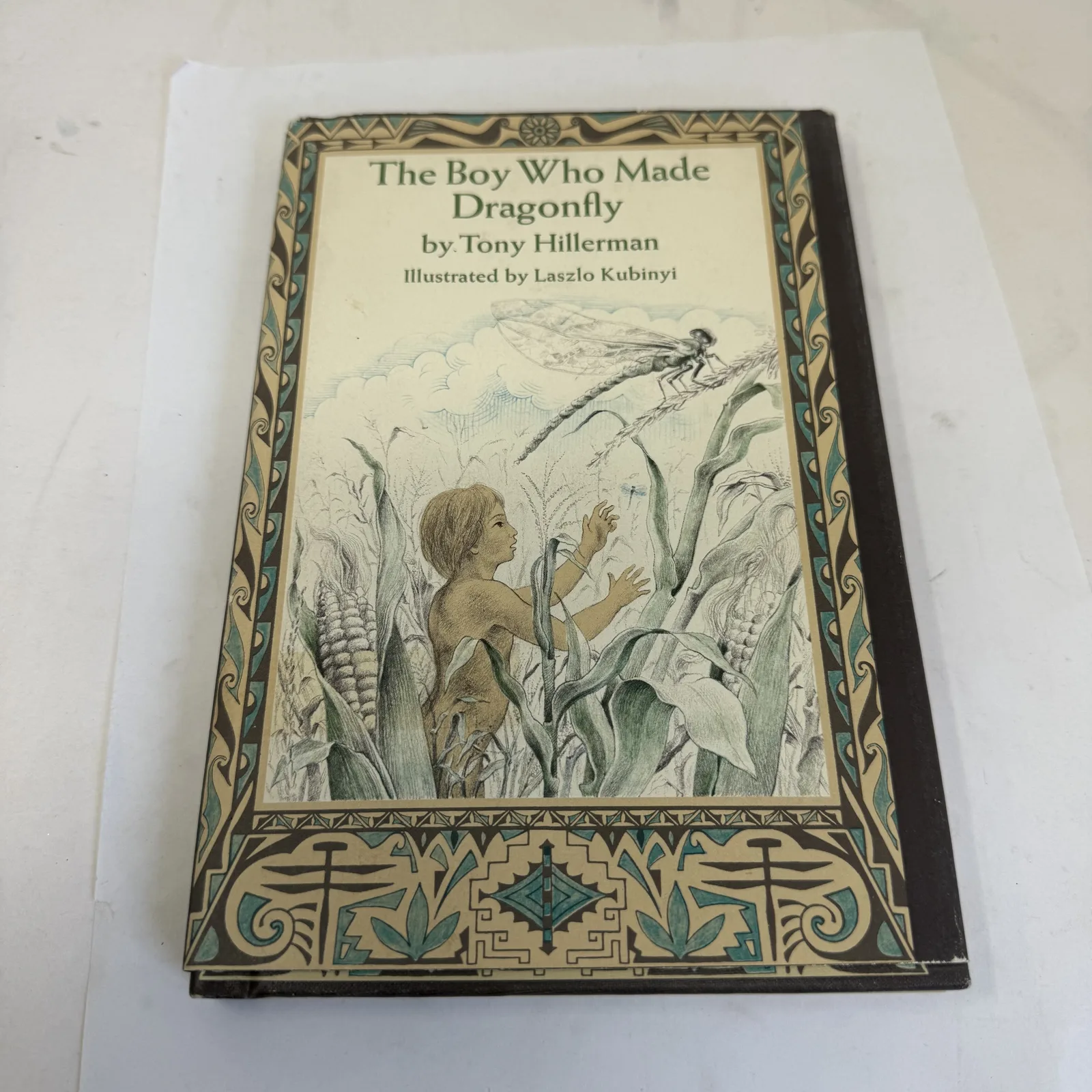
Other canonical Hillerman: Finding Moon (HarperCollins 1995), the second standalone novel, photographed below. The Boy Who Made Dragonfly: A Zuni Myth (Harper & Row 1972, illustrated by Laszlo Kubinyi, his first children’s book, often overlooked, an accessible Tier 2 target) and Buster Mesquite’s Cowboy Band (Buffalo Medicine Books 2001, his picture book). Seldom Disappointed: A Memoir (HarperCollins 2001 first hardcover, the autobiographical Tier 2 target and winner of Agatha and Anthony awards for nonfiction). The Spell of New Mexico (UNM Press 1976, edited by Hillerman, an anthology of writers on New Mexico from Mary Austin and D. H. Lawrence to Ernie Pyle). Hillerman Country: A Journey Through the Southwest with Tony Hillerman (HarperCollins 1991, with photographs by his brother Barney Hillerman). Tony Hillerman’s Indian Country Map & Guide (Time Traveler Maps).
Overlooked, but it surfaces: this signed copy of The Boy Who Made Dragonfly crossed the NMLP sorting desk in Albuquerque — the Harpercrest library-binding issue with FIRST EDITION stated on the copyright page, signed by Hillerman, privately owned rather than ex-library:

The Anne Hillerman Continuation Series, 2013-Present
Anne Hillerman (born in Lawton, Oklahoma, in 1949; a journalist and travel writer based in Santa Fe; Tony Hillerman’s daughter) has continued the Joe Leaphorn / Jim Chee / Bernadette Manuelito series for HarperCollins since 2013. The continuation series deliberately raises Officer Bernadette Manuelito (introduced by Tony Hillerman in The Fallen Man, 1996, and married to Jim Chee by The Shape Shifter, 2006) to co-equal protagonist alongside Leaphorn and Chee, creating a fundamentally Diné-woman-centered narrative perspective that the Tony Hillerman canon did not previously offer.
Anne Hillerman canonical bibliography: SPIDER WOMAN'S DAUGHTER (HarperCollins 2013, the first continuation novel: Joe Leaphorn is shot in the opening pages, the deliberate narrative pivot establishing Bernadette Manuelito as principal investigator and signaling the generational handoff); ROCK WITH WINGS (HarperCollins 2015); SONG OF THE LION (HarperCollins 2017); CAVE OF BONES (HarperCollins 2018); THE TALE TELLER (HarperCollins 2019); STARGAZER (HarperCollins 2021); THE SACRED BRIDGE (HarperCollins 2022); THE WAY OF THE BEAR (HarperCollins 2023); LOST BIRDS (HarperCollins 2024); SHADOW OF THE SOLSTICE (HarperCollins 2025); plus continuing publication. Anne Hillerman has signed at Collected Works Bookstore in Santa Fe and Bookworks in Albuquerque, and in 2004 she launched the Tony Hillerman Writers Conference through Wordharvest, the company she co-founded with Jean Schaumberg. Signed firsts of the early continuation novels (Spider Woman's Daughter 2013, Rock with Wings 2015, Song of the Lion 2017) carry a meaningful premium with specialist dealers.
Dark Winds (AMC 2022-Present)
Dark Winds is the AMC and AMC+ television adaptation of the Hillerman Leaphorn-Chee canon, created by Graham Roland (a Chickasaw Nation citizen), with George R.R. Martin (a Santa Fe resident) and Robert Redford among the executive producers. The series premiered June 12, 2022 on AMC; season two premiered July 30, 2023, season three March 9, 2025, and season four February 15, 2026, and AMC has renewed it for a fifth season.
Casting: Zahn McClarnon (Hunkpapa Lakota) plays Lieutenant Joe Leaphorn; Kiowa Gordon (Hualapai) plays Sergeant Jim Chee; Jessica Matten (Métis/Cree/Saulteaux) plays Officer Bernadette Manuelito; supporting cast includes Deanna Allison (Diné/Navajo) as Emma Leaphorn, Rainn Wilson and Noah Emmerich in season one, and others. The deliberate Indigenous-cast-and-creative-team production approach extends the precedent set by the Robert Redford-produced 2002-2004 American Mystery! PBS adaptations (with Adam Beach as Chee and Wes Studi as Leaphorn).
Season one (six episodes, 2022) draws mainly on Listening Woman (1978), with elements of People of Darkness (1980); season two (six episodes, 2023) adapts People of Darkness; season three (eight episodes, 2025) draws on Dance Hall of the Dead (1973) and The Sinister Pig (2003); and season four (2026) is based on The Ghostway (1984). The AMC Dark Winds TV-tie-in trade paperback editions 2022-present are accessible Tier 3 working-library acquisitions.
I pick up books for free anywhere in the metro area. Call 505-250-3804 to schedule.
Five Identification Problems
Problem one: Harper & Row vs HarperCollins imprint dating. Harper & Row published the first trade editions of Hillerman’s novels from The Blessing Way (1970) through Coyote Waits (1990); HarperCollins, formed after News Corporation bought Harper & Row in 1987 and merged it with William Collins, published every novel from Sacred Clowns (1993) on. The imprint on the title page is the first thing to check: a HarperCollins imprint on one of the pre-1993 novels means a later printing. The exception to “Harper & Row means first” is The Ghostway, whose true first is the 1984 Dennis McMillan limited edition of 300 signed copies; the Harper & Row trade edition followed in 1985 and reads “FIRST HARPER & ROW EDITION 1985” on its copyright page.
Problem two: Where the number line is, and what Library of Congress numbers can and can’t tell you. Harper & Row firsts state “FIRST EDITION” and carry a number line that must run down to 1, but on the earliest books the line is not on the copyright page: The Blessing Way prints 70 71 72 73 10 9 8 7 6 5 4 3 2 1 on its last page, and Dance Hall of the Dead prints its line at the foot of page 168. HarperCollins firsts carry “FIRST EDITION” with a number line on the copyright page. Library of Congress numbers are a cross-check, not a date: the Library of Congress record for the 1970 Blessing Way is LCCN 73-96009, a 73 prefix on a 1970 book. You can look up any LCCN with my LCCN lookup, and title-by-title points are in my guide to identifying a Tony Hillerman first edition.
Problem three: Dust jacket points-of-issue and price-clip. Original first-edition dust jackets carry the original cover price (rising from a few dollars on The Blessing Way 1970 to modest value or above on the late HarperCollins firsts). Price-clip is a serious Tier-degradation issue at specialist auction — a price-clipped Blessing Way 1970 first sells at a meaningful discount to a fine unclipped copy. Original Harper & Row 1970s-era dust jackets have distinctive Navajo-region cover art that differs from the subsequent paperback editions and the post-Skinwalkers commercial-appeal cover redesigns.
Problem four: Signed-Hillerman authentication. Hillerman signed extensively from the late 1970s through 2008 at Albuquerque events (Bookworks, Page One Books, now closed, and UNM events), Santa Fe events (Collected Works Bookstore), national mystery conferences, and bookstore tour stops. Signed Hillerman is present in the secondary market in substantial numbers, but signed 1970 Harper & Row Blessing Way first editions are genuinely scarce (a small first-novel print run, and 1970 predates his years of extensive signing), so a signed early first deserves the checks in my signed book authentication guide. Provenance documentation (event photographs, dated inscriptions, bookseller letters of authenticity) matters.
Problem five: Skinwalkers 1986 vs subsequent printings. The 1986 Harper & Row Skinwalkers first hardcover is the second-most-important collector target after The Blessing Way 1970. The first edition is bound in cream boards with a red cloth spine, a star pressed into the front board, and silver spine lettering, in the first of Peter Thorpe’s Hillerman jackets. Later paperback reprints, book-club copies, and the TV tie-in editions that followed the 2002 PBS film and the Dark Winds series are reading copies; the 1986 Harper & Row hardcover with original dust jacket is the artifact.
Three-Tier Collector Market
Tier 1 trophy (low-four-figure and up): Signed Tony Hillerman The Blessing Way Harper & Row 1970 first hardcover with original dust jacket in fine condition (the principal Hillerman canon trophy); fine unsigned Blessing Way 1970 Harper & Row first hardcover with dust jacket; signed Tony Hillerman Dance Hall of the Dead Harper & Row 1973 first hardcover (Edgar Award winner); complete signed-by-Hillerman canon runs in fine first-edition state with matched original dust jackets (extremely rare, and seldom offered as a complete run).
Tier 2 collector targets (low-to-mid three-figure): Early trade firsts of canonical Hillerman novels: The Fly on the Wall Harper & Row 1971, Listening Woman 1978, People of Darkness 1980 (introducing Jim Chee), The Dark Wind 1982, and The Ghostway (the 1984 Dennis McMillan signed limited, and the 1985 Harper & Row trade first). Signed firsts of Skinwalkers 1986 and A Thief of Time 1988, and the signed, numbered, slipcased limited issues of A Thief of Time, Talking God, Coyote Waits, Sacred Clowns, and The Fallen Man. The Boy Who Made Dragonfly Harper & Row 1972 children’s book first hardcover. Seldom Disappointed: A Memoir HarperCollins 2001 first hardcover. Anne Hillerman continuation firsts: Spider Woman’s Daughter HarperCollins 2013 signed first hardcover, Rock with Wings HarperCollins 2015 signed first, Song of the Lion HarperCollins 2017 signed first. Unsigned trade firsts from Talking God (1989) on were printed in large numbers and are common, so for those titles it is the signed copies and limited issues that matter.
Tier 3 working library (reading copies, worth little individually): Harper & Row and HarperCollins mass-market paperback editions of all canonical Hillerman novels (the editions most NM mystery readers actually own); Avon, Harper Paperbacks, and HarperTorch mass-market reprints; HarperCollins trade paperback editions of the 1990s and 2000s; the AMC Dark Winds TV-tie-in trade paperback editions; the 2002 PBS TV-tie-in editions; Anne Hillerman trade paperback editions; and the reader’s guides and companions (The Tony Hillerman Companion, the Hillerman Country photographic essay editions).
Reference & Companion: Tony Hillerman's Navajoland by Laurance D. Linford
If you're collecting the Hillerman canon, you eventually want the book that maps the fiction to reality. Tony Hillerman's Navajoland: Hideouts, Haunts, and Havens in the Joe Leaphorn and Jim Chee Mysteries by Laurance D. Linford (Expanded Third Edition, University of Utah Press, 2011, ISBN 978-1-60781-137-4) is that book. It's an encyclopedic dictionary of every real-world location mentioned across the eighteen novels — each entry gives the common name, the Navajo name, the history, and its significance in specific Hillerman plots. The foreword is by Tony Hillerman himself, making this one of the last references he endorsed before his October 2008 death.
Linford's credentials are exactly right for this project. Trained as an archaeologist, he served as executive director of the Inter-Tribal Indian Ceremonial Association in Gallup, New Mexico — the annual event that's been the principal meeting ground for Navajo, Zuni, Hopi, and Pueblo arts since 1922. He's also the author of Navajo Places: History, Legend, Landscape (University of Utah Press, 2000). The Expanded Third Edition adds all 72 location entries from Hillerman's final novel, The Shape Shifter (2006), ensuring completeness across the entire closed canon.
As New Mexico Magazine put it: "An invaluable guide … This book belongs in the car of any traveler passing through this land." I agree. If you're driving Hillerman country — Window Rock, Shiprock, Canyon de Chelly, Chaco Canyon, the Hopi mesas — this is the companion that turns the novels into a road atlas. Here's my copy, photographed on the sorting desk.


The LOC classification PS3558.I45 Z76 tells you exactly where this sits in the scholarly apparatus: it's cataloged under Hillerman criticism and interpretation, not geography or Navajo studies — because it's fundamentally a literary companion. If you're building a serious Hillerman shelf, this is the reference that completes it.
Beyond Leaphorn & Chee: A Signed First Edition of Finding Moon
Every Hillerman collector knows the eighteen Navajo Tribal Police novels. Fewer know that in 1995, between Sacred Clowns and The Fallen Man, Hillerman published the one major novel that deliberately left Leaphorn and Chee behind. Finding Moon (HarperCollins, 1995, ISBN 0-06-017772-1) is set in Southeast Asia — Cambodia, the Philippines, Vietnam — during the fall of Saigon era. It's a Hillerman novel about a man searching for his brother's child in a collapsing war zone, and it reads nothing like the Navajo mysteries. That's the point.
This copy is a signed first edition, first printing. The copyright page states "FIRST EDITION" with the number line 95 96 97 98 99 ❂/RRD 10 9 8 7 6 5 4 3 2 1 — confirming a true first printing. And on the title page, in bold black ink: “To Chuck who can outwalk me but I’m bigger! Tony Hillerman” — a warm, funny personal inscription that's pure Hillerman personality. That confident handwriting is unmistakable if you've handled signed Hillerman before.

What makes this copy significant for the canon page isn't just the signature — it's what the book represents. Hillerman's dedication page is titled “AN APOLOGY, ACKNOWLEDGMENT, DENIAL, AND DEDICATION” and is addressed to fellow veterans he served with. He writes candidly about “wandering away from our Navajo country” and explicitly promises that “The next book will find us back with Leaphorn of the Tribal Police.” He kept that promise. The Fallen Man arrived the following year. For collectors, that dedication is a fascinating piece of authorial self-awareness — Hillerman knew exactly what his readers expected, acknowledged the departure, and committed to the return.


The back jacket is worth noting for collectors because it carries no Finding Moon text at all — it's entirely “PRAISE FOR SACRED CLOWNS” with review quotes from the Chicago Tribune, Baltimore Sun, New York Times, Chicago Sun-Times, Los Angeles Times, San Francisco Chronicle, and others. That's HarperCollins hedging its bet, selling a Southeast Asia departure through the credibility of the last Navajo mystery. It worked. Finding Moon hit the bestseller lists on Hillerman's name alone.
This copy pairs naturally with the Navajoland reference guide above — Hillerman the fiction writer and the landscape chronicler, with the one departure that proves how central Navajo country was to his identity. A signed Finding Moon first is a collector's piece precisely because it's the exception. The signature proves the handling, the inscription proves the personality, and the dedication proves the commitment to the canon.
NMLP Intake Position
Tony Hillerman novels arrive in the NMLP donation stream with exceptional frequency; he is the New Mexico mystery author I see most often in donated boxes. Avon and Harper mass-market paperbacks turn up in nearly every New Mexico estate with a mystery shelf, and many readers own all eighteen novels in paperback. Albuquerque retirees who studied in his UNM journalism program, and readers who went to his Albuquerque and Santa Fe signings, often have signed Hillerman (and signed Anne Hillerman) on the shelf. Donor contributions fund NMLP’s specialist sorting of these high-volume mystery-fiction collections.
Rare Hillerman, like every book that comes in, is sorted by hand at the warehouse. I don’t appraise, evaluate, or authenticate anyone’s books, and nothing needs to be researched or set aside before it comes in; resale of donated books is what funds the free pickup and the 24/7 drop box.
Paperback reprints, the copies most likely to be read again, go to community literacy partners and Little Free Libraries, including the four-LFL Sunday loop documented at /lfl-restock-2026-05-10. Free Albuquerque-metro pickup with no condition limit and no minimum quantity: schedule your pickup or text/call 505-250-3804.
External References
- Wikipedia: Tony Hillerman
- Wikipedia: Anne Hillerman
- Wikipedia: The Blessing Way
- Wikipedia: Skinwalkers (novel)
- Wikipedia: Dark Winds (TV series)
- HarperCollins — current Hillerman publisher
- The Tony Hillerman Portal (University of New Mexico): bibliographic records, jackets, and papers for Hillerman’s editions
Related on This Site
- Closed Signature Pools — Albuquerque/NM Authors — Tony Hillerman (closed 2008)
- NM Hispano Literature — the parallel NM literary canon, Anaya canon overlap on UNM faculty contemporaries
- Navajo Weaving Books — the Diné material-culture canon underlying Hillerman's cultural research
- Pueblo Pottery Books — the Pueblo material-culture canon underlying Hillerman's Pueblo subplots
- NM Spanish Colonial Historians — the Pueblo-voice scholarship (Joe S. Sando, Alfonso Ortiz) parallel to Hillerman's research consultants
- Book Authentication Methodology — signature-pool authentication for the closed Hillerman pool
- First Edition Identification Encyclopedia — Harper & Row and HarperCollins number line conventions, BCE detection, and the full imprint-dating methodology for the 18-novel Hillerman canon
- Top 50 Most Collectible NM First Editions — The Blessing Way 1970 and Skinwalkers 1986 entries
- NM Children's Literature — Ann Nolan Clark's Pueblo classroom readers and Byrd Baylor's Southwestern picture books share Hillerman's deep engagement with Indigenous landscape and culture
- NM Trading Posts & Indian Arts Books — the trading-post world that forms the backdrop for multiple Leaphorn-Chee investigations
- NM Film & Cinema History — the 1991 Dark Wind film adaptation and the broader Hillerman screen-rights history
Looking to sell?
See my guide to selling Tony Hillerman books in Albuquerque →
Cite This Guide
Eldred, J. (May 2026). Tony Hillerman Leaphorn-Chee Canon: A Collector's Authority Guide. New Mexico Literacy Project.
https://newmexicoliteracyproject.org/tony-hillerman-leaphorn-chee-canon-collecting
Content is original research by Josh Eldred. Licensed under CC BY 4.0. Cite with attribution.