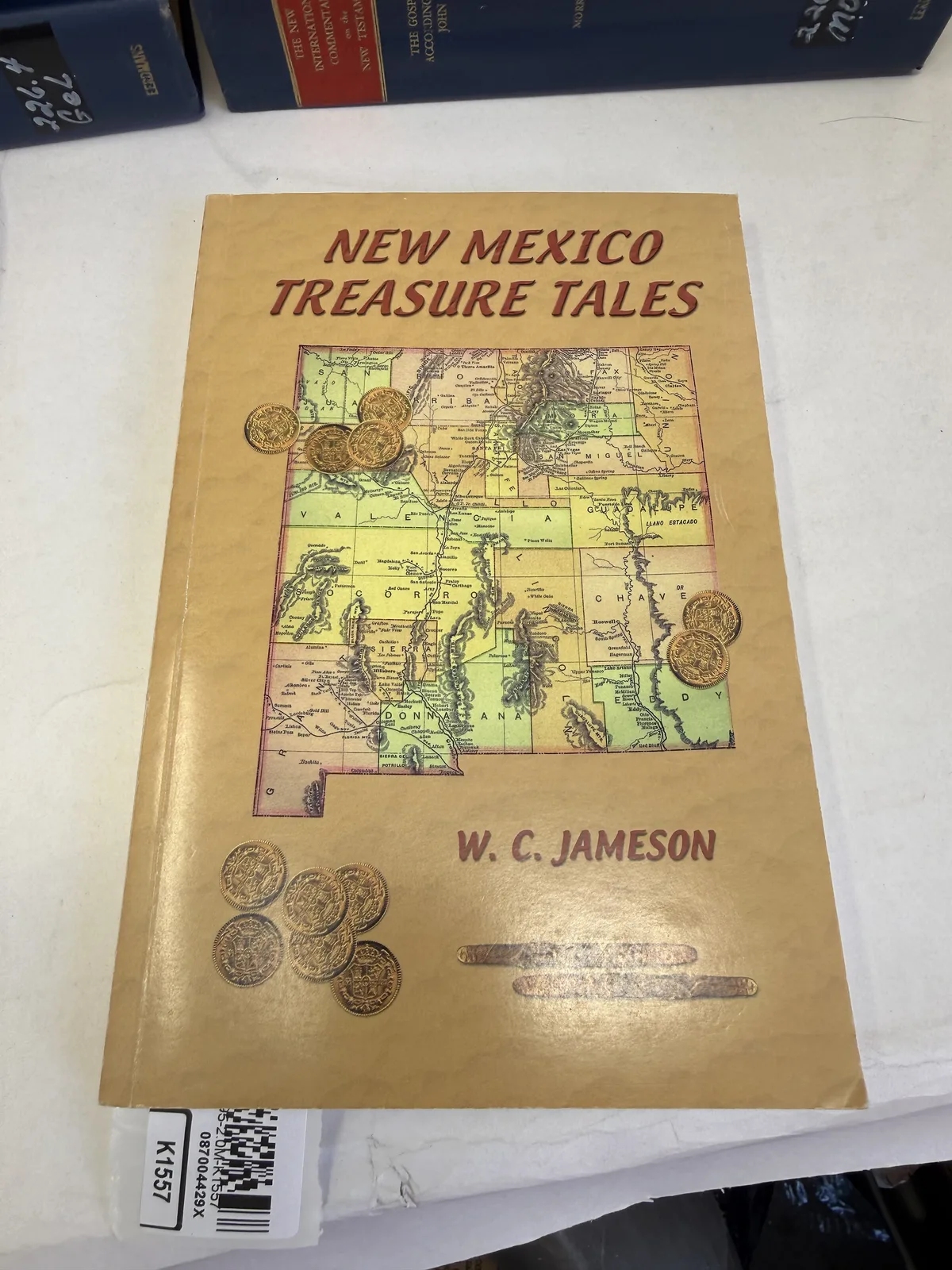
The first miners in New Mexico did not carry pick axes or shovels. They carried stone hammers and antler tools. At Mount Chalchihuitl in the Cerrillos Hills south of Santa Fe, Ancestral Puebloan people were mining turquoise by about 700 to 900 AD, and Cerrillos turquoise moved along the trade networks of the ancient Southwest, where Chaco Canyon’s great houses alone have yielded some 200,000 pieces of turquoise. Before there was a New Mexico, before there was a Spanish Empire in the Americas, the Cerrillos Hills were already a node in a continental trade. That is where the story begins.
It ends — or rather, arrives at its most recent catastrophe — on July 16, 1979, when a tailings-pond dam at the United Nuclear Corporation Church Rock mill in McKinley County failed, releasing 94 million gallons of radioactive liquid waste and 1,100 tons of solid radioactive tailings into the Puerco River. The river ran through the Navajo Nation. The Church Rock spill was the largest release of radioactive material in United States history by volume — larger than Three Mile Island, which had occurred four months earlier and had received incomparably more national press coverage. The Navajo communities downstream did not learn of the spill for days. Federal response was slow. The contamination was long-lasting.
Between those two bookends, pre-Columbian turquoise and Cold War uranium, lies one of the richest and most historically layered regional mining literatures in the American West. Spanish colonial lead and silver in the Cerrillos Hills. The 1866 Elizabethtown gold rush, New Mexico Territory’s first significant Anglo-American mineral boom. The silver strikes of the late 1870s and 1880s that produced Hillsboro, Kingston, Lake Valley’s legendary Bridal Chamber, and the gold camp of White Oaks. The copper country of Grant County, where Santa Rita del Cobre has been worked since about 1800 and open-pit mining began in 1910. The company coal town of Madrid, which fed the Atchison, Topeka & Santa Fe Railway, fielded the first lighted ballpark west of the Mississippi, and drew holiday crowds to its Christmas light displays, organized under mine superintendent Oscar Huber. And then the uranium boom: Paddy Martinez’s 1950 discovery near Grants, the companies that made the Grants belt one of the country’s great uranium districts, and the decades of radiation exposure that killed Navajo miners whose families are still, as of this writing, working through the Radiation Exposure Compensation Act claims system.
This pillar covers the book-collecting market of that entire arc. It is organized around the key authors and works, the major districts, the specific collecting problems of each tier, and the three-tier market structure that governs what these books are worth when they surface in a donation pile or an estate sale.
Last verified October 2026 · Original research by Josh Eldred
Fayette Jones and the 1904 New Mexico Mines and Minerals: the territorial survey
Fayette Alexander Jones’s New Mexico Mines and Minerals (World’s Fair edition; Santa Fe: The New Mexican Printing Company, 1904) is the territorial-era survey at the head of the NM mining book canon. Compiled for the Louisiana Purchase Exposition at St. Louis and subtitled an epitome of the early mining history and resources of New Mexican mines, it was a promotional document as much as a history: organized by district, it documents operating and recently worked properties with brief production histories, ore descriptions, and the optimistic projections that capital-attraction literature of the era required. The ore is always richer than it will prove. The railroad is always coming. Reading Jones with that in mind makes it more valuable as a primary source rather than less, because the gap between what was claimed and what the later record shows is itself evidence of how the territorial mining economy worked.
Collecting notes: New Mexico Mines and Minerals (Santa Fe, 1904)
Jones is the classic early survey for a New Mexico mining shelf, the way first-edition Bourke or Calhoun anchor an Apache-campaigns shelf. Original 1904 copies turn up mainly through specialist Western Americana dealers and auctions, and surviving copies usually show the wear of working use in mine, land, and investment offices. Fine copy without significant damage or margin annotation: the high three-figure to low four-figure range. Good copy with working wear, intact: respectable collectible value. A reading copy with damage: solid mid-range collectible value. Two things to know: digitized copies of the 1904 book are freely readable at the Internet Archive, and in 1964 the Stagecoach Press of Santa Fe drew on it for Old Mining Camps of New Mexico, 1854-1904, a small book collected in its own right.
Rossiter Raymond and the Federal Mining Reports (1868–1876)
Rossiter Worthington Raymond (1840 to 1918) served as U.S. Commissioner of Mining Statistics from 1868 through 1876, producing eight annual reports titled Statistics of Mines and Mining in the States and Territories West of the Rocky Mountains. Printed by the Government Printing Office as Treasury Department reports to Congress, they are the foundational federal primary source for territorial-era western mining, and for New Mexico they record the gold placers and early lode mines of the years before the railroad and the silver camps of Lake Valley and Kingston.
The New Mexico chapters give district-by-district accounts of mines, mills, ores, and output, and set the territory’s operations within the broader western mining economy. The Moreno Valley gold camps around Elizabethtown and Baldy Mountain, the Old and New Placers south of Santa Fe, Cerrillos, and the early mines at Pinos Altos and Silver City all appear in the Raymond reports.
The Raymond Reports as Collector Targets
The Raymond reports are government documents printed for Congress and distributed through official channels rather than the book trade, so complete private runs are uncommon. The eight annual volumes cover the years 1868 through 1875 and vary in scarcity. Individual volumes trade the mid-range to upper collectible zone depending on year and condition. A complete run of all eight is a trophy acquisition for a serious NM and western mining history library, rarely assembled in the private market and valued at four-figure collectible territory complete in matching condition.
Sherman & Sherman Ghost Towns and Mining Camps of New Mexico (OU Press, 1975) — the canon’s systematic core
James E. Sherman and Barbara H. Sherman’s Ghost Towns and Mining Camps of New Mexico (University of Oklahoma Press, 1975) is the ghost-town canon’s systematic core, a statewide survey built as a research reference rather than a travel narrative. It pairs short histories of the towns and camps with photographs, which makes it a record of what was still standing in the early 1970s, before later decades of collapse, fire, vandalism, and demolition reduced the physical inventory at many sites.
The entries trace each place from discovery and boom through decline and abandonment, with the mines, the ores, and the people and events each town is remembered for. That systematic coverage, together with the photographs, makes Sherman and Sherman the reference against which later New Mexico ghost-town documentation is measured.
Points of Issue: Ghost Towns and Mining Camps of New Mexico (OU Press, 1975)
The 1975 University of Oklahoma Press first hardcover is the standard Tier 2 collector target. Points of issue: University of Oklahoma Press imprint; copyright 1975 on verso of title page with no printing notice beyond first; original dust jacket. The dust jacket is the primary condition variable: fine or near-fine jacket (no chips, tears, fading, or price clipping) turns a standard first into a premium copy. Without original dust jacket: the common reading copy to mid-range zone. With very-good dust jacket: solid mid-range collectible value. With fine dust jacket: respectable collectible value. Signed by one or both Shermans in the 1975 first hardcover with original dust jacket: respectable collectible value (check current closed-pool status for both authors). The OU Press Western Americana imprint has reprinted Sherman-Sherman multiple times; subsequent printings are identifiable by the printing notice on the copyright page. Multiple paperback reprints circulate in the used-book market at modest value.
Stuart Northrop’s Minerals of New Mexico (1942, revised 1959 and 1996): the mineralogy foundation
Stuart A. Northrop (1904-1994) was a geologist and mineralogist at the University of New Mexico whose Minerals of New Mexico is the systematic catalog of the mineral species recorded from the state. For the mining history collector, Northrop is essential in a way that might not be obvious at first: the book is organized by mineral name, not by district or historical period, but the occurrence and locality data for each species add up to an indispensable district-level mineralogy reference. Knowing that museum-grade smithsonite came from the Kelly Mine in the Magdalena district, that collector-grade fluorite came from the Hansonburg district in Socorro County, that argentiferous galena was among the Kingston ores, that Cerrillos turquoise has its own trace-element chemistry: this mineralogical specificity is what Northrop provides, and it is the foundation on which the district-level mining histories rest.
Northrop’s book first appeared in 1942 as a University of New Mexico Bulletin (Geological Series, vol. 6, no. 1), was revised for UNM Press in 1959, and came out in a third edition revised by Florence A. LaBruzza in 1996, two years after Northrop’s death. The 1996 edition is the preferred working reference and supersedes the earlier ones for research; the 1942 first is the collector’s edition. The 1959 and 1996 editions both trade the mid-range collectible zone.
Inherited a library and not sure where to start? Call or text 505-250-3804 — I handle this all the time.
Julyan and Pearce — the Place-Name References for Mining Research
Robert Julyan’s The Place Names of New Mexico (University of New Mexico Press, first edition 1996, revised edition 1998) and Thomas M. Pearce’s New Mexico Place Names: A Geographical Dictionary (University of New Mexico Press, 1965) are the two essential place-name references for NM mining and ghost-town research. Every ghost town, mining camp, mill site, and mine property in New Mexico has a place name, and the question of where that name came from, what it originally referred to, whether it was a Spanish colonial designation or an Anglo territorial-era invention, and what geographic coordinates attach to it, is often the first research problem a collector or historian faces.
The Pearce 1965 volume was the standard reference for thirty years: thousands of NM place names with origin, county, and location, with strong coverage of the Spanish colonial and early Anglo-American naming traditions that dominate the mining-district geography. The Julyan 1996/1998 volume substantially supersedes Pearce in coverage, accuracy, and depth: over 7,000 place names, more thorough treatment of Navajo and other indigenous place names, correction of Pearce errors, and incorporation of thirty years of additional historical and geographical research. For ghost-town researchers, the Julyan entries for abandoned mining communities explain the name and give the place’s location, history, and current status, often with cross-references to related names.
Mining-Camp Entries in Julyan and Pearce
The specific value of both references for mining history research lies in the entries for communities that appear in no other standard reference. Many NM mining camps — worked briefly in the 1870s–1880s silver rush, populated for perhaps three to seven years, and then completely abandoned — left no newspaper record, no Bureau of Mines bulletin coverage, no entry in the Sherman-Sherman survey. Their sole documentary surviving in standard reference is a Pearce entry (if the toponym was formally filed with the state geographic board) or a Julyan entry (with the additional research coverage). These entries may contain nothing more than the origin of the name and a county location, but they are the only confirmation the camp ever existed. For the serious NM mining history researcher, working through the full Julyan alphabetical sequence for the silver-belt counties (Sierra, Grant, Socorro, Dona Ana, Lincoln) reveals dozens of named camps that the documentary ghost-town surveys omit. Pearce 1965 UNM Press first hardcover with dust jacket: the mid-range collectible zone. Julyan 1996 UNM Press first hardcover with dust jacket: solid mid-range collectible value. Julyan 1998 revised edition: solid mid-range collectible value.
The District Canon — Key Mining Districts and Their Books
Understanding the NM mining book canon requires a working knowledge of the district taxonomy. The following covers the major districts, the key events that defined each, and the specific books most relevant to each district’s literature.
Cerrillos and Madrid (Santa Fe County). The Cerrillos Hills turquoise, lead, and zinc district contains Mount Chalchihuitl, where Ancestral Puebloans were mining turquoise by about 700 to 900 AD; Cerrillos is thought to be the site of the oldest turquoise mines in the country. Spanish explorers noted the lead-silver deposits of the “Sierra de San Mateo,” the modern Cerrillos Hills, in 1581. Coal was mined at nearby Madrid from about 1835; the Santa Fe Railway took over the coal bank in 1891 and laid out the company town, and Madrid coal fed the railroad’s steam locomotives until diesels and natural gas killed demand. The Albuquerque and Cerrillos Coal Company shut down in 1954, and most residents left. The Christmas light displays organized under mine superintendent Oscar Huber, and a ballpark that was the first lighted one west of the Mississippi in the 1920s, are part of the town’s legend. Madrid today is an arts community. Key books: Joseph E. Pogue’s The Turquois (Memoirs of the National Academy of Sciences, 1915; Rio Grande Press reprint 1975); Christiansen’s The Story of Mining in New Mexico (1974); Sherman and Sherman (1975); and local museum publications from Cerrillos and Madrid.
Elizabethtown (Colfax County, 1866 to the early 1900s). New Mexico’s first incorporated town grew from the 1866 gold discoveries in the Moreno Valley. At its height in 1869 it may have had 5,000 to 9,000 residents, making it the most populous place in New Mexico at the time, and in 1870 it became the first seat of the new Colfax County. By 1872 the population had dwindled to about 100 as the gold rush subsided; the railroad brought a revival in the 1890s, but a 1903 fire destroyed most of the wooden town. Today Elizabethtown is a true ghost town of stone ruins, a cemetery, and scattered foundations. The 1866 gold rush predates the silver strikes of the late 1870s and 1880s and represents a distinct NM boom tradition. Key books: Sherman and Sherman (1975) and Looney’s Haunted Highways (Hastings House, 1968).
Mogollon (Catron County, 1880s to 1942). The most remote major ghost-town destination in New Mexico. Sergeant James C. Cooney of Fort Bayard found gold in the Mogollon Mountains in the 1870s, and the town grew up in the 1880s at the bottom of Silver Creek Canyon to serve the gold and silver mines around it. In the 1890s it had a transient population of 3,000 to 6,000 miners, and in 1909 about 2,000 people. The federal shutdown of gold mining in 1942 ended production for most operators. Mogollon today has a handful of residents and a substantial inventory of surviving commercial buildings in a canyon reached by NM-159, a narrow mountain road that limits casual access. Sherman and Sherman (1975) and Varney (1981) provide the best popular-reference coverage.
Silver City and Grant County copper. The Santa Rita del Cobre deposit, first developed around 1800 and now worked as the Chino Mine by Freeport-McMoRan, is the third-oldest active open-pit copper mine in the world; open-pit mining began there in 1910. At Tyrone, Phelps Dodge built the “Million Dollar Ghost Town,” with a town plan and several buildings by Bertram Goodhue; the original town was later destroyed by mining operations, and a new townsite went up nearby. Silver City itself is a functioning city, not a ghost town, but the institutional literature of Grant County copper, from company publications and corporate reports to NM Bureau of Mines bulletins, is a significant collecting category.
Hillsboro and Kingston (Sierra County, 1877 to 1893). Hillsboro was founded in 1877 after prospectors found gold and silver float near the future Opportunity Mine, and placer gold turned up in the nearby gulches that November. Kingston, first called Percha City, followed in 1882 after silver was found at what became the Solitaire Mine, and the district produced almost six million ounces of silver from 1883 to 1893. Sadie Orchard, the stage-line operator and hotel keeper, is the district’s best-remembered character. Hillsboro survived the 1893 silver collapse as a small town; Kingston is a near-ghost with a few dozen residents. Sherman and Sherman (1975) and Varney (1981) provide the primary reference coverage.
Lake Valley and the Bridal Chamber (Sierra County, 1881 to 1893). Lake Valley’s heyday ran from 1881 to 1893. Its miners broke into a silver-lined cavity they named the Bridal Chamber, which alone yielded about 2.5 million troy ounces of silver and was worked out by 1883. A railroad line arrived in 1884, but the mines were worked only periodically after that, and despite the bonanza, shareholders in the mining companies lost money. The last resident left in 1994. Today Lake Valley is a Bureau of Land Management historic townsite, open in daylight hours. Sherman and Sherman and Varney both cover Lake Valley.
White Oaks (Lincoln County, 1879 to the early 1900s). Gold strikes in 1879, including John J. Baxter’s Homestake claims, made White Oaks a boomtown that eventually reached about 4,000 people, with some 50 businesses, among them four newspapers, two hotels, three churches, a bank, and an opera house. Billy the Kid, Pat Garrett, and Dave Rudabaugh all passed through. When the Santa Fe and the El Paso and Northeastern railroads were planning lines in the late 1890s, local business interests demanded premium prices for right-of-way, and the railroad ran twelve miles west through Carrizozo instead; by then the mines were playing out as well. White Oaks is the canonical NM railroad-bypass ghost town.
Magdalena and Kelly (Socorro County). The Magdalena district operated primarily from the 1870s to the 1930s, producing silver, lead, and zinc from the mines around Kelly. The Kelly Mine smithsonite specimens are top-tier mineral-collector targets. The AT&SF Magdalena Branch carried ore and cattle, the cattle driven across the Plains of San Agustín to the railhead at Magdalena. If you live in that corridor, my Socorro and Truth or Consequences book donation guide lists local options; I don’t pick up there, but the 24/7 drop box in Albuquerque takes mining books in any condition.
Grants Uranium Belt (Cibola, McKinley, Sandoval counties, 1950–1980s). The Cold War uranium boom, triggered by Paddy Martinez’s 1950 discovery, is covered in detail below in the uranium section.
Looney, Varney, and Harris: the ghost town survey tradition
Ralph Looney’s Haunted Highways: The Ghost Towns of New Mexico (Hastings House, New York, 1968; University of New Mexico Press paperback, 1979) is the foundational popular ghost-town narrative for the state, an early trade-press treatment written for general readers rather than a mining-history or geological-survey audience. Looney, a journalist, wrote with a travel-narrative quality that the more systematic Sherman and Sherman survey lacks. His prose is accessible and often vivid, and the photographs document structures that have since collapsed or been demolished, making the book a visual record of the 1960s ghost-town landscape. The 1968 Hastings House first hardcover with original dust jacket is the Tier 1 Looney collector target; the UNM Press paperback circulates widely.
Points of issue: Haunted Highways (Hastings House, 1968)
Hastings House, New York imprint; copyright 1968 with no later printing noted; original dust jacket. Without jacket: common reading copy range. With very-good jacket: solid mid-range collectible value. With fine jacket: respectable collectible value. Signed by Looney: add an appropriate premium. The 1979 UNM Press paperback is common at modest value.
Philip Varney’s New Mexico’s Best Ghost Towns: A Practical Guide (Northland Press, Flagstaff, 1981; later University of New Mexico Press editions) is the principal traveler’s ghost-town guide: explicitly selective, built around the sites most worth the drive, with directions and historical context. The selectivity is a feature, producing a practical road companion that the more encyclopedic Sherman and Sherman is not. The 1981 Northland first is the Tier 2 Varney collector target. Varney wrote companion guides in the same vein, among them Arizona’s Best Ghost Towns (Northland, 1980) and Southern California’s Best Ghost Towns (University of Oklahoma Press, 1987), and Southwest ghost-town collectors often target the set.
Linda G. Harris’s Ghost Towns Alive: Trips to New Mexico’s Past (University of New Mexico Press, 2003; photographs by Pamela Porter) is the contemporary itinerary guide, written decades after the Sherman and Varney surveys and organized around trips rather than as an alphabetical reference. It is the supplement for tracking what has survived, what has collapsed, and how access has changed at individual sites since the 1970s and 1980s.
Keleher, White Oaks, and the single-community books
William A. Keleher’s Violence in Lincoln County, 1869-1881 (University of New Mexico Press, 1957) is a Lincoln County War history rather than a mining history, but it is the essential background for the White Oaks story: the gold strikes there came in 1879, just as the county was emerging from the war, and several of Keleher’s figures turn up in White Oaks history. The Murphy-Dolan combine that dominated Lincoln County’s mercantile economy before the war drew much of its power from supplying the Fort Stanton garrison and controlling local credit. The 1957 UNM Press first hardcover with original dust jacket is the collector target; the book predates the Billy the Kid publishing explosion of the 1970s and 1980s and has a different tone from the popular outlaw literature that followed.
White Oaks and the single-community books
The most collecting-intensive tier of the NM mining canon is the single-community book: one camp, studied in enough depth to be useful as a research source rather than a reference entry. White Oaks is the best served. Morris B. Parker’s White Oaks: Life in a New Mexico Gold Camp, 1880-1900 (University of Arizona Press, 1971), edited by C. L. Sonnichsen, is a memoir of the camp by a man who lived it, and Roberta Key Haldane’s Gold-Mining Boomtown (Arthur H. Clark Co., 2012) is a people-centered history of the town. For the territorial camps generally, Old Mining Camps of New Mexico, 1854-1904 (Stagecoach Press, Santa Fe, 1964) reprints material from Fayette Jones’s 1904 survey. Local historical-society and museum booklets for Cerrillos, Madrid, Elizabethtown, Kingston, and the Magdalena district fill in the rest, and they rarely travel far from home.
For the economic geology behind the district histories, the Bureau’s own statewide surveys come first. S. G. Lasky and T. P. Wootton’s The Metal Resources of New Mexico and Their Economic Features (NM Bureau of Mines Bulletin 7, 1933) gathers what was known about the state’s metal deposits for people interested in developing them, and it sits naturally beside Christiansen on a research shelf. Bureau bulletins of this kind trade in the standard bulletin range: the common reading copy to mid-range zone, depending on number, topic, date, and condition.
Found old books in an estate or attic? Text me a photo at 505-250-3804 and I'll set up a free pickup, scheduled by route, or you can bring them to the 24/7 drop box.
The NM Bureau of Mines Bulletin Series — The Core Institutional Archive
The New Mexico Bureau of Mines and Mineral Resources (now the New Mexico Bureau of Geology and Mineral Resources, a division of New Mexico Tech at Socorro) has been publishing technical bulletins, circulars, open-file reports, and data releases since 1927. The bulletin series covers individual NM mining districts in monograph-length technical surveys, mineral commodity surveys, geological mapping reports, and economic geology studies — the primary-source archive for serious NM mining history research.
The collecting challenge has several dimensions. Distribution: Bureau bulletins were sold at nominal prices to mining operators and researchers and sent to university and public libraries rather than sold through trade-book channels, so most never had bookstore distribution. Survival: technical bulletins on specialized mining topics were printed in small runs, and surviving copies are concentrated in institutional libraries. Condition: bulletins used for field reference suffered working damage, and fine copies without library markings are much rarer than fine copies of trade-press regional history. Completeness: the Bureau has published well over a hundred numbered bulletins plus circulars, guidebooks, open-file reports, and data releases, and assembling a complete run takes years. Many titles are now free downloads from the Bureau, which keeps the market focused on clean original copies.
Key Individual Bulletins for Mining History Collectors
Paige W. Christiansen, The Story of Mining in New Mexico (Scenic Trips to the Geologic Past no. 12, 1974), the accessible statewide survey; S. G. Lasky and T. P. Wootton, The Metal Resources of New Mexico and Their Economic Features (Bulletin 7, 1933); F. J. Kuellmer, Geologic Section of the Black Range at Kingston, New Mexico (Bulletin 33, 1954); H. L. Jicha Jr., Geology and Mineral Deposits of Lake Valley Quadrangle (Bulletin 37, 1954); Alan E. Disbrow and W. C. Stoll, Geology of the Cerrillos Area, Santa Fe County (Bulletin 48, 1957); W. M. Bundy, Wall-Rock Alteration in the Cochiti Mining District (Bulletin 59, 1958); and the Grants mineral belt uranium reports of the 1950s through the 1970s. Fine copies without library markings or field damage trade the mid-range collectible zone; Christiansen in fine original condition trades respectable collectible value in the specialist market.
The Uranium Boom — Paddy Martinez, Kerr-McGee, and the Navajo Miners
In 1950 Patricio “Paddy” Martinez (1881-1969), a Navajo sheepherder and prospector who spoke Navajo, Keresan, Spanish, and English, found yellow carnotite, a uranium ore, near Haystack Mountain outside Grants, on land owned by the Santa Fe Railway. The railroad and the Anaconda Company hired him as a uranium scout, the find was developed into the Haystack mine, and the Santa Fe paid him a monthly stipend for the rest of his life. His was the first discovery in the Grants Uranium District.
What followed was a uranium boom that lasted almost thirty years. The Grants mineral belt, a sedimentary uranium district running through Cibola, McKinley, and Sandoval counties in northwest New Mexico, became a leading domestic source of uranium for the Atomic Energy Commission’s weapons program and, later, for civilian nuclear power plants. Kerr-McGee Corporation, Anaconda, United Nuclear Corporation, Homestake Mining Company, and dozens of smaller operators drove shafts, built mills, and employed thousands of workers, a substantial proportion of them Navajo men for whom the uranium mines were among the few high-wage industrial jobs available on or near the reservation.
The human cost was not disclosed. Radon gas, a radioactive decay product of uranium that accumulates in underground mine workings, had been tied to lung cancer in miners long before the boom: in 1879 the disease was identified in miners from Schneeberg in Saxony, and the first major studies of radon and health came from the uranium mines of the Joachimsthal region of Bohemia. The Atomic Energy Commission and the uranium mining operators were aware of the radon hazard. The mines were not adequately ventilated. Navajo miners were not warned in their own language, or in English, that the air they were breathing underground could kill them. Lung cancer deaths among former uranium miners began accumulating in the 1960s and accelerated through the 1970s and 1980s, falling on men who had no access to the epidemiological data that would have confirmed the occupational cause.
If You Poison Us: Uranium and Native Americans by Peter Eichstaedt (Red Crane Books, Santa Fe, 1994)
This is the foundational book-length treatment of the Navajo uranium miners’ story — the account that brought the radiation exposure history to general readership beyond the specialist public-health and Native American studies audiences. Eichstaedt, an Albuquerque journalist, draws on federal agency records, medical studies, personal interviews with former miners and their surviving family members, and the legal record of the Radiation Exposure Compensation Act (RECA) of 1990 and its implementation. The book covers the discovery-and-boom period, the mine operations and working conditions, the accumulating evidence of radiation hazard that the operators and AEC suppressed, the pattern of lung cancer deaths in former miner communities on the Navajo Nation, the political organizing that eventually produced RECA, and the Church Rock mill tailings spill of July 16, 1979 — the largest release of radioactive material in U.S. history by volume, which contaminated the Puerco River and its floodplain through Navajo territory for miles downstream. Points of issue for the 1994 Red Crane Books first hardcover: Red Crane Books imprint (a Santa Fe independent publisher); copyright 1994; original dust jacket. Red Crane Books was a significant Santa Fe regional publisher in the 1990s. The 1994 first hardcover trades the mid-range collectible zone; signed Eichstaedt copies add modest premium. A paperback edition was issued; common at modest value.
The Church Rock spill of July 16, 1979, remains the largest single release of radioactive material in U.S. history by volume. The United Nuclear Corporation tailings pond at Church Rock, McKinley County, held approximately 94 million gallons of radioactive process liquid and 1,100 tons of solid tailings behind an earthen dam. When the dam failed on the morning of July 16, the entire contents flowed down the Puerco River — a wash-type drainage that ran through several Navajo communities before joining the Little Colorado River in Arizona. The Navajo communities downstream were not warned of the failure for days; children played in the water; livestock drank from the river; people were exposed to radiation levels the uranium operators and regulatory agencies subsequently acknowledged were dangerous. The Church Rock spill occurred four months after Three Mile Island but received a small fraction of the national media attention. The contamination in the Puerco River floodplain persisted for years and in places for decades.
The Church Rock Spill and the Uranium-Literature Canon
Beyond Eichstaedt’s foundational account, the uranium-miners literature includes Judy Pasternak’s Yellow Dirt: An American Story of a Poisoned Land and a People Betrayed (Free Press, 2010; the 2011 paperback is subtitled A Poisoned Land and the Betrayal of the Navajos), a later book-length trade account; the NM Bureau of Mines uranium geology reports on the Grants mineral belt; the Navajo Nation and EPA reports on abandoned uranium mine cleanup (the Navajo Nation has more than five hundred abandoned uranium mine sites); and the RECA claims files at the Department of Justice, a primary archive of individual miner health histories. The uranium literature connects NM mining history to federal atomic-energy policy, Navajo Nation history, environmental justice, and the broader Cold War West documented by Raye Ringholz, Stewart Udall, and others. Udall’s The Myths of August: A Personal Exploration of Our Tragic Cold War Affair with the Atom (Pantheon, 1994) gives the federal policy context that structured the Grants belt operations.
Ghost Town Tourism Literature and the Popular Book Tradition
Beyond the documentary survey tradition anchored by Sherman-Sherman, Looney, and Varney, a substantial body of popular ghost-town tourism literature has developed around New Mexico’s mining heritage. This literature ranges from the large-format photography book through the regional travel guide to the county historical society pamphlet, and it constitutes the Tier 3 stratum of the collector market — widely available, inexpensive, valuable as working reference, and significant as a record of public engagement with the mining heritage.
New Mexico Magazine (published continuously since 1923) has run ghost-town and mining-district features throughout its publication history, with a particular documentation peak in the 1950s–1970s that coincides with the surge of popular interest in the ghost-town landscape just as many sites were experiencing final collapse. Bound runs of the magazine covering this period are a Tier 3 collecting target for researchers trying to build a photographic record of specific sites. The magazine’s coverage of Madrid, Mogollon, Hillsboro, Kingston, White Oaks, Elizabethtown, and Cerrillos through the postwar decades constitutes a significant primary visual archive.
The Rio Grande Press of Glorieta, New Mexico, issued “Rio Grande Classic” reprints of scarce Southwest titles, among them Pogue’s turquoise monograph (1975), typically with new introductory matter. The reprints are collectible in their own right at the Tier 3 level, but they should not be confused with the original editions they reproduce. To identify one, look for the Rio Grande Press, Glorieta imprint with a reprint date and the added introduction.
County historical society and local museum publications on the mining history of their own districts (Sierra County on Hillsboro and Kingston, Colfax County on Elizabethtown, Catron County on Mogollon, Grant County on Silver City, Pinos Altos, and Santa Rita, Lincoln County on White Oaks) are Tier 3 targets that provide community-level documentation not found in the state surveys. These pamphlets and booklets were printed in small runs and distributed locally; they rarely appear outside the state and are hard to find through standard bibliographic tools.
Marc Simmons and the Ghost Town Journalism Tradition
Marc Simmons (1937 to 2023), the independent New Mexico historian credited with more than forty books, did as much as anyone to keep the state’s history in front of general readers. From 2000 to 2016 he wrote a weekly history column for the Santa Fe New Mexican, and his popular writing returned often to the frontier towns and mining districts covered on this page.
Simmons’s ghost-town and mining-history contributions extend through his monograph work: New Mexico: An Interpretive History (W. W. Norton, 1977; UNM Press edition, 1988) provides the mining boom’s economic and political context within the broader NM narrative; his wider work places the Elizabethtown and White Oaks histories within the territorial-period land-grant and violence tradition. Signed Simmons copies in first hardcover editions with original dust jackets are the Tier 1 Simmons collecting target; Simmons died in 2023, so his signature pool is now closed. See the Marc Simmons collecting pillar for the complete bibliography treatment.
Ready to clear the shelves? Call or text me at 505-250-3804 — free pickup across the Albuquerque metro, scheduled by route, or use the 24/7 drop box.
The Three-Tier Collector Market
The NM mining history and ghost town book market is structured around three distinct tiers that reflect the combination of scarcity, condition rarity, and collector demand specific to this field.
Tier 1: Trophy and Institutional Rarities (upper mid-range to serious collector territory)
At the apex of the collecting pyramid: Fayette Alexander Jones, New Mexico Mines and Minerals (Santa Fe: New Mexican Printing Company, 1904) in any condition, upper mid-range to serious collector territory clean and solid mid-range collectible value as a reading copy. This is the field’s trophy acquisition. The complete run of Rossiter Raymond’s Statistics of Mines and Mining annual volumes (covering 1868 to 1875): individual volumes in the mid-range to upper collectible zone, a complete run in four-figure collectible territory. Paige W. Christiansen, The Story of Mining in New Mexico (NM Bureau of Mines Scenic Trip 12, 1974), fine copy without library markings: respectable collectible value. Signed copies: Sherman and Sherman, OU Press 1975 first hardcover with original dust jacket, signed by both Shermans (respectable collectible value); Looney, Hastings House 1968 first hardcover with original dust jacket, signed (respectable collectible value); Varney, Northland Press 1981 first, signed (solid mid-range collectible value). Signed Marc Simmons works with substantial ghost-town and mining content (the mid-range collectible zone depending on title). Fine copies of individual NM Bureau of Mines district bulletins for Mogollon, Elizabethtown, White Oaks, Lake Valley, Kingston, or Cerrillos without library markings (solid mid-range collectible value).
Tier 2: Scholarly Works and Fine Firsts (the mid-range collectible zone)
The middle market: unsigned Sherman and Sherman OU Press 1975 first hardcover with fine dust jacket (the mid-range collectible zone); unsigned Looney Hastings House 1968 first hardcover with fine dust jacket (solid mid-range collectible value); unsigned Varney Northland Press 1981 first (solid mid-range collectible value); Stuart Northrop Minerals of New Mexico (1959 revision or 1996 third edition, the mid-range collectible zone); Robert Julyan The Place Names of New Mexico (UNM Press 1996 first hardcover or 1998 revision, solid mid-range collectible value); T. M. Pearce New Mexico Place Names (UNM Press 1965 first hardcover with dust jacket, the mid-range collectible zone); Peter Eichstaedt If You Poison Us (Red Crane Books 1994 first hardcover, the mid-range collectible zone); William A. Keleher Violence in Lincoln County (UNM Press 1957 first hardcover with dust jacket, solid mid-range collectible value); Linda G. Harris Ghost Towns Alive (UNM Press 2003, the common reading copy to mid-range zone); the complete run of NM Bureau of Mines bulletins for any single mining district (the mid-range collectible zone per district set); Judy Pasternak Yellow Dirt (Free Press 2010 first hardcover, common reading copy range).
Tier 3: Working Library (common reading copy range)
The broad base: Sherman and Sherman and Varney paperback reprints; the Looney UNM Press paperback; Rio Grande Press reprints; county historical society and local museum ghost-town pamphlets (Sierra, Colfax, Catron, Grant, and Lincoln counties); NM School of Mines and NM Tech alumni and institutional publications; NM Bureau of Geology and Mineral Resources open-file reports for specific mining districts; Mine Safety and Health Administration district closure and remediation reports; Bureau of Land Management mine-history and land-status reports; bound runs of New Mexico Magazine covering the 1950s to 1970s ghost-town documentation peak; later printings of all of the above.
Five Identification Problems for NM Mining Books
Problem 1: Christiansen’s Story of Mining is a Scenic Trip, not a bulletin. Paige W. Christiansen’s The Story of Mining in New Mexico is number 12 in the Bureau’s Scenic Trips to the Geologic Past series (1974), and listings sometimes cite it under the wrong series. The Bureau now lists it as out of print and offers it as a free download and on disc, so collectors are paying for a clean original printing, not for the text. Check the series number and the Bureau imprint, and tell originals apart from home-printed copies of the digital file.
Problem 2: Sherman-Sherman 1975 OU Press first vs. later printings. Multiple hardcover and paperback printings exist. The first hardcover printing is identified by: OU Press imprint; copyright 1975 on the verso of the title page with no printing notice or “second printing” language; original dust jacket with specific cover photograph and back-panel text. Later printings carry a printing notice. The dust jacket in fine or near-fine condition is the critical differentiator for collector value.
Problem 3: Rio Grande Press reprints vs. originals. The Rio Grande Press of Glorieta issued reprints of scarce Southwest titles in its “Rio Grande Classic” series, including the Pogue turquoise monograph in 1975. The reprints are collectible in their own right at the Tier 3 level, but they are not first editions of the original works and should not be bought or sold as such. Identification: the Rio Grande Press, Glorieta imprint with a reprint date, and new introductory matter ahead of the original text.
Problem 4: NM Bureau of Mines bulletin edition identification. Several key bulletins were substantially revised and reissued under different bulletin numbers. The original bulletin and the revision may have different authors, substantially updated content, and different research utility. The Bureau’s current catalog (geoinfo.nmt.edu) identifies the current in-print edition and the predecessor bulletin it superseded. For research purposes, both the original and the revision may be needed.
Problem 5: Northrop’s three editions. Minerals of New Mexico first appeared in 1942 as a University of New Mexico Bulletin (Geological Series, vol. 6, no. 1), was revised in 1959, and was issued in a third edition revised by Florence A. LaBruzza in 1996. For research, the 1996 edition supersedes the earlier ones. For collecting, the 1942 first is the artifact; check the date and edition statement before paying a first-edition premium for a later edition.
What NMLP Does with NM Mining History Books — and What I Want
NM mining history and ghost town books turn up in my donation stream regularly. They come mostly from Albuquerque-area estate and downsizing donations: the working libraries of geologists, engineers, and retired mining people, often with runs of Bureau of Mines bulletins; history readers’ shelves with Sherman and Sherman, Looney, and Varney; and families whose roots run back to the old mining towns.
Categories I particularly want: any NM Bureau of Mines and Mineral Resources bulletin, circular, Scenic Trip guide, or open-file report in any condition; Paige W. Christiansen’s The Story of Mining in New Mexico (Scenic Trip 12, 1974), especially clean unmarked copies; Fayette Jones’s New Mexico Mines and Minerals (1904) in any condition; Sherman and Sherman, Ghost Towns and Mining Camps of New Mexico (OU Press 1975), especially the first hardcover with original dust jacket; Stuart Northrop’s Minerals of New Mexico (the 1942, 1959, or 1996 edition); Robert Julyan’s The Place Names of New Mexico (UNM Press 1996 or 1998); Peter Eichstaedt’s If You Poison Us (Red Crane Books 1994); any annual volume of Rossiter Raymond’s Statistics of Mines and Mining; Philip Varney’s New Mexico’s Best Ghost Towns (Northland Press 1981), especially signed; Ralph Looney’s Haunted Highways (Hastings House 1968), especially the first hardcover; Judy Pasternak’s Yellow Dirt (Free Press 2010); any signed copy by a NM mining historian, geologist, or Bureau of Mines author; county historical society and local museum mining-camp pamphlets for any NM county; Mogollon district material of any kind; and single-community books on the old camps, from Morris B. Parker’s White Oaks memoir to the Stagecoach Press Old Mining Camps of New Mexico.
Have New Mexico mining history or ghost town books?
NMLP picks up free across the Albuquerque metro. No minimum, no condition requirement. Bureau bulletins, Jones 1904, Sherman-Sherman firsts, signed Varney, Eichstaedt uranium history — I know what they are and I handle them accordingly.
Schedule Free PickupOr drop off 24/7 in the box outside the gate at 5445 Edith Blvd NE, Albuquerque NM 87107 · Call/text 505-250-3804
External References
- New Mexico Bureau of Geology and Mineral Resources — current catalog and digitized bulletin archive
- Wikipedia: NM Bureau of Geology and Mineral Resources
- Wikipedia: Paddy Martinez
- Wikipedia: Church Rock uranium mill spill
- Wikipedia: Kerr-McGee Corporation
- Wikipedia: Elizabethtown, New Mexico
- Wikipedia: White Oaks, New Mexico
- Wikipedia: Mogollon, New Mexico
- Wikipedia: Madrid, New Mexico
- Wikipedia: Lake Valley, Sierra County, New Mexico
- Wikipedia: Marc Simmons
- Wikipedia: Rossiter Worthington Raymond
- NM Bureau of Geology: Scenic Trips to the Geologic Past series, including Christiansen’s The Story of Mining in New Mexico (no. 12)
- University of New Mexico Press
- University of Oklahoma Press
- Wikipedia: Grants, New Mexico and the uranium belt
- Wikipedia: Santa Rita del Cobre / Chino Mine
Frequently Asked Questions
What is the single most important book for New Mexico mining history?
How rare is the 1904 Jones New Mexico Mines and Minerals?
What are the points of issue for Sherman & Sherman’s ghost town book?
Which edition of Northrop’s Minerals of New Mexico should I get?
What books cover the Cerrillos turquoise mines, thought to be among the oldest in North America?
Who was Paddy Martinez and what books cover the Grants uranium boom?
What is the Lake Valley Bridal Chamber and which books cover it best?
What are the Rossiter Raymond federal mining reports and why are they collected?
How do the Julyan and Pearce place-name references compare for ghost-town research?
Where should I donate New Mexico mining history and ghost town books?
Cite This Guide
Eldred, J. (May 2026). New Mexico Mining History, Ghost Towns & Mineral Districts — Book Collecting. New Mexico Literacy Project.
https://newmexicoliteracyproject.org/new-mexico-mining-history-ghost-towns-books-collecting
Content is original research by Josh Eldred. Licensed under CC BY 4.0. Cite with attribution.